
A Beginner's Athleisure Capsule: Fewer Pieces, Sharper Outfits
A capsule wardrobe built for the gym, the coffee run, and the 40-minute train ride in between tends to collapse under one bad assumption: that every piece must be a performance garment. The result is a drawer of moisture-wicking tops that look wrong at a restaurant and leggings that announce their brand from across the street. Athleisure works when a small set of pieces can cross contexts without apologizing. The trick is fewer pieces chosen for how they read in daylight, not how they perform on a treadmill.
Most beginner capsules fail at the fabric stage. Thin polyester jersey photographs well and feels terrible by noon. A useful athleisure piece needs a bit of weight, some structure at the seams, and a matte surface that does not catch light like a plastic bag. Cotton-blend fleece, compact ponte, brushed jersey, and nylon with a matte finish all qualify. They drape, they hold a shape, and they do not broadcast the word athletic from twenty feet away.
A capsule of roughly ten to twelve items is enough for a week of casual wear with two laundry cycles. That count includes shoes. Anything beyond twelve means the pieces are not earning their space, and the drawer becomes a decision problem rather than a system.
The base: two bottoms, one of them dark
Bottoms do the heaviest lifting in athleisure, and they are where the money should go. A good pair of joggers in a mid-weight fabric sits at the ankle without pooling and pulls on without a fight. The color choice matters more than the cut: charcoal, black, or a deep olive read as trousers from a distance, while heather grey reads as gym wear. The second bottom is a straight-leg pant in a ponte or stretch twill, cut close but not tight, with a flat front and no visible drawstring.
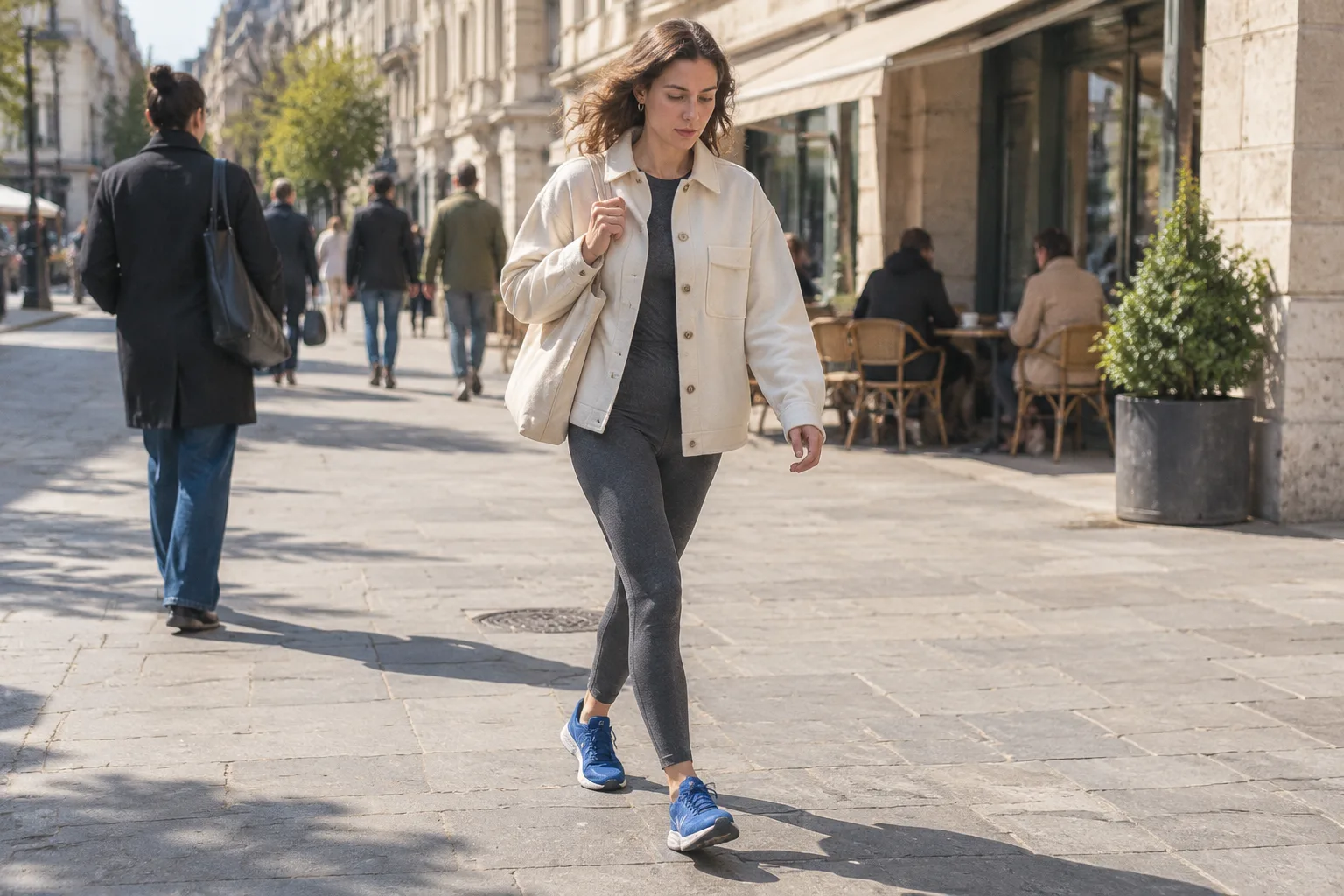
Leggings belong in the capsule only if the wearer actually wears them as pants. A high-rise pair in a matte black, with a wide waistband and no side pocket, can pass under a long shirt or a knit. The key word is matte. Shiny compression fabric catches every overhead light in a grocery store and makes the outfit read as a costume.
Two bottoms, then, plus one pair of leggings if the wearer wants them. Three at most. The drawer should feel slightly underfilled on day one. That is the point.
The top half: three shirts, one of them a button-up
Tops are where the capsule gets its range. Two long-sleeve tees in a heavier cotton blend, one in a neutral and one in a muted color, handle most days. A short-sleeve tee in a similar weight covers warmer weather. The fourth piece is the one that changes everything: a relaxed overshirt in a technical fabric or a brushed flannel, worn open over the tee. That single layer moves the outfit from errand to dinner without a change.
The button-up should be cut generously, with a hem that falls below the hip. A fitted technical shirt looks like a cycling jersey. A loose one looks like a shirt. The difference is entirely in the silhouette, and it is the cheapest upgrade in the whole capsule.
Collar shape does quiet work here. A camp collar or a simple point collar frames the neck and reads as deliberate. A crew-neck tee alone, however good, always looks like the first layer of something else. The overshirt supplies the finish.
Outerwear: one layer that handles wind and a chill
A single outer layer is enough, provided it is not a hoodie. A hoodie in a capsule is a trap: it is comfortable, it is everywhere, and it makes every outfit underneath look like an afterthought. A zip-front jacket in a matte nylon or a quilted vest in a solid color does the same job with more structure. The vest is the smarter pick for most climates because it layers over the overshirt without bulk at the arms.
Color should be either the darkest thing in the closet or the lightest. A black vest over a grey tee is a finished look. A navy vest over a navy tee is a uniform. The outer layer is the piece most likely to be seen from across a room, so it should carry a decision, not just a function.
Shoes: two pairs, neither of them running shoes
Running shoes with a thick foam midsole and a mesh upper are the single fastest way to make an athleisure outfit look like gym clothes. The capsule needs two pairs instead. One is a clean low-profile sneaker in leather or a matte knit, in white or off-white. The other is a slip-on or a chunky sole sneaker in a darker color, depending on whether the wearer leans minimal or casual.
The white sneaker is the workhorse. It pairs with the joggers, the ponte pants, and the leggings, and it reads as intentional in a way that a grey running shoe never will. Keep it clean with a damp cloth once a week. Scuffed white leather looks careless; clean white leather looks like a choice.
The second pair handles wet days and the outfits that need a little weight at the bottom. A dark slip-on in suede or a matte leather sneaker with a thicker sole does the job. Avoid anything with a visible logo larger than a thumbnail.
The color rule that keeps twelve pieces looking like thirty
Pick three colors and one accent. A workable set: black, charcoal, oatmeal, with a single muted accent like olive or rust. Every piece in the capsule should combine with at least three others without thought. That constraint is what makes a small wardrobe feel large. When the drawer holds only black, grey, and cream, every top matches every bottom, and getting dressed becomes a two-second decision.
The accent color belongs in exactly one piece, usually the overshirt or the second pair of shoes. Two accent pieces start to compete. Three turn the capsule into a color story that only works on a mood board.
Texture does the work that color cannot. A capsule in three flat colors can still look rich if the surfaces vary: a brushed fleece against a compact ponte against a matte nylon. Smooth over smooth reads cheap. Smooth over textured reads expensive.
Fit details that separate athleisure from pajamas
Most athleisure fails at the hem and the shoulder. A jogger that bunches at the ankle looks slept in. A tee that droops past the hip looks borrowed. The fix is unglamorous: check the inseam and the sleeve length before buying, and expect to pay for hemming on the pants. A $20 alteration on a $90 pair of joggers is the difference between a piece that gets worn twice a week and one that gets worn twice.
Shoulder seams should sit at the edge of the shoulder bone, not past it. Sleeves should end at the wrist bone or just above. Waistbands should sit flat against the small of the back with no gap. These are the measurements that make a garment look tailored even when it is soft.
One more fit note: the overshirt should be the loosest thing in the capsule. Everything else stays close to the body. Volume in one layer reads as style. Volume in two reads as a bag.
What to leave out of the first capsule
Several categories look essential and are not. Matching sets, for one: a jogger and a cropped hoodie in the same fabric photograph well and wear like a uniform after the third outing. Graphic tees are another; a single loud print limits every outfit it appears in. And the technical quarter-zip, beloved of golf and office casual alike, reads as corporate athleisure and rarely earns its place.
Accessories deserve a short mention. A plain cap in a neutral color is useful for sun and bad hair days. A crossbody bag in a matte fabric or leather finishes the outfit better than a gym duffel. A duffel on the shoulder signals the gym; a small crossbody signals the day.
The first week of wearing it
A new capsule needs a trial week before any additions. Wear the pieces in rotation, note which combinations get repeated, and leave the rest alone. By day five, the drawer will reveal its own logic: the ponte pants will be in the wash, the overshirt will be on the chair, and one tee will have been worn three times. That tee is the one to buy a second color of. The piece that never left the drawer is the one to return.
The math of a capsule is simple: fewer pieces, worn more often, bought less often. Twelve items worn across a week produce more distinct outfits than thirty items worn once each. The constraint is the feature. A drawer that fits in a single suitcase is a drawer where every piece has a reason to be there, and the getting-dressed problem shrinks to a glance.
By the end of the trial week, the wearer should be able to reach into the drawer in the dark and pull out a complete outfit without thinking. That is the test. If the hand hesitates, the capsule is not finished, and the missing piece is usually a layer, not another pair of pants.