

Affordable Sneakers With an Expensive Look
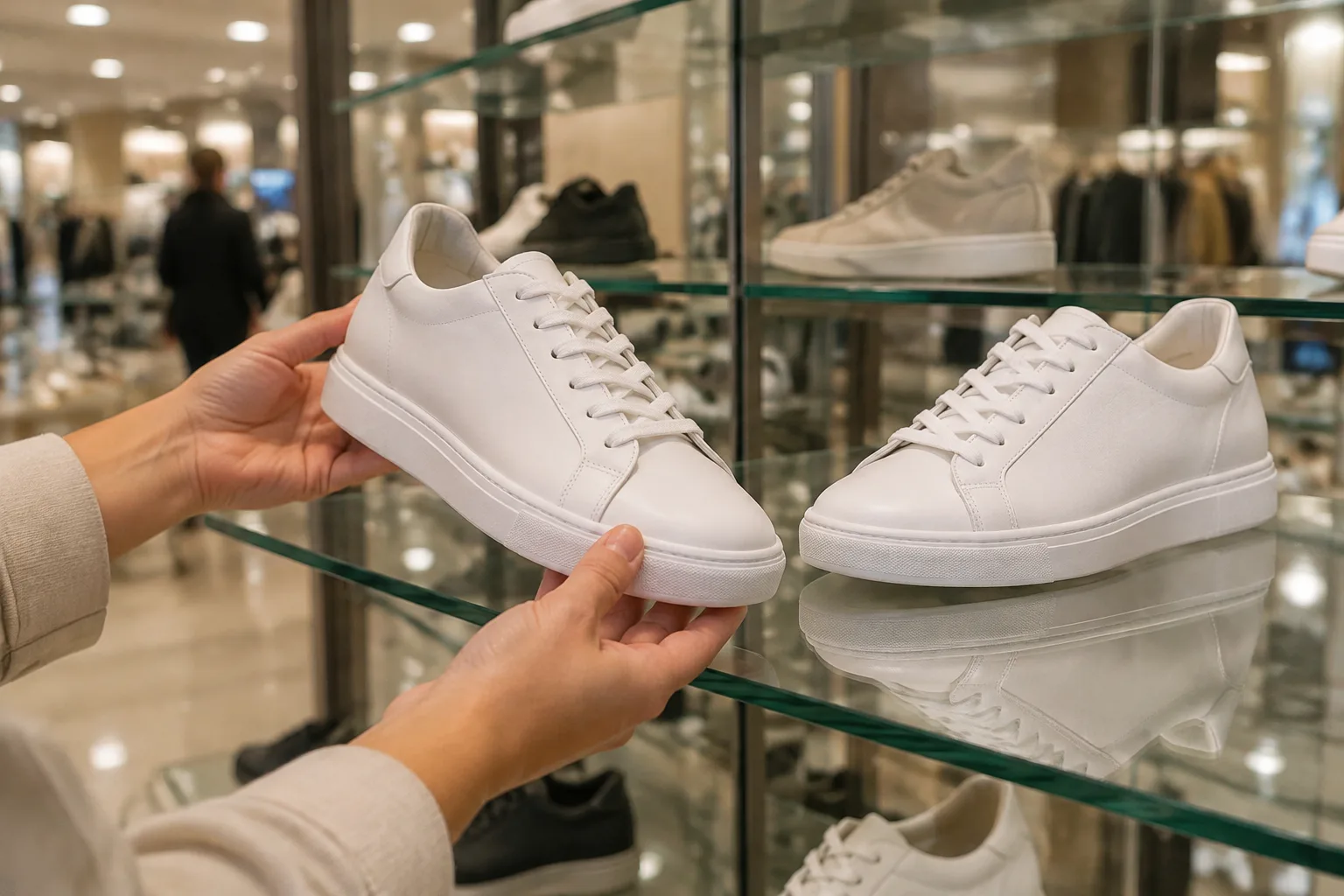
A pair of plain white leather sneakers sits on a shelf in a department store, priced at 39 dollars. Six feet away, behind glass, sits another pair that looks nearly identical and costs 450. The difference between them is not leather quality, not construction, not even the name stamped on the heel. It is the shape of the toe box, the height of the sole, the angle at which the laces sit. These are the details that separate a shoe that reads as cheap from one that reads as expensive, and most of them cost the manufacturer almost nothing to get right.
The sneaker market has spent the last decade teaching people that price equals quality. That logic holds for boots and dress shoes, where leather hides and welted soles justify the cost. Sneakers run on different math. A vulcanized rubber sole costs the same whether it sits under canvas or calfskin. The expensive look comes from proportion and restraint, and proportion is free.
The toe box is the first thing the eye reads
Cheap sneakers tend to have bulbous, rounded toe boxes. The leather or synthetic upper wraps over the toe like a helmet, and the result looks like a child's shoe scaled up. Expensive sneakers, almost without exception, have a lower, flatter toe profile. The upper sits closer to the sole, and the line from the vamp to the tip runs almost parallel to the ground.
This is a manufacturing choice, not a cost. A lower toe box requires a slightly different last, the foot-shaped form the shoe is built around. Brands that sell at 30 dollars use a generic last because it fits more feet with fewer sizes. Brands that sell at 400 dollars use a slimmer last because the silhouette matters more to their customer than the fit of the widest possible foot.
Adidas has made this visible for decades. The Samba and the Gazelle, both under 100 dollars, have a toe box so low and flat that the shoe reads as a slipper from above. That low profile is the entire reason the Samba went from a soccer training shoe to a fashion staple. The same shape appears on sneakers costing five times as much. A buyer willing to look at the toe box first can find the cheap version of an expensive line.
Sole thickness and the ratio that sells the shoe
Sole height is the second signal. A thick, chunky sole reads as either orthopedic or deliberately fashion-forward, and most inexpensive sneakers land in the first category by accident. The sole is thick because the rubber is cheap and the midsole foam is stiff, so the manufacturer adds volume to compensate. The shoe ends up looking like a platform.
Expensive sneakers tend to keep the sole thin relative to the upper. A cupsole that runs 20 to 25 millimeters at the heel and tapers to 12 at the toe creates a wedge that lifts the silhouette without looking bulky. That taper is a mold design, and mold designs are a one-time cost. A brand that sells a million pairs amortizes the mold to nothing. A brand that sells ten thousand pairs cannot afford the taper, so it uses a flat slab.
The practical test is to look at the shoe from the side. If the sole is the same thickness from heel to toe, the shoe will read as inexpensive no matter what the upper is made of. If the sole tapers and the toe sits low, the shoe reads as considered. Nike's Killshot, a tennis shoe from the 1980s that costs around 90 dollars, has exactly this taper. So does the Common Projects Achilles, which costs 400. The Killshot is not a copy. It is the same proportion executed at a different price point, and the eye cannot tell the difference from three feet away.
Leather that looks expensive without being expensive
Full-grain leather is the expensive material. It is the top layer of the hide, with the natural grain intact, and it creases in a way that reads as character rather than damage. Cheap sneakers use split leather or synthetic coatings that crease sharply and then crack. The difference is visible after a month of wear, and it is the main reason a 40 dollar white sneaker looks like a 40 dollar white sneaker by the end of summer.
There is a middle path. Some brands use a corrected-grain leather, which is split leather with a stamped grain pattern and a polyurethane coating. It looks uniform and clean when new, and it does not crease badly if the coating is thick enough. The problem is that the coating gives the leather a plastic sheen that reads as cheap under direct light. A matte finish, even on corrected grain, reads as more expensive than a glossy one.
The cheapest way to get an expensive-looking upper is to skip leather entirely. Heavy canvas, especially a tight weave with a visible texture, reads as intentional. Suede reads as expensive even when it is not, because the nap absorbs light and hides imperfections. A 70 dollar suede sneaker from a mid-tier brand will outclass a 70 dollar smooth-leather sneaker every time, because the material does the work that the construction cannot.
The laces and eyelets nobody notices until they do
Flat, wide laces in a color that matches the upper exactly look cheap. This is a small thing, and it is almost universal on budget sneakers, because matching laces are a single SKU and contrasting laces are two. Expensive sneakers often use a slightly narrower lace, or a lace with a subtle sheen, or a color that sits a half-shade off the upper. The effect is that the laces recede and the shape of the shoe comes forward.
Eyelets matter more than they should. Stamped metal eyelets, the kind that sit flush with the upper, read as finished. Plastic eyelets or stitched buttonholes read as unfinished. The cost difference per pair is pennies. The visual difference is the difference between a shoe that looks like it was designed and a shoe that looks like it was assembled.
There is a reason high-end sneakers often hide the eyelets entirely, using a gusseted tongue or a lace loop system. Hiding hardware is a way of signaling that the shoe does not need to announce its construction. A budget sneaker with visible plastic eyelets announces everything.
Brands that already sell the expensive look at a low price
The market has done most of the work already. Several brands sell sneakers under 100 dollars that photograph and wear like shoes costing three or four times as much.
The Adidas Samba, Gazelle, and Campus are the obvious entry. All three sit under 100 dollars, all three have the low toe box and tapered sole that read as expensive, and all three have been in production long enough that the molds are paid off. The Samba in particular has a gum sole and a suede toe cap that give it a patina as it wears.
The Nike Killshot 2 is the other obvious pick. It was a J.Crew exclusive for years and now sells broadly for around 90 dollars. The leather is not full-grain, and it will crease, but the silhouette is correct: low toe, tapered sole, a gum outsole that reads as vintage rather than cheap.
On the canvas side, the Converse Jack Purcell and the Vans Authentic both have a lower, flatter profile than the Chuck Taylor, and both sell for under 70 dollars. The Jack Purcell's smile-shaped toe bumper is a design detail that reads as deliberate. The Authentic's vulcanized sole is thin and tapered in a way that most canvas sneakers are not.
For suede, the Puma Suede and the New Balance 574 both sit under 90 dollars and both use a suede that looks more expensive than the price suggests. The 574's chunky sole is the exception to the taper rule, but the suede upper and the visible stitching carry it.
What to look at in the store, in order
The toe box first. Hold the shoe at eye level and look along the top line. If the toe rises above the line of the vamp, put it back. If the toe sits flat and low, keep looking.
The sole second. Turn the shoe sideways. If the sole is a uniform slab, put it back. If it tapers from heel to toe, the shoe has a chance.
The upper third. Run a thumb across the leather or canvas. If it feels slick and plastic, it will look plastic in a month. If it feels matte and slightly rough, it will age better. Suede should feel like a short, dense carpet, not like felt.
The laces and eyelets last. If the laces are wide and flat and match the upper exactly, the shoe was built to a price. If the eyelets are plastic, the shoe was built to a price. These are the details that separate a shoe that reads as expensive from one that reads as cheap, and they are the cheapest details to fix. A brand that skips them has decided the customer will not notice. The customer notices.
The 39 dollar pair and the 450 dollar pair, revisited
The two shoes on the shelf are not as far apart as the price suggests. The 450 dollar pair has better leather and a more careful stitch, and it will last longer. The 39 dollar pair has a bulbous toe and a flat sole and wide matching laces, and it will look tired by August. But there is a third pair, somewhere between them, that costs 80 dollars and has the low toe, the tapered sole, the matte suede, and the narrow laces. That pair will outlast the cheap one and outclass the expensive one on the feet of anyone who is not reading the label.
The expensive look in sneakers is a set of proportions, and proportions are the cheapest thing a manufacturer can get right. The brands that get them right at a low price are not hiding a secret. They are selling a shape. The shape is free. The shoe is not.