

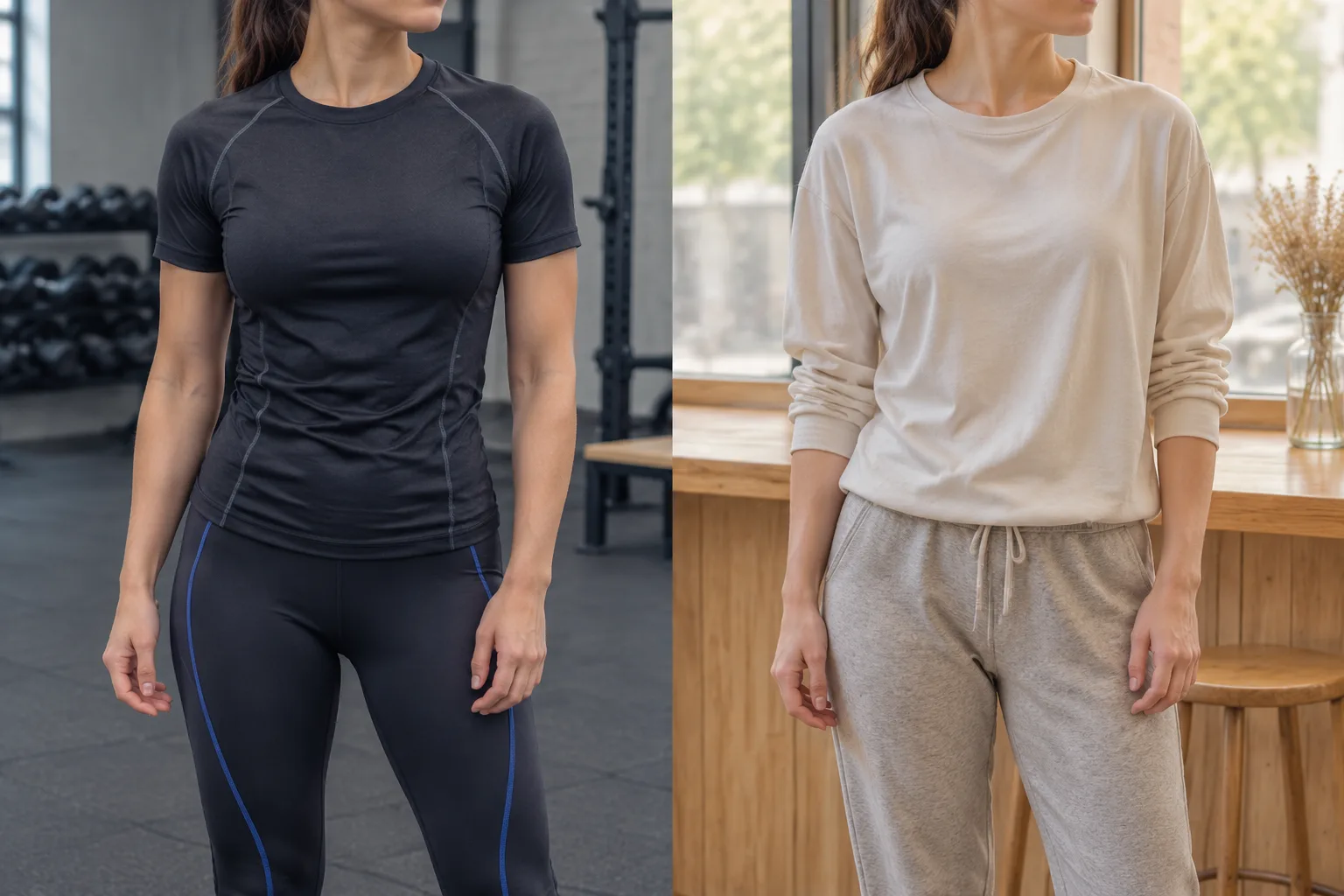
Athleisure and Sportswear: Drawing the Line
Gym clothes left the gym roughly a decade ago and never filed a forwarding address. They now turn up in grocery aisles, on transatlantic flights, in offices with exposed brick and standing desks, at restaurants where the menu is printed daily. The wardrobe category that absorbed them is usually called athleisure, and the phrase has become so elastic that it threatens to mean nothing at all. A pair of compression tights designed for marathon training and a pair of $120 joggers designed for a coffee run get filed under the same word, even though they were built for entirely different lives.
That confusion has a cost. It muddles how clothes get designed, how they get priced, and how they get judged. A shopper standing in a store holding two pairs of black pants has no shared vocabulary for why one costs three times the other. The industry has a vocabulary, internally, but it rarely shares it. Drawing the line between athleisure and sportswear is not pedantry. It is the difference between a garment that will survive a decade of washing and one that will pill by March.
Two Categories Wearing the Same Fabric
Sportswear is the older term. It covers garments engineered around physical performance: running shorts, tennis skirts, training tees, swimwear, the whole apparatus of organized movement. The design brief is functional. Fabric is chosen for moisture management, stretch recovery, durability under repeated load. Seams are placed to avoid chafing. A pair of running shorts is expected to survive hundreds of kilometers of sweat and washing.
Athleisure arrived later, as a marketing category rather than an engineering one. The word itself is a portmanteau of athletic and leisure, and it describes clothing that borrows the visual language of sportswear while serving the needs of daily life. A soft jersey jogger, a fitted tank with a flattering neckline, a zip-up hoodie with a slightly cropped hem: these are clothes for errands and travel and long airport layovers. They look athletic. They are not built for athletics.
The overlap is real, which is why the confusion persists. Leggings occupy both worlds. So do hoodies, sneakers, and half the contents of a modern carry-on. But the intent behind the garment is different, and that intent shows up in the construction, the fabric weight, the seam placement, and the price.
What the Fabric Weight Actually Tells a Buyer
Pick up a performance tee and a lifestyle tee made by the same brand. The performance version often feels slightly cool and slippery, with a denser hand and a touch of elastane that lets it snap back into shape. The lifestyle version feels softer, drapes more, and holds a crease in a way the performance fabric resists. That softness comes at a cost: cotton-blend jersey pills, stretches out at the elbows, and loses its shape after a season of regular wear.
None of this makes the lifestyle tee worse. It makes it different. A person wearing a soft jersey tee to a Saturday brunch does not need moisture-wicking polyester. They need a shirt that feels good against the skin and photographs well. The mistake is assuming the two shirts are interchangeable because they look similar on a hanger.
Seam construction is the quietest tell. Performance garments tend to use flatlock or bonded seams that sit flush against the skin to prevent chafing during repetitive motion. Athleisure often uses standard overlock seams, which are cheaper to produce and perfectly comfortable for sitting in a car. A wearer who buys athleisure for a half marathon will discover the difference around kilometer eight, when the seam starts to rub.
The Compression Tight and the Lounge Legging
No garment better illustrates the split than the legging. A performance compression tight is a piece of equipment. It is engineered to apply graduated pressure to the leg, support muscle during sustained effort, and stay in place through squats, sprints, and lunges. The fabric is dense, often a nylon-elastane blend with high recovery, and the waistband is designed to stay put without a drawstring.
The lounge legging looks identical from across the room and behaves nothing like it. The fabric is thinner, often a brushed polyester or a cotton blend, chosen for softness rather than support. The waistband rolls. The seams are decorative rather than structural. Worn to a yoga class, it performs fine. Worn to a 10K, it will slide down and chafe and generally make its wearer miserable.
Brands know this, and many now sell both under nearly identical names. The shopper who buys the wrong one for the wrong purpose tends to blame the brand, or the garment, when the real failure was categorical. The label said legging. The label did not say which kind.
Why the Office Accepted the Jogger
The spread of athleisure into workplaces is usually told as a story about relaxed dress codes, remote work, and the slow death of the suit. That story is incomplete. The jogger became office-acceptable because a specific version of it was engineered to look structured while feeling soft, with a tapered leg, a clean waistband, and a fabric that held a crease. That garment is athleisure, but it borrowed sportswear's visual cues and then added tailoring logic.
The result is a piece of clothing that occupies its own category. It is not a running pant. It is not a dress pant. It is a soft tailored jogger, and it works because the wearer is not actually going to sprint in it. The same logic applies to the performance blazer, the sneaker with a leather upper, the hoodie in a wool blend. Each one takes a sportswear silhouette and re-engineers it for a life that involves sitting.
That re-engineering is where the line gets blurry, and where a lot of money gets spent badly. A wool-blend hoodie at $300 is a real garment with real construction behind it, and it will last. A polyester hoodie at $300 that borrowed the same silhouette and skipped the fabric upgrade is athleisure priced like sportswear, and it will not survive a winter of regular wear.
The Price Tag Is Not the Signal
Price is the least reliable guide to which category a garment belongs to. A $40 pair of running shorts from a serious performance brand can outperform a $180 pair of athleisure shorts from a luxury label on every functional measure. The luxury shorts were designed to look good in a mirror and feel good for an hour. The cheap shorts were designed to survive a marathon. Neither is a bad purchase. They are different purchases.
The more useful signal is the brand's stated intent. A label that publishes fabric weights, seam construction, and testing protocols is telling the shopper the garment was built for performance. A label that talks about drape, feel, and versatility is telling the shopper the garment was built for daily life. Both are honest. The shopper who reads only the price and the picture is the one who ends up disappointed.
The Gym Test and the Grocery Test
A simple heuristic separates the categories in practice. Take the garment to the gym and see what happens. A piece of sportswear will hold its shape through a sweaty session, dry quickly, and look roughly the same afterward. A piece of athleisure will feel damp, cling in the wrong places, and start to sag at the waistband. That sag is the tell.
Take the same garment to the grocery store and see what happens. Sportswear often looks slightly out of place: too technical, too shiny, too obviously built for a different activity. Athleisure looks correct. It was designed for exactly this errand, this coffee, this school pickup. The garment that looks right in both settings is rare, and when it exists it is usually a deliberate hybrid, priced accordingly.
The gym test and the grocery test are not perfect. They are, however, more useful than the label, and they cost nothing to run. A shopper who runs them before buying will make better decisions than one who trusts the marketing copy.
What the Line Means for the Closet
The practical consequence of drawing the line is a smaller, more intentional wardrobe. A person who knows which garments are sportswear and which are athleisure stops expecting one to do the other's job. The running shoes stay by the door for running. The soft joggers stay folded for the flight. The compression tights go in the gym bag and nowhere else.
That division also changes how clothes get replaced. Sportswear wears out through use and gets replaced when performance degrades: the elastic goes, the seam rubs, the fabric loses its snap. Athleisure wears out through washing and gets replaced when it stops looking presentable: the color fades, the fabric pills, the fit sags. Knowing which failure mode to expect tells a person when to retire a garment and when to keep wearing it.
The closet that respects the line tends to be smaller and lasts longer. It also tends to cost less over time, because fewer garments get bought for the wrong purpose and then abandoned in a drawer. The savings are not dramatic. They are steady, and they compound the way a well-chosen wardrobe always does.
The Runner Who Bought the Wrong Legging
A runner buys a pair of black leggings online, on sale, because they look like the ones worn by every fitness influencer on the feed. They arrive soft and stretchy and feel wonderful. The runner wears them to a Saturday long run. Two kilometers in, the waistband starts to slip. Five kilometers in, the inner seam begins to rub. By the end of the run, the leggings have migrated downward and the runner is holding them up with one hand while trying to keep pace.
The leggings were not defective. They were athleisure, sold as a legging, bought for a run. The failure was categorical, and it was predictable. A shopper who knew to look for flatlock seams, high-recovery fabric, and a wide structured waistband would have bought the right pair the first time, for perhaps twice the sale price and a fraction of the frustration.
That runner is the reason the line matters. The categories are not a marketing distinction or a snob's taxonomy. They are a practical tool for matching a garment to a life. A person who can tell a compression tight from a lounge legging, a performance tee from a jersey tee, a running short from a lifestyle short, will spend less money and complain less. The line is worth drawing because the alternative is a closet full of clothes that almost work.