
Autumn Sneakers: Earth Tones and Textures for Layered Outfits
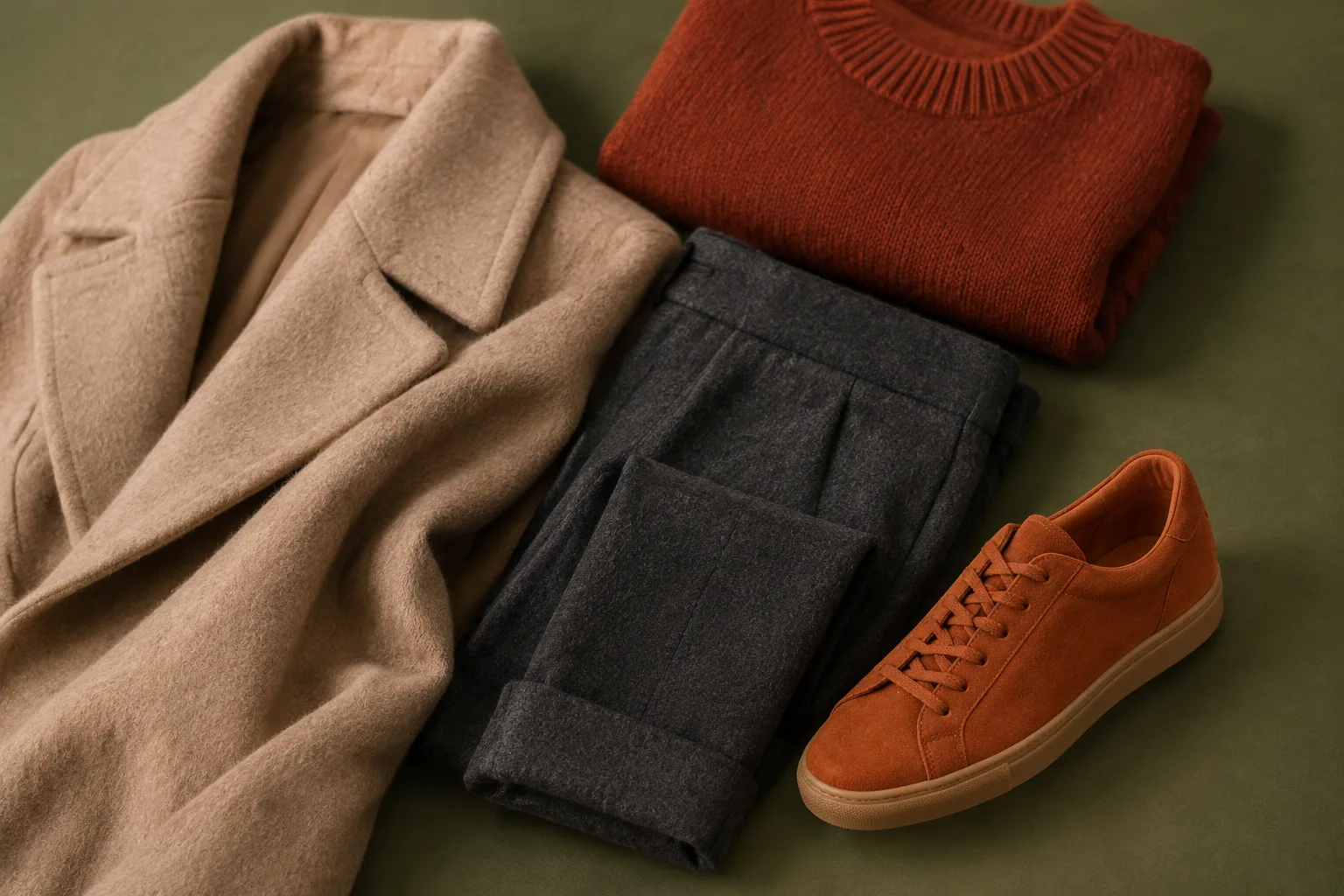
A pair of suede sneakers in burnt orange, set beside a wool coat in oatmeal and a pair of charcoal trousers, does something a white leather sneaker cannot: it makes the whole outfit read as a single decision. The white sneaker sits on top of an autumn outfit. The earth-toned one belongs to it. That distinction, small as it sounds, is the entire case for building a fall shoe rotation around browns, rusts, olives, and tans rather than the bright, clean trainers that carry a person through summer.
The sneaker has spent the last decade climbing into places it was not always welcome. It has replaced the loafer at weddings, the dress shoe at dinner, the boot on a wet Tuesday. That climb has made the category crowded and, in its own way, bland. A wall of white leather low-tops in a shoe shop is a wall of near-identical objects. Autumn is the season where the sneaker gets its texture back, where the material does the talking and the color does the organizing.
Why earth tones organize an outfit better than neutrals
Black and white are often called neutral, and in a strict color-theory sense they are. But they are neutral in the way a blank wall is neutral: they flatten. A white sneaker against a navy trouser and a gray sweater gives the eye three separate, unrelated blocks of color. An earth-toned sneaker against the same outfit gives the eye a bridge. Brown sits between the cool navy and the warm gray in a way that pulls the pieces into a conversation.
This is the practical argument for earth tones, and it holds up in the morning when a person is standing in front of a closet at 7:40 with four minutes to decide. A rust suede sneaker goes with denim, with olive chinos, with charcoal wool, with cream, with brown. A single pair covers more combinations than a pair of white trainers, which tend to demand a certain cleanliness and a certain contrast to look intentional. Earth tones forgive. They blend. They make a layered outfit look like it was assembled by someone with a plan.
The textile argument is stronger still. Autumn clothing is textured: wool, corduroy, flannel, brushed cotton, tweed, waxed canvas. A smooth leather sneaker against a heavy wool coat reads as a slight mismatch, the way a silk tie against a denim jacket reads as a mismatch. Suede, nubuck, and oiled leather sit next to those fabrics without friction. The nap of suede against the nap of a brushed wool coat is a small pleasure, and it is the kind of detail that separates an outfit that looks considered from one that simply looks expensive.
The four textures worth knowing before buying
Suede is the obvious autumn choice and the one most people reach for first. It has a soft, matte surface that absorbs light rather than reflecting it, which is why a suede sneaker in cognac or olive looks warmer than the same shoe in polished leather. The trade-off is weather. Suede and rain are not friends, and a person who walks twenty minutes to a train station in a wet climate should think hard before making suede the everyday pair. A protectant spray helps, but it does not make suede waterproof, and a soaked suede toe box will never quite look the same afterward.
Nubuck is suede's tougher cousin, buffed from the outer grain of the hide rather than the inner. It has a finer, denser nap and takes scuffs better. A nubuck sneaker in a dark brown or a deep olive can handle a light drizzle and a scuffed stair edge without immediate damage. It reads slightly more rugged than suede, which suits a chunkier sole and a more casual outfit.
Oiled leather, sometimes sold as pull-up leather, is the practical answer for wet autumns. The oils in the hide push water away, and the surface develops a patina as it creases and scuffs, darkening in the folds. A pull-up leather sneaker in a tan or a whiskey color will look better after two seasons than it did on the first day, which is rare in footwear. It is heavier than suede and takes a break-in period, but it earns its place in a rotation that includes rain.
Canvas is the forgotten option, and it deserves a mention because it is cheap and it works. A heavy waxed canvas sneaker in an olive or a sand color has a rugged, almost workwear quality that pairs well with chinos and a field jacket. It will not last as long as leather, and it will not survive a soaking, but for a person who wants the earth-tone look without the maintenance, it is a reasonable entry point.
Sole thickness and the silhouette question
Autumn sneakers tend to run chunkier than summer ones, and this is not only a fashion cycle. A thicker sole lifts the foot off cold, wet pavement, which matters more in October than in June. A cupsole, the flat rubber sole stitched or glued to the upper, gives a clean, low profile that works with tailored trousers. A running-style or trail-style sole, with visible lugs and a bit of foam, gives a more casual look that works with denim and cords.
The silhouette decision is mostly about the trouser. A slim, cropped trouser wants a low-profile cupsole, because a chunky sole under a narrow hem looks like a mistake. A straight or wide trouser wants volume underneath, and a chunky sole balances the fabric. The worst outcome is a delicate suede upper on a massive foam sole, which reads as two different shoes fighting for the same foot. Material and sole should agree on how serious the shoe is.
Color pairings that actually work in a layered outfit
Cognac and tan are the safest entries. They sit comfortably next to navy, denim, olive, charcoal, and cream, which covers most of a typical autumn wardrobe. A tan suede sneaker with dark indigo jeans and a gray crewneck is almost impossible to get wrong. The same shoe with olive chinos and a cream sweater is a slightly warmer, more deliberate version of the same idea.
Rust and burnt orange are the boldest of the earth tones, and they work best when they echo something else in the outfit. A rust sneaker under a navy coat with a rust-and-navy scarf is a coordinated look. The same shoe under an all-gray outfit is a single bright note, which can be good or can look accidental depending on the confidence of the wearer. The rule, if there is one, is that a bold earth tone wants either a partner somewhere above the ankle or a completely quiet outfit around it.
Olive and forest green are the underrated pairings. Olive sneakers work with brown, with tan, with charcoal, with denim, and with the ubiquitous olive field jacket that half the population owns. A dark green suede sneaker against a camel coat is a combination that looks far more expensive than it is. Green also has the advantage of hiding scuffs and dirt better than tan.
Brown and chocolate are the workhorses. A dark brown leather sneaker is the closest thing to a dress shoe in sneaker form, and it can carry a person from a casual office to dinner without a change of footwear. It pairs with gray wool trousers in a way that a white sneaker never will.
The sock decision nobody talks about
An earth-toned sneaker exposes the sock in a way a boot does not, and the sock is where many otherwise good outfits fall apart. A white athletic sock peeking out of a brown suede sneaker under a wool trouser is a jarring note. The fix is simple: match the sock to the trouser, not to the shoe. Charcoal trousers want charcoal socks. Olive chinos want olive or dark green socks. This keeps the leg line continuous and lets the shoe be the only earth tone at the bottom of the outfit.
For a more casual look, a thick ribbed sock in a cream or oatmeal color, worn with a cropped trouser and a suede sneaker, is a deliberate styling choice that reads as autumnal without trying too hard. The sock becomes a visible layer, which is the whole point of a layered outfit.
Care in wet weather, and the case for a second pair
The single biggest mistake with autumn sneakers is treating one pair as a daily driver through October and November. Suede and nubuck need a day to dry between wears, and a person who wears the same pair every day will find the nap flattened and the shape collapsed by mid-season. A rotation of two pairs, even one suede and one oiled leather, extends the life of both and keeps each looking presentable.
When suede does get wet, the instinct to put it near a radiator is the wrong one. Heat cracks the leather and sets the water stain. A stuffed shoe, newspaper or a cedar insert, left at room temperature, will dry more slowly and more evenly. A suede brush, used once the shoe is dry, lifts the nap back up. These are small rituals, and they are the difference between a pair that lasts three seasons and a pair that lasts one.
What a $150 pair and a $350 pair actually differ in
The price gap in earth-toned sneakers is mostly about the upper and the sole, and the difference is visible on close inspection. A cheaper suede is thin, splits easily, and shows a uniform, flat surface. A better suede has a denser nap, a slight variation in tone across the panels, and a backing that holds its shape. The sole matters too: a stitched cupsole can be resoled, while a glued sole cannot, and a shoe with a stitched sole can outlive its first owner's interest in it.
The stitching is the tell. A well-made sneaker has even, tight stitching along the welt and the heel counter, and the panels line up without puckering. A cheap one has loose, uneven stitching and panels that overlap slightly. This is not a matter of brand loyalty; it is a matter of looking at the shoe in the shop for thirty seconds longer than usual.
The case for buying the brown pair first
Most people building an autumn rotation start with the boldest color, the rust or the burnt orange, because it is the one that looks most like autumn in a photograph. The better first purchase is the plain brown or tan, because it is the pair that will get worn four days out of five. The bold pair is the second purchase, the one that comes out on the days when the outfit has room for a statement.
A tan suede sneaker with a stitched cupsole, worn with charcoal wool trousers and a navy coat, is the outfit that makes the case for the whole category. It is unremarkable in the best sense: nothing in it demands attention, and yet the whole thing looks resolved. That is what earth tones and textures do for a layered outfit. They make the pieces agree, and agreement is the quiet goal of every good autumn wardrobe.