

City Layering: Building an Outfit Around Active Pieces
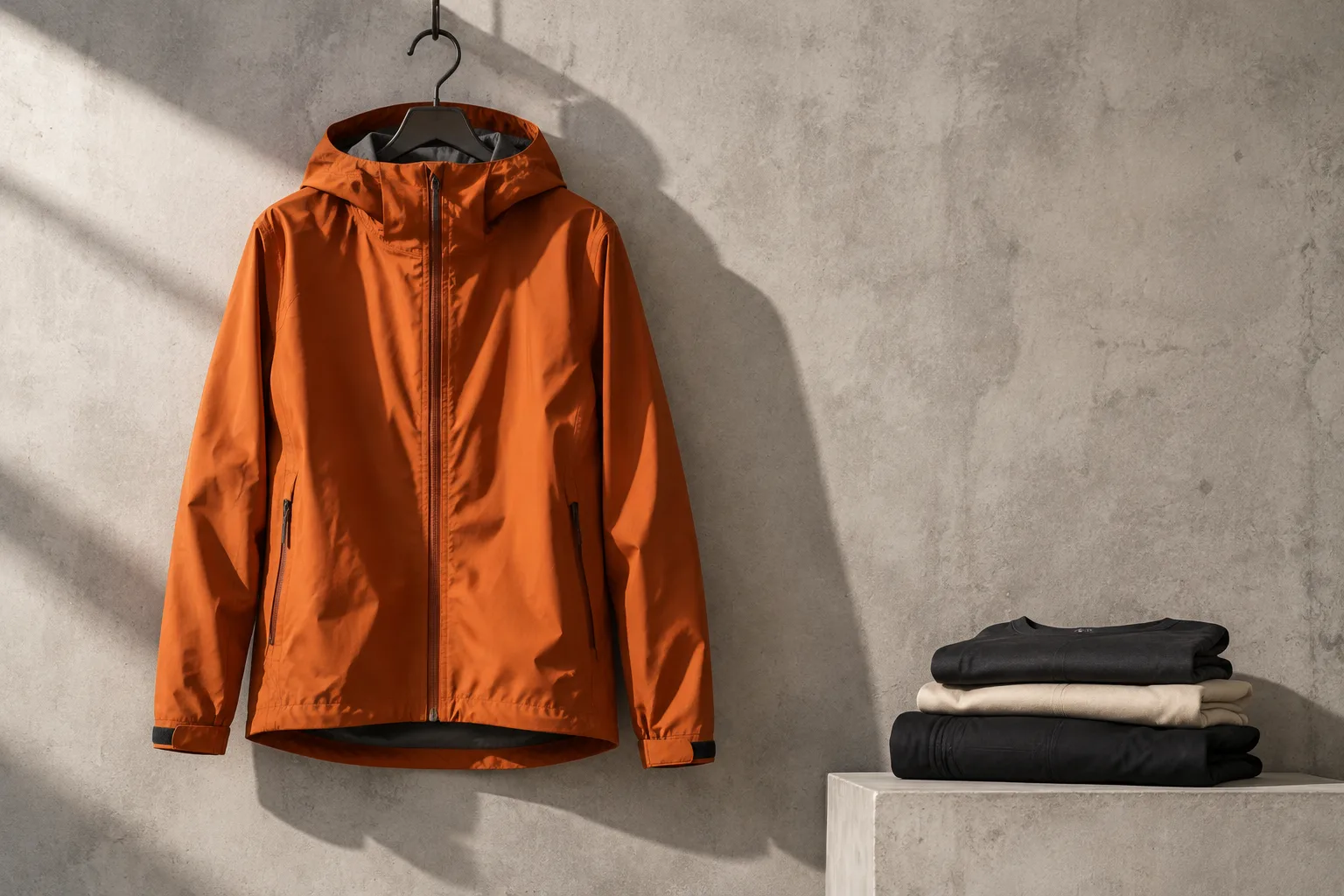
A rain shell in burnt orange, cut short at the hip, has one real job: keep weather off the shoulders. The trouble starts when it gets promoted to the center of an outfit. Suddenly a piece of technical gear is asked to carry a whole look, and the seams show. The shell is loud, the fabric rustles, the cut is boxy in a way that flatters nobody. Layering around active pieces is the specific craft of keeping that shell in the picture without letting it run the whole show.
The first move is to sort active pieces by how much visual noise they generate. A pair of black running tights produces almost none. A neon windbreaker produces a great deal. Those two categories need opposite handling. The quiet pieces can be treated almost like ordinary clothing, given room to breathe, matched with wool, denim, cotton. The loud pieces need to be contained, surrounded by duller surfaces so they read as one deliberate statement rather than three competing ones.
Most people get this backwards. They build the outfit around the loudest item as if it were a dress, layering quiet things on top to tame it. The result looks like a runner who got lost on the way to the track and wandered into a restaurant.
The base layer sets the temperature, not the look
Active base layers, the merino crews and synthetic quarter-zips sold for hiking and cycling, are the easiest technical pieces to work with because they disappear under nearly everything. A thin merino long-sleeve in charcoal behaves like a cashmere sweater if the collar sits close and the cuffs stay tucked. The trick is fit: a base layer that bunches at the wrist or bags at the waist shows through a jacket in a way a flat-fitting one does not.
These layers should be chosen for temperature, then forgotten. A base layer chosen for color or pattern is usually a mistake. Its job is to sit under the outer layers and regulate heat during a commute or a walk between meetings. The visible portion is a sliver at the neck and maybe a cuff. That sliver should be neutral: charcoal, navy, oatmeal, black. Anything brighter turns the sliver into a flag.
Midlayers do the actual outfit work
The fleece is where layering gets interesting. A Patagonia Synchilla or a similar retro pile fleece has genuine texture, a deep pile that catches light and holds shape, and it can sit in for a cardigan without anyone thinking about camping. Worn open over a plain tee with wide-leg wool trousers, it reads as a soft jacket. Zipped to the chin under a trench coat, it reads as insulation. Same garment, two completely different registers.
The pile fleece works because its surface is dense and matte, which lets it sit beside wool and cotton without friction. A smooth technical softshell does not have that advantage. It looks slick next to natural fibers, and slick next to wool looks like a mistake. When a softshell has to appear, put it at the outermost layer and put something matte underneath: chunky knit, denim, heavy cotton twill.
There is a hierarchy worth memorizing. Pile fleece goes over cotton. Quilted vests go over fleece. Shells go over everything. Each layer should be one step smoother and one step more weatherproof than the one beneath it. Break that order and the outfit looks assembled rather than worn.
The shell needs volume beneath it to look intentional
A rain shell worn over a t-shirt looks like a mistake because the shell has volume and the t-shirt has none. The shell drapes over empty space, and empty space under technical fabric reads as a bag. A rain shell worn over a heavy sweater, a fleece, or a hoodie fills out the cut and makes the shell look like a considered outer layer.
This is why the gorpcore look that dominated city streets a few years back worked when it worked. It was never the shell alone. It was the shell over the fleece over the tee over the cargo pant, a stack of volumes that gave the silhouette something to do. Strip out the middle layers and the same shell collapses into a poncho.
The length of the shell matters here too. A hip-length shell over a long sweater creates a visible hem below the jacket, which is a good trick: the sweater's hem softens the shell's hard bottom edge. A long shell over a short sweater looks top-heavy. Match the shell's hem to the layer beneath, or let the layer beneath extend past it by two or three inches.
Color lives in the middle, never at the edges
Active pieces tend to come in strong colors, and the temptation is to let that color lead. The better pattern: put the strong color in the middle of the stack, where it gets framed by quieter pieces above and below. A cobalt blue fleece under a black shell and over black trousers reads as a deliberate flash. The same fleece as the outermost layer reads as sports equipment.
Edges are where color goes wrong. A bright shell at the top of the outfit, a bright sneaker at the bottom, and the eye has nowhere to rest. Move the color inward, and the outfit gets a focal point without getting loud. This is the single most useful rule for working bright technical gear into a city wardrobe, and it costs nothing to apply.
Footwear is the hinge between active and ordinary
A trail runner in a muted colorway can carry a technical outfit into ordinary life, provided the rest of the outfit is not also technical. Worn with tapered trousers and a wool coat, a Salomon or a Hoka in all-black or sand reads as a chunky sneaker. Worn with running tights and a windbreaker, the same shoe reads as a workout. The shoe itself is neutral; the outfit around it decides what it means.
The reverse is also true. A clean leather sneaker under a rain shell and fleece looks like a person who got dressed for a hike and then changed their mind about the shoes. When the top half is technical, the feet should either commit to the technical register or commit hard to the opposite one. Halfway is the look that fails.
When the active piece is the only active piece
The most reliable formula for a city outfit with a technical element: one active piece, everything else ordinary. A fleece over tailored trousers and a leather shoe. A shell over a wool sweater and denim. A running cap with a trench coat and chinos. One piece does the work; the rest of the outfit gives it a context to sit in.
Two active pieces can work if they are related, say a fleece and a shell in the same family of color, or a base layer and a midlayer from the same system. Three active pieces almost never work outside of actual outdoor activity. The eye starts reading the person as a catalog page rather than a person.
This is the discipline the style press rarely states plainly. Technical clothing is designed to be worn in stacks of five or six pieces, each doing a specific job. Transplanted into a city wardrobe, that same clothing needs to be thinned out to one or two pieces, with ordinary clothing filling the other roles. The gear does not get worse; it gets outnumbered.
Fabric weight, not color, decides whether a stack works
A heavy fleece under a thin shell looks lumpy at the shoulders and strained at the zip. A thin base layer under a heavy parka disappears entirely. The weight of each layer has to step up gradually from skin to weather, and the jump between any two adjacent layers should be small. This is why the best technical outfits look almost boring up close: each layer is only slightly heavier than the one beneath it.
Most layering advice fixates on color and proportion. Weight is the variable that actually determines whether a stack of technical clothing looks like a person dressed for weather or a pile of laundry with arms. Get the weights right, and the colors have room to be almost anything.
The shell comes off first, and the outfit has to survive it
Any outfit built around active pieces has to work in two states: with the outer shell and without it. The shell is the first thing to come off when the train gets warm or the rain stops, and whatever is underneath becomes the outfit for the rest of the day. If the layer beneath the shell is a plain tee and running tights, the outfit dies at the moment the shell comes off. If the layer beneath is a fleece over a good base layer over decent trousers, the outfit survives the transition intact.
This is the test to apply before leaving the house. Take the shell off in front of a mirror. If the remaining outfit still looks like something a person would wear to lunch, the layering is done. If it looks like the warm-up portion of a gym session, rebuild from the middle out. The shell is the easiest layer to get right and the least important; the outfit beneath it is the actual work.