
Duffel or Daypack? The Gym-to-Street Bag Decision
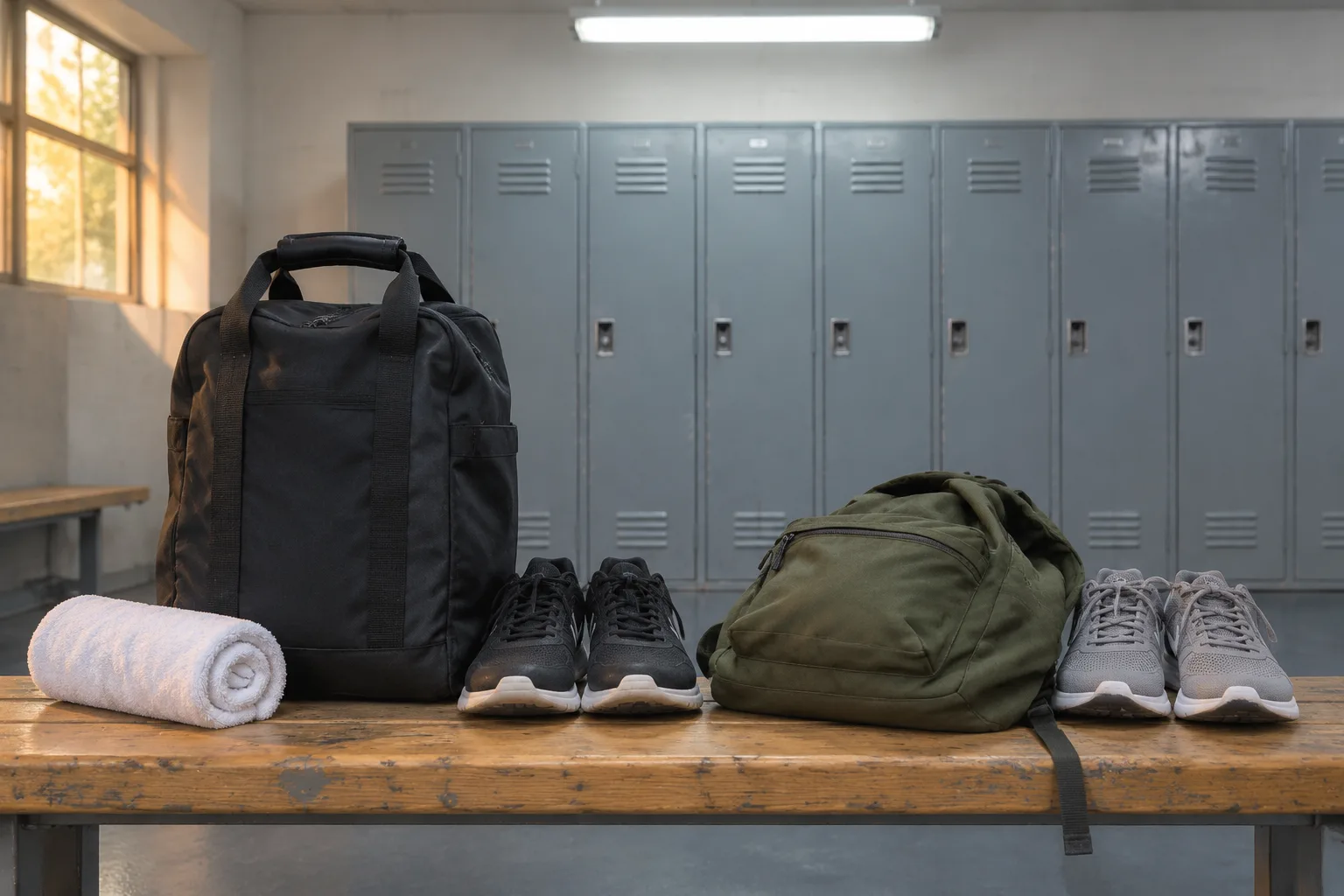
A duffel bag holds its shape when it is empty. Set one on a bench and it stands there like a small dog waiting for a command. A daypack collapses into whatever space it occupies, folds over itself, and looks vaguely apologetic until it is filled. The difference sounds trivial until a person is standing in a locker room at 6:40 in the morning trying to decide which one to carry to the office after the workout, and the two bags are doing entirely different things to the same set of clothes.
Both bags claim the same territory: the trip from the gym floor to the street, from the squat rack to the coffee shop, from a change of clothes to a laptop. The category has a name now, gym-to-street, and it sells a lot of nylon. The honest answer to which one wins depends on what the bag has to do in the eight hours after the gym, and most people never ask that question until they have already bought the wrong one.
The duffel's flat bottom is the whole argument
A duffel sits. That flat rectangular base, usually reinforced with a panel of heavier fabric, means the bag holds position on a bench, a locker shelf, the floor of a bus. Shoes go in the bottom compartment, a towel on top, a water bottle in the end pocket. Nothing has to be arranged; the bag accepts whatever is dropped into it because the volume is a single open cavity with a wide mouth.
That openness is a gift at the gym and a liability on the train. A duffel carried by its handles hangs low and swings against the leg. Carried over the shoulder on a strap, it slides forward when the body leans. On a crowded rush-hour car, a full duffel occupies roughly the footprint of a small suitcase and announces itself every time it turns.
The bag also has a social register. A leather-trimmed duffel in navy reads as weekend travel, as a person with a car and a plan. The same bag in ballistic nylon reads as a gym bag that has been promoted. Neither is wrong. The question is which one is walking into the meeting.
A daypack redistributes the weight and hides the gear
Two straps across the shoulders change everything. The load sits against the back, centered, and the hands stay free. A daypack can hold a laptop in a padded sleeve, a change of clothes in the main compartment, shoes in a separate pocket at the base, and a water bottle in a side holster, and it can do all of that while looking like a person is simply going to work.
That is the daypack's quiet advantage: it disappears into the outfit. A dark canvas pack with clean lines passes at a desk, in a lecture hall, on a bike. Nobody asks what is inside it. The gym clothes stay hidden, the shoes stay hidden, and the whole operation becomes private.
The cost is access. A top-loading daypack means digging. The laptop is at the back, the shoes are at the bottom, and the shirt that was packed on top has migrated into a corner. A clamshell opening fixes most of this, laying the bag flat like a book, but clamshell packs tend to be boxier and less forgiving on the back. There is a reason hiking packs and commuter packs have evolved separately, and the gym-to-street pack lives in the uneasy space between them.
The wet towel problem nobody mentions in the product photos
Any bag that carries gym clothes has to survive a wet towel. This is the detail that separates a bag designed for the gym from a bag designed to look like it belongs at the gym. A duffel with a ventilated shoe compartment and a separate wet pocket handles the problem cleanly, because the cavity is large and the air moves. A daypack with a sealed laptop sleeve and a single main compartment turns a damp towel into a humidity chamber, and by the afternoon the laptop smells like a locker room.
The fix is a dedicated wet pocket, ideally lined and taped, and a shoe compartment that vents to the outside. Bags without both of these fail the actual test of the category, which is not how they look on a model but how they smell after a Thursday session and a full workday.
What the body is doing between the two locations
The commute decides more than the gym does. A person who drives from the gym to the office can carry a duffel without thinking about it, because the bag travels from a car trunk to a locker and back. A person who walks twenty minutes, rides a bike, or takes two trains needs the bag to be attached to the body, and only a daypack does that well.
Cycling is the clearest case. A duffel on a bike is a hazard; it swings, it catches on the frame, it needs a rack. A daypack with a sternum strap and a padded back panel sits still, and the rider arrives without a red stripe across one shoulder. Walking is less dramatic but the same logic applies over distance: a loaded duffel carried by hand for a mile is a slow punishment, and the shoulder strap only moves the punishment to a different muscle.
There is also the matter of what the bag has to hold after the gym. A duffel swallows a pair of shoes, a towel, a change of clothes, and a laptop with room to spare, and it does so without any of the compartments fighting each other. A daypack holds the same load but forces a decision about order: laptop against the back, shoes at the bottom, clothes in the middle, towel in the wet pocket. That order has to be rebuilt every single time, and the person who ignores it ends up with a laptop pressed against a damp towel by noon.
The shape of the bag on a chair in a meeting
Consider the bag at rest. A duffel placed beside a desk chair slumps into a soft lump and takes up floor space. It reads as luggage. A daypack hung on the back of the chair or set on the floor leans against the leg and reads as a commuter's bag, which is a different social category entirely. In a shared office, the daypack is invisible; the duffel invites a comment about a trip.
This is not vanity. It is the practical question of whether the bag can be left in a room without drawing attention. A bag that looks like travel gear implies the person is leaving. A bag that looks like a work bag implies the person is staying. The gym-to-street category exists precisely because most people are staying, and most people would rather not explain their morning to a room of colleagues.
The duffel wins on volume and loses on the last mile
A duffel in the 35 to 45 liter range will hold a full gym kit plus a laptop plus a lunch plus a pair of shoes, and it will do so without a single zipper negotiation. That volume matters for anyone who lifts heavy, swims, or carries a change of clothes plus a towel plus toiletries. The flat bottom means the bag can be packed standing open, and the wide mouth means nothing has to be excavated.
The last mile is where it falls apart. The final walk from the station to the office, the climb up the stairs, the wait at the elevator, all of it is done with the bag in one hand or swinging from one shoulder. A duffel with a padded shoulder strap and a luggage pass-through can be carried comfortably for a short distance, but the body notices the asymmetry by the end of the week.
The daypack wins the last mile by default. Two straps, weight centered, hands free. The trade is capacity and access, and for many people that trade is worth making.
A convertible bag solves the argument by refusing to pick a side
There is a third option, and it has become the quiet answer for people who cannot decide: a bag with backpack straps that tuck away behind a panel, leaving a clean duffel silhouette when carried by the handles. The straps hide in a zippered compartment, the bag converts in about ten seconds, and the same piece of luggage works for the drive to the gym and the train to the office.
The compromise is real. Convertible bags tend to be heavier than either pure form, because the hardware for both carry modes adds weight. The backpack mode is rarely as comfortable as a dedicated daypack, and the duffel mode is rarely as clean as a dedicated duffel. But for the person who drives on Monday and takes the train on Wednesday, the convertible bag is the only object that does not force a second purchase.
The category has a name for a reason. The gym-to-street bag is a bag that has to be two things, and the market has responded by building bags that are two things at once. The choice between duffel and daypack is really a choice about which half of the day matters more, and the honest answer is that most people know within a week of carrying the wrong one.
The decision comes down to the walk between the locker and the desk
Picture the walk. A person leaves the gym at 7:45, showered, dressed, carrying the bag. The walk to the car is forty steps. The walk to the train is eight minutes, then a platform, then a crowded car, then six more minutes to the building. The bag is carried the whole way. By the time the desk is reached, the body has rendered a verdict on the bag, and it is not a verdict about style.
A duffel belongs to the person whose commute is short and whose gym kit is large, and who values the ability to see everything in the bag at once. A daypack belongs to the person whose commute is long and whose gym kit is compact, and who values arriving at the desk with two free hands and no stories to tell about the shoulder strap. Neither bag is the better bag. The better bag is the one that matches the walk, and the walk is the only specification that actually matters.