
Everyday Sneakers: What a Good Pair Actually Costs
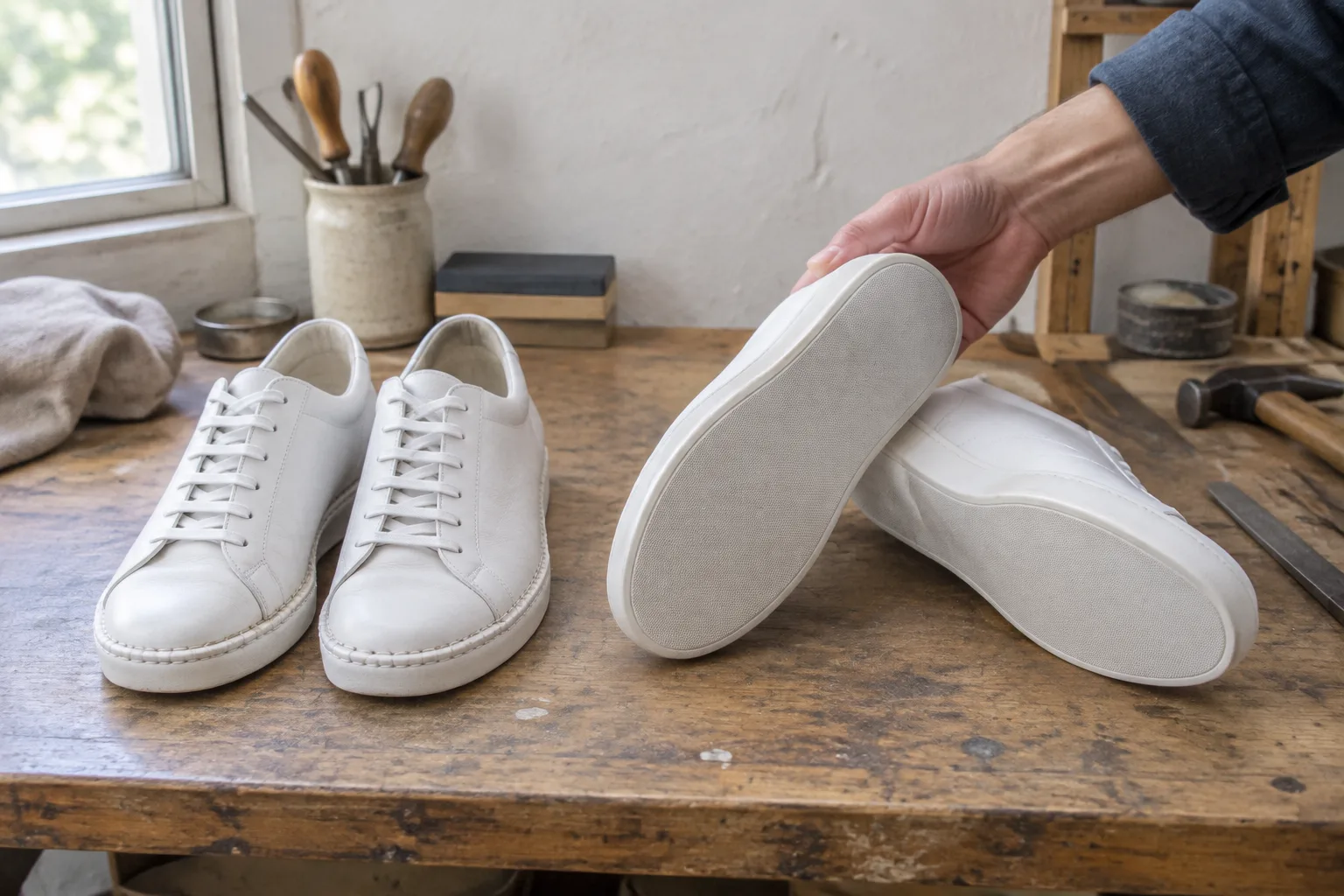
A pair of plain white court sneakers, size 42, made of full-grain leather and stitched in Portugal, sells for about $180. The same silhouette in corrected-grain leather, cemented rather than stitched, made in a factory that runs three shifts, sells for $55. They look nearly identical in a photograph. On a sidewalk they are not the same object, and the gap between them is where the entire question of everyday sneaker value lives.
Most people shopping for everyday sneakers are not really shopping for shoes. They are shopping for a feeling of having solved something. The sneaker is the one piece of clothing that has to do four jobs at once: stand up to pavement, look acceptable in an office, survive a spill, and not announce itself as a compromise. That set of demands is narrow, and it drives prices in ways the buyer rarely sees.
The price on the box is a poor guide. A better one is what a pair costs per month of actual wear, and that number has less to do with the logo than with four physical facts: the leather, the sole, the construction, and how often the thing gets worn.
What the leather is doing
Full-grain leather is the top layer of the hide, with the grain intact. It takes dye unevenly, creases in specific places, and holds a shape. Corrected-grain leather has been sanded flat and stamped with a uniform pattern, usually to hide scars and to let the factory cut more usable pieces from a cheaper hide. The difference shows up around month four, when full-grain has formed a soft map of creases at the toe box and corrected-grain has started to flake at the flex point like a sunburn.
That is the honest trade. A $55 sneaker will look good for a season. A $180 sneaker will look worn in a way some people find pleasant. Neither is a scam. The mistake is buying the cheap pair expecting the expensive pair's third year.
The sole is where the cost hides
Most inexpensive sneakers use a vulcanized or cemented rubber sole bonded with adhesive. Cemented construction is fast and cheap, and it works until the bond fails, which is usually at the flex point behind the ball of the foot, often after a year of real use. Once that bond lets go, the shoe is finished. A cobbler can attempt a re-glue, and it will fail again in the same place.
A stitched sole, whether through a cup sole or a welt, holds because thread fails more slowly than glue. That single difference is worth more than any brand name. A pair with a stitched sole can be resoled, which means the upper gets a second and sometimes a third life. The math is simple and slightly brutal: two pairs of $55 sneakers over four years cost about the same as one $180 pair that gets resoled once, and the expensive pair looks better at the end of it.
The $90 pair that quietly beats both
There is a middle band that deserves more attention than it gets: $80 to $110, usually from a brand that makes its own shoes and doesn't pay for a celebrity. At this price the leather is often split-grain or a decent synthetic, the sole is cemented, and the construction is not going to survive a decade. What changes is the last, the shaped form the shoe is built around, and the quality control on the stitching.
A well-shaped last is the difference between a sneaker that looks intentional and one that looks borrowed. The toe box sits lower. The heel counter grips. The eyelets line up. None of this is expensive to manufacture, but it requires a brand that cares, and caring is rarer than leather.
For a person who walks two miles a day on city pavement and replaces sneakers every eighteen months, this is the rational purchase. The $180 pair is for someone who will actually resole it. The $55 pair is for someone who treats sneakers as disposable and is fine with that. The $90 pair is for the large middle, and it is where most people should start.
Why the white sneaker costs more than the black one
Color is a cost driver that almost no one accounts for. White leather shows every scuff and needs cleaning to stay presentable, which means the wearer either spends time on maintenance or replaces the shoe sooner. Black and dark brown hide scuffs and creases. The same silhouette in black can last visibly longer than in white, purely because the eye forgives more.
This is why a person who wants one pair to do everything should think hard before defaulting to white. The white sneaker is a maintenance commitment disguised as a neutral. The dark pair is the lower-cost decision over three years, even at the same sticker price.
The insole is a consumable, not a feature
Nearly every sneaker under $200 ships with a glued-in foam insole that compresses to nothing within a year. This is normal and not a defect. The insole is a wear item, like a brake pad. The problem is that many cheap sneakers glue it in so aggressively that it cannot be removed, which means the shoe's comfort dies with it.
A removable insole is a small sign of a brand that expects the shoe to be kept. It also lets the wearer swap in a firmer orthotic or a thinner leather footbed, extending the useful life by years. When comparing two pairs at the same price, pull the insole. If it lifts, the shoe was designed to be lived in.
The break-in period is a signal
A leather sneaker that feels perfect in the store is often a sneaker with a soft, thin upper that will collapse. Good leather is stiff at first. It takes a week or two of short wears to mold to the foot, and during that time it will rub in places that feel wrong. This is the leather learning the shape of the foot, and it is the whole point.
A sneaker that requires no break-in has usually skipped the step that makes it last. The stiffness is the cost of the crease pattern that will look right in year two. Buying for immediate comfort is how people end up replacing shoes every season.
What the resole actually costs
A cobbler will charge somewhere between $60 and $90 to resole a stitched sneaker, depending on the city and the sole. That number is the hinge on which the whole argument turns. If the resole costs a third of the original price and buys another two years, the expensive pair wins on cost per wear. If the cobbler won't touch the shoe because the construction is cemented, the expensive pair was never expensive in the right way.
Before buying any sneaker above $150, the useful question is whether a local cobbler will resole it. Most will answer honestly in a thirty-second phone call. A brand that cannot survive that call is selling leather, not a shoe.
The realistic budget for one good pair
For a single pair meant to be worn four or five days a week, the honest number is $120 to $200, with $150 as the sensible center. Below $80, the shoe is a consumable. Above $250, the buyer is paying for a name, a collaboration, or a leather so fine it belongs on a dress shoe. Neither end is wrong. Both ends should be entered with open eyes.
The $150 pair, chosen well, will look presentable for two years, get resoled once, and finish its life as a beat-up shoe that still works for errands. That is roughly $50 a year for the thing underfoot every day. Few purchases in a wardrobe return more.
The pair nobody photographs
The most cost-effective everyday sneaker is usually the least interesting one on the shelf: a plain leather low-top in a dark color, stitched sole, removable insole, no visible logo, bought from a brand that has been making the same shoe for twenty years. It will not appear in a trend report. It will not sell out. It will simply be the pair still by the door in year three, creased at the toe, holding the shape of a specific foot, while the trendier pairs have gone to the back of the closet or the bin.
That shoe costs about $150, and it is the only number in this whole conversation that a buyer can actually verify before spending a cent: pick it up, bend the sole, pull the insole, and ask whether anyone will fix it when it breaks. The answers to those four questions tell more than the price tag ever will.