

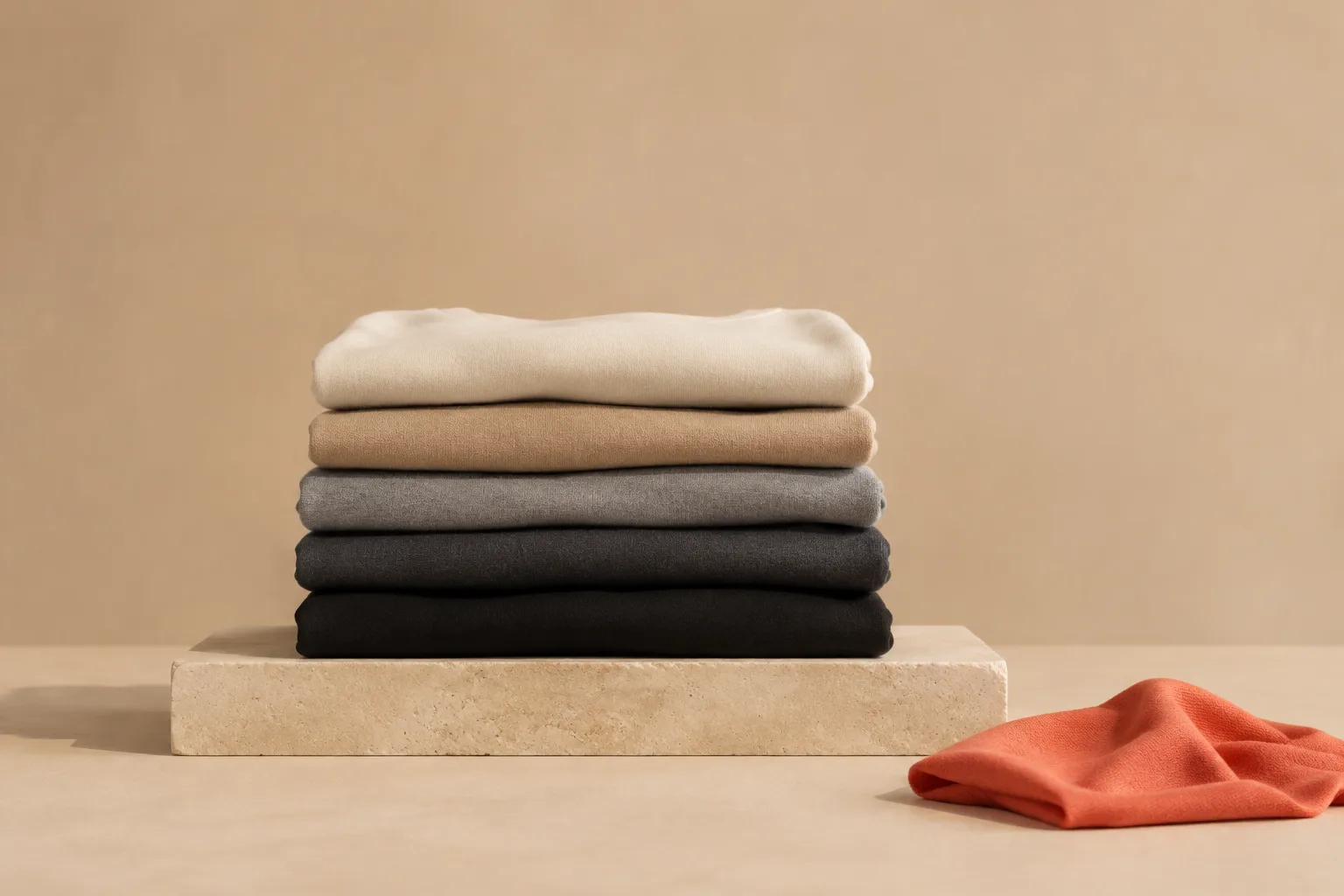
First Capsule, Best Neutrals: Where to Start
A capsule wardrobe begins with the decision to stop buying the wrong things. The first capsule is where that decision gets tested, because the temptation is to fill it with variety: a stripe here, a bright color there, a statement piece that photographs well and gets worn twice. The better move runs in the opposite direction. The foundation of a first capsule is neutrals, and the specific neutrals matter more than the number of pieces.
Most capsule advice skips this part. It hands over a list of thirty items and calls it a system, when the honest work happens earlier: choosing a base palette that survives a year of mornings. That choice is where a first capsule succeeds or quietly falls apart.
What "neutral" actually means on a hanger
Neutral gets used loosely, as if any muted color qualifies. It does not. A true neutral sits beside other colors without competing for attention. Black, white, navy, gray, beige, camel, and olive all earn the label because they can carry a whole outfit while letting one accessory or one interesting shoe do the talking.
The test is simple and physical. Lay two candidate pieces side by side on a bed, in daylight, and look for which one pulls the eye first. If the answer flips depending on the day, the piece is a feature, not a foundation. Foundations recede. A first capsule needs pieces that recede reliably.
Undertone adds a second filter. Neutral is not a single hue. A warm beige and a cool gray can both be neutral and still refuse to live in the same wardrobe. The base palette has to agree with itself before it agrees with anything else.
The case for starting with three colors, not seven
A first capsule built on seven neutrals is really four capsules fighting for hanger space. Three colors, chosen deliberately, produce more outfits than seven chosen hopefully, because each new piece multiplies against the others instead of sitting beside them.
The most forgiving trio for a beginner is navy, white, and a warm mid-tone like camel or oatmeal. Navy reads as serious without the severity of black. White lifts everything it touches, especially in a tee or a shirt collar where it catches light near the face. Camel or oatmeal softens the pairing and keeps the whole palette from looking like a uniform for a very formal office.
Black, white, and gray is the other obvious trio and it works, though it skews cool and can feel a little flat in daylight. Cameras love it. Laundry loves it. On a gray February morning, a person wearing head-to-toe black, white, and gray may find the palette has nothing to say. That is worth knowing before the shopping starts.
Three colors do not mean three shades. A pale blue oxford shirt sits close enough to navy to function as a neutral in the same wardrobe, and a cream sweater does the same work as a white tee. The palette has room for range. It does not have room for a fourth hue that fights the other three.
Fabric weight decides more than color
A capsule of beautiful colors in the wrong weights will still fail. A thin white tee and a heavy white oxford are the same color and behave nothing alike. The first capsule needs a deliberate ladder of weights so the pieces can layer through a season instead of clustering into one temperature band.
For a first capsule, the useful ladder runs roughly like this: a light cotton tee, a mid-weight shirt, a fine-gauge knit, a heavier outer layer. Four weights in the same palette produce dozens of combinations. Add a fifth piece in an intermediate weight and the number climbs again. The math of a capsule lives in these small jumps.
Texture does similar work. A smooth cotton, a ribbed knit, and a brushed wool catch light differently even when they share a color family, which keeps an all-neutral outfit from reading as flat. This is why an outfit of navy, white, and camel can look rich while an outfit of three identical gray cottons can look like a mistake.
The pieces that earn their place first
The first capsule does not need a trench coat, a blazer, and a silk blouse in week one. It needs the load-bearing pieces: one pair of trousers that fit correctly, one pair of jeans, two or three tops, one knit, one outer layer, one pair of shoes that works with most of the rest.
Fit is the part that gets skipped. A navy crewneck sweater in the right shoulder width and the right body length will outperform a beautiful camel coat that pulls across the chest. A person who tries on ten pairs of trousers to find the one with the correct rise has done more for their wardrobe than someone who bought four pairs in a hurry.
Shoes belong in the first capsule, not the second. One pair of leather sneakers in white or cream, or one pair of simple leather loafers in a mid-brown, anchors more outfits than a closet of specialty footwear. The shoe is not the place for a first capsule to take a risk.
Accessories deserve fewer pieces than most guides suggest. A single belt in a mid-tone that bridges the shoe and the bag does more work than three belts in three colors that each match only one outfit. The first capsule should probably own one belt, one bag, and one scarf, chosen in the same palette as everything else.
Why the pattern pieces wait
Stripes, checks, and prints are not the enemy. They are simply poor foundational pieces. A striped shirt is a good second-capsule purchase because by then the palette is settled and the stripe can be chosen to match it. In a first capsule, a stripe competes with the neutrals before they have had a chance to prove they work together.
There is one exception worth making. A single subtle pattern in the same palette, a fine breton stripe in navy and white, or a low-contrast check in oatmeal, can add life to a first capsule without disrupting it. The rule is not zero patterns. The rule is that the pattern must be nearly a neutral itself.
The number problem, and why twenty-two is not magic
Every capsule guide arrives at a number, and the number is usually twenty-two or thirty or thirty-three. These numbers are not derived from anything. They are chosen because they sound intentional. A first capsule built for a specific climate, a specific job, and a specific laundry schedule will land somewhere between fifteen and thirty-five pieces, and the exact figure is almost irrelevant once the palette is right.
What matters is the ratio. In a working first capsule, roughly two-thirds of the pieces should be bottom layers and tops, because those are the pieces that meet each other most often. The remaining third should be outerwear, shoes, and accessories, which get reused across more outfits than their count suggests.
A first capsule with twenty pieces in the right palette will outperform a first capsule with forty pieces in seven hopeful colors. The smaller wardrobe forces the pieces to be chosen carefully. The larger one hides bad decisions behind variety.
What to buy last, and what to buy twice
The last pieces to buy in a first capsule are the ones with the most personality: the interesting coat, the distinctive bag, the shoes with a shape that gets noticed. These are good purchases and belong in a wardrobe, just not in the first round. Waiting a season gives the palette time to prove itself and reveals which gaps actually exist.
The pieces to buy twice are the ones that get washed most: white tees, underwear, socks, and the basic shirt that gets worn three days a week. A first capsule that owns one white tee owns a wardrobe with a hole in it. Owning three identical white tees is not a failure of minimalism. It is the minimum.
One more thing worth buying in duplicate: the pants that fit. When a pair of trousers fits correctly, in the right neutral, the instinct is to buy one and move on. Buy two. The second pair extends the life of the first and removes the low-grade anxiety of a single pair in the laundry basket on a Monday morning.
A note on climate, which changes every list
Capsule guides tend to assume a temperate climate with four seasons and a need for a coat. A person living in a hot city needs a different first capsule: lighter weights, more breathable fabrics, maybe three tops instead of two, and almost no outerwear. A person in a cold city needs the opposite: fewer tops, one very good coat, and a knitwear layer that can be worn indoors.
The palette survives both climates. The piece count does not. This is why copying a capsule list from a magazine rarely works. The list was assembled for someone else's weather and someone else's laundry machine.
The first morning the capsule is tested
The real verdict on a first capsule arrives on an ordinary Tuesday, not in the mirror after a careful purchase. It arrives when the alarm goes off late, the coffee is cold, and the outfit has to be assembled in ninety seconds without thought. On that morning, a wardrobe built on three neutrals and four fabric weights either produces an outfit or does not.
If it does, the first capsule has done its job. The next purchases can be more interesting, more personal, more patterned. If it does not, the fault is almost never in the number of pieces. It is in the palette, the fit, or the weights, and the fix is smaller than it feels. Pull the weakest color out, replace the piece that never fit, add the missing weight. A capsule is a structure, and structures are repaired at the joints, not rebuilt from scratch.
The first capsule does not need to be perfect. It needs to be honest, which means it needs to reflect how a person actually lives, what the weather actually does, and what actually gets worn. Neutrals are the right place to start because they are the pieces that survive the ordinary Tuesdays long enough for the wardrobe to grow around them.