
Gym Bag, Meet Commute: A Choosing Guide
Gym bags and commuting bags live in different physical universes. A gym bag is designed for a locker room: it gets thrown on a bench, unzipped with wet hands, and asked to hold a pair of shoes that have been through a spin class. A commuting bag is designed for a train seat, a lap, a walk through a parking garage. The person who tries to make one bag do both jobs usually ends up with a bag that does neither well. The zippers smell faintly of chlorine. The laptop sleeve has a sweat stain shaped like a phone. Somewhere in the bottom, a sock is composting.
The honest solution is two bags. The practical solution, the one that survives a real schedule, is a single bag chosen with an almost fussy eye for how the two jobs collide. This is a guide to that collision, written from the perspective of someone who has watched a lot of bags fail in the gap between the gym door and the office door.
The Smell Problem Comes First
Before materials, before pockets, before laptop protection, there is the question of air. A bag that carries worn gym clothes for six hours and then carries a clean laptop home is a bag that will eventually smell like a high school locker room. This is not a matter of laundering the bag more often. It is a matter of separating the wet zone from the dry zone by design.
The bags that handle this well share one feature: a dedicated, sealed compartment for shoes and soiled clothes, usually lined with a wipeable material and vented somewhere discreet. The vent matters more than people expect. A fully sealed compartment traps moisture until the next unzipping, at which point the whole bag breathes out a small weather system. A vented one lets the worst of it escape gradually, which is less dramatic and much more livable.
Mesh side pockets are not a substitute. A mesh pocket holds a water bottle, not a wet towel. The towel goes in the sealed compartment or it goes in a separate laundry bag, and if it goes in a laundry bag, the bag needs a place to live that is not pressed against the laptop sleeve.
Laptop Protection Versus Everything Else
A padded laptop sleeve is table stakes for a commuter. The trouble is that the padding that protects a laptop also takes up space, and that space is usually stolen from the gym side of the bag. A bag with a good laptop compartment and a thin main compartment is a bag that will hold a laptop and a pair of shoes and almost nothing else.
The bags that get this right tend to have a suspended sleeve, meaning the laptop sits off the bottom of the bag rather than resting on it. That detail matters when the bag gets set down on concrete. It also tends to mean the sleeve is a separate walled-off section rather than a padded pocket sewn to the back panel, which keeps the main compartment's shape intact.
One useful test: a bag should hold a 14-inch laptop, a pair of size 10 sneakers, a water bottle, and a change of clothes without the zipper straining at the pull. If it cannot do that empty, it will not do it full, and the zipper is the first thing to fail.
The Shape of a Bag on a Shoulder
Commuting bags are carried for longer than gym bags are. A backpack gets worn for twenty minutes on a platform and another fifteen walking to the office. A duffel gets carried by a handle for a hundred yards and then set down. These are different ergonomic problems, and the bag that tries to solve both with a convertible strap usually solves neither.
The convertible backpack-duffel is a popular idea and a compromised object. The straps, when deployed, rarely sit flat against the back. When stowed, they bunch into a lump that presses into the spine. The bag ends up carried by the handle more often than intended, which defeats the point.
A backpack with a wide, flat main compartment is the more honest shape. It carries like a backpack, which is how most of the commute is actually spent, and the wide compartment holds a folded change of clothes and shoes without the bag becoming a narrow tube. The tradeoff is that it looks like a backpack at the gym, which is fine, because nobody at the gym is grading.
Fabric That Survives Both Rooms
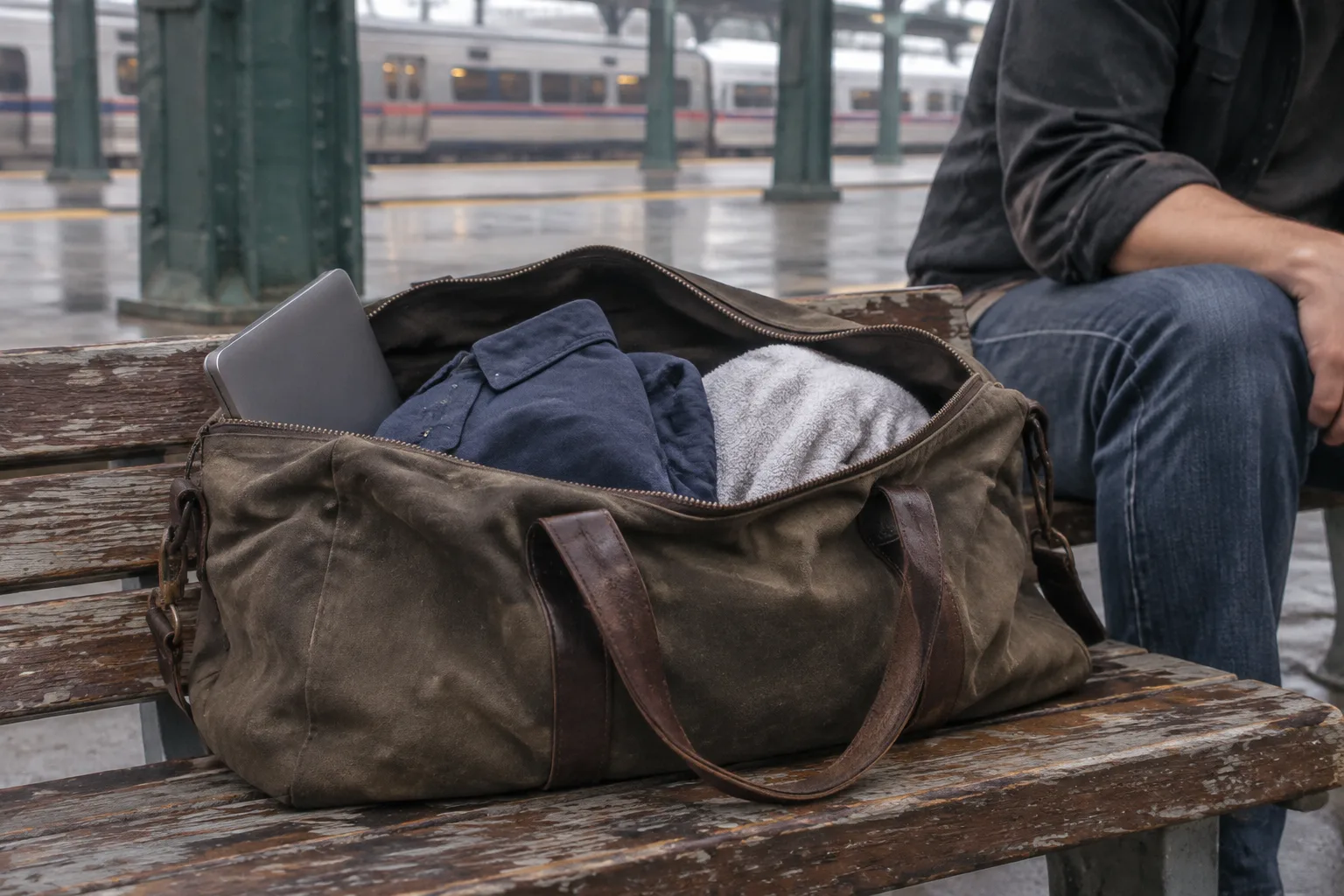
Gym floors are wet. Locker room benches are wet. The bottom of a commuting bag that gets set down in a locker room will absorb whatever is on that bench. This is why the base material matters more than the body material.
A coated polyester or a heavy ballistic nylon base sheds water and wipes clean. A canvas or cotton base drinks it and holds it. The difference shows up within a month: the canvas bag develops a permanent dark ring on the bottom, and the ring smells like the ring.
The body of the bag can be softer. A 600-denier polyester is light and reasonably tough. A 1000-denier is tougher and heavier. For a bag that spends most of its life on a shoulder, the lighter fabric is usually the better call, with the heavier material reserved for the base and the high-wear corners.
Water resistance is worth having but worth being realistic about. A bag rated for light rain will keep a laptop dry through a dash from the car to the office door. It will not keep a laptop dry through a twenty-minute walk in a downpour. For that, a rain cover or an internal dry bag is the actual answer, and most bags have a small pocket where a folded rain cover can live.
The Small Pockets That Earn Their Space
A gym-commute bag needs a small number of well-placed pockets and no more. Every extra pocket is a place for a wet sock to hide and a place for the bag to gain weight without gaining function.
The pockets that earn their space: a quick-access front pocket for a phone and a transit card, a side pocket sized for a water bottle, a small internal pocket for a lock and a hair tie or a spare pair of socks, and a key leash. The key leash is the most underrated feature on any bag. A bag without one becomes a bag where keys are found by feel at the bottom, usually after the train has arrived.
A shoe compartment counts as a pocket only if it is sealed and vented. A shoe bag that is just a mesh pouch at the bottom of the main compartment is a bag that will transfer the smell of shoes to everything above it.
What to Leave at Home
The bag that carries everything is the bag that gets too heavy to carry. A gym-commute bag should hold the gym clothes, the shoes, the laptop, the water bottle, and a small pouch of toiletries. It should not hold a towel unless the towel is a compact travel towel, and it should not hold a full shower kit unless the shower is actually happening at the gym.
The discipline is in the packing list. A person who packs a full change of clothes, a towel, a shower kit, a laptop, a charger, a water bottle, and a lunch is carrying a bag that weighs ten pounds before the shoes go in. The bag is not the problem. The list is.
A short list, packed the night before, is the difference between a bag that gets carried and a bag that gets left in the car. The bag should be light enough to carry on a shoulder for the length of the commute and empty enough at the end of the day that it does not need to be unpacked until the next morning.
The Zipper Is the Failure Point
Every bag fails somewhere. In gym-commute bags, the failure is almost always the main zipper. It is the part that gets stressed every time the bag is overpacked, and it is the part that gets stressed most when the bag is full of shoes and a laptop at the same time.
A metal zipper with a large pull is more durable than a coil zipper, but it is also heavier and more likely to scratch a laptop. A coil zipper from a reputable maker is smoother and lighter, and it handles a stuffed bag reasonably well as long as the bag is not overstuffed. The real test is the pull: a zipper with a chunky, easy-to-grab pull is a zipper that gets used properly, and a zipper that gets used properly lasts longer than one that gets yanked by a tiny tab.
Reinforced stitching at the zipper ends is the other detail to check. That is where the stress concentrates, and that is where a cheap bag splits first.
A Note on the Locker Room Bench
The bag gets set down on a bench that has held a hundred other bags and a hundred other pairs of shoes. It gets picked up and put on a shoulder that will later be in a car, on a train, in an office. The bottom of the bag is the part that touches the world, and the bottom of the bag is the part that most bags neglect.
A bag with a wipeable, dark, reinforced base is a bag that can be wiped down with a disinfecting wipe at the end of the week and look the same as it did on day one. A bag with a fabric base is a bag that will look like a locker room bench within a season. The base is not a glamorous feature. It is the feature that determines whether the bag is still in use a year from now.
That is the whole calculation, really: a bag that survives the bench, the train, the office floor, and the bottom of a closet, and still opens without a smell. Everything else is preference.