

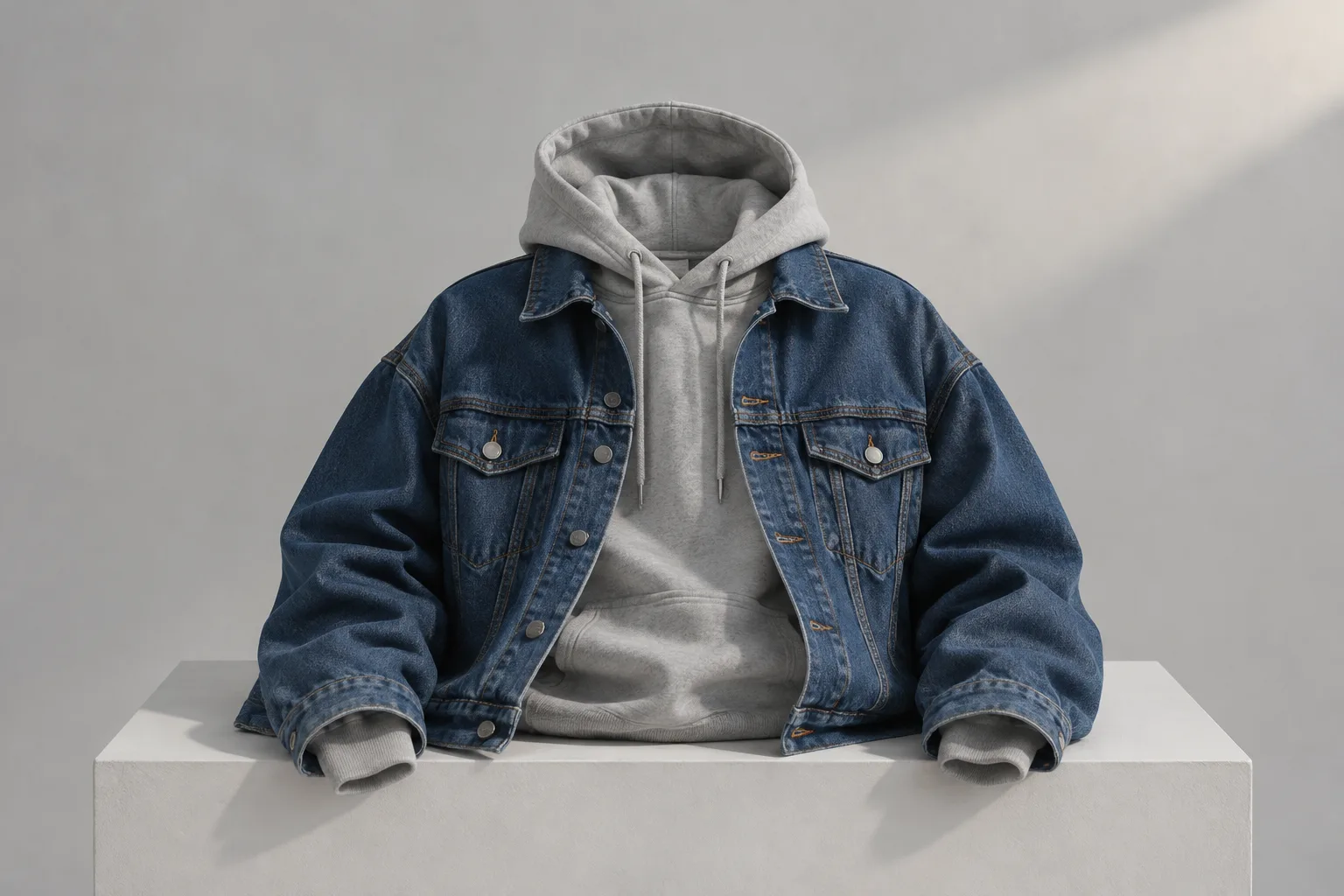
Hoodie Under Jacket: A Layering Guide That Holds
The hoodie under a jacket is the most common layering move in casual dressing and the one most likely to go wrong. A grey cotton hoodie shoved under a wool overcoat produces a silhouette that looks like a sleeping bag wearing a belt. The same hoodie under a boxy denim jacket can read as deliberate, almost sharp. The variable is not the hoodie. It is the jacket, the depth of the hood, and whether the two garments have agreed on a single shape before leaving the house.
This guide treats the combination as an engineering problem with a style payoff. The layers have to fit, the fabrics have to cooperate, and the hood has to sit somewhere sensible when it is not on the head. Get those three things right and the outfit holds together through a cold morning, a warm train car, and the walk back home.
The Jacket Has to Be Cut for a Second Layer
Most jackets are drafted over a shirt. A shirt is roughly a quarter inch of fabric at the chest. A midweight fleece hoodie is closer to half an inch, and a heavy one with a brushed interior can be thicker still. That difference has to come from somewhere, and it comes from the armholes and the chest.
A jacket that fits cleanly over a t-shirt will usually pinch across the shoulder blades and pull at the front closure once a hoodie goes underneath. The fix is a jacket sized one step up from the t-shirt fit, or a jacket designed with room to spare. Field jackets, chore coats, bomber jackets cut generously, and overcoats with a dropped shoulder all handle the extra bulk without strain. A trim moto jacket or a slim peacoat generally does not, and forcing it produces the sausage-casing look that no amount of styling rescues.
The test is simple and takes ten seconds. Put the hoodie on, then the jacket, then raise both arms overhead and reach forward as if grabbing a bus rail. If the jacket hem lifts past the waistband or the shoulders bind, the jacket is too small for the layer. A jacket that passes this test will sit properly for the whole day.
Hoodie Weight Decides Which Jacket Works
Hoodies come in three practical weights for layering. A lightweight cotton or cotton-poly blend, often around 8 to 10 ounces per square yard, behaves almost like a heavy long-sleeve shirt. A midweight fleece, roughly 12 to 14 ounces, is the classic sweatshirt and the most versatile option under a jacket. A heavyweight fleece, 16 ounces and up, is a garment with its own presence and demands a jacket with real volume.
The pairing follows from that. Lightweight hoodies slip under almost anything, including tailored coats, because they add warmth without adding shape. Midweight hoodies suit denim jackets, chore coats, and bombers. Heavyweight hoodies want a parka, an oversized field jacket, or a work coat with a boxy cut. Putting a 16-ounce fleece under a fitted Harrington is a mistake that shows up immediately at the shoulders.
Fabric content matters too. All-cotton fleece holds its shape and takes dye well but absorbs moisture and dries slowly. A cotton-poly blend keeps its structure through repeated washing and resists the sagging that turns a hood into a wet noodle by mid-afternoon. For a layer that will be compressed under a jacket all day, the blend is the more reliable choice.
The Hood Is the Hard Part
A hood has to live somewhere when it is not covering the head. Under a jacket collar it bunches at the neck and pushes the collar away from the body, which reads as sloppy. Over the collar it looks like a mistake. The clean solution is a hood that lies flat against the upper back, which requires two things: a hood cut with a modest depth, and a jacket collar with enough gap to accommodate the fabric.
Jackets with a stand collar, a zip-through funnel neck, or a wide notch lapel generally give the hood room to sit flat. Jackets with a tight ribbed collar or a high snapped collar fight the hood and win. The visible result is a lump at the nape that no adjustment fixes.
There is also the question of the drawstrings. Long flat cords hanging down the chest under an open jacket add visual noise. Tucking them inside the hoodie, or choosing a hoodie with short or knotted cords, keeps the front of the outfit readable. Small thing. Noticeable in photographs.
Color and Texture Carry the Outfit
Two layers of fabric create an opportunity that a single garment cannot: contrast. A heather grey fleece under a navy chore coat reads as considered. A charcoal hoodie under a tan canvas jacket reads as outdoorsy. A black hoodie under a black wool overcoat reads as a uniform, which can be sharp or can be flat depending on the textures involved.
The reliable formula pairs a matte, textured hoodie with a jacket that has a different surface. Fleece against waxed cotton. Fleece against wool melton. Fleece against nylon. When both layers are smooth and dark, the outfit loses its depth and the hoodie disappears into the jacket.
Color follows the same logic. A neutral hoodie (grey, oatmeal, black, navy) under a colored or patterned jacket keeps the focus on the outer layer. A colored hoodie under a neutral jacket reverses the emphasis and works when the hoodie is the point. Two strong colors at once usually compete, and the eye does not know where to land.
Length Relationships Between Hem and Jacket
The hoodie hem should sit at or just below the jacket hem, never well past it. A hoodie hanging three inches below a cropped bomber creates a proportion problem that makes the legs look shorter. A hoodie ending well above the jacket hem leaves a band of shirt or waistband visible and breaks the line of the outfit.
The cleanest relationship is a hoodie hem that lands within an inch of the jacket hem, either slightly above or slightly below. This keeps the layered silhouette reading as one unit. For jackets with a defined waist, a hoodie that ends at the same point reinforces the shape. For boxy jackets, a hoodie ending just below the jacket hem adds a small step that reads as intentional.
What Goes Under the Hoodie
A hoodie worn under a jacket is already two layers. A third layer underneath adds bulk at the neck and chest, which is where fit problems concentrate. A plain t-shirt is the usual and correct choice. A thermal or a thin merino base layer works in genuinely cold weather, provided it is cut close to the body and does not add visible thickness at the collar.
Collared shirts under hoodies create a specific look that some wearers like and many regret. The collar has to sit cleanly above the hoodie neckline, and most button-down collars are too soft to hold that position under a jacket. When it works, it is usually with a structured oxford or a band collar. When it fails, it looks like laundry day.
Footwear and the Rest of the Outfit
The hoodie-under-jacket combination sits in a casual register, and the rest of the outfit has to agree. Sneakers, boots, and casual leather shoes all work. Dress shoes with a fine welt and a polished toe generally do not, because the formality gap between the shoe and the fleece is too wide to bridge.
Pants follow the same rule. Denim, chinos, corduroys, and heavy cotton twills match the texture of a fleece layer. Dress trousers with a sharp crease fight it. The outfit reads best when every piece shares a similar level of roughness, and the hoodie is the piece that sets that level.
Three Combinations That Reliably Work
A midweight grey fleece under a navy wool overcoat, with dark denim and leather boots, is the most dependable version of this look. The overcoat has the volume to absorb the hoodie, the grey and navy contrast cleanly, and the boots carry the casual weight of the fleece. This pairing handles a cold city day without looking like gym clothes with a coat thrown over them.
A black heavyweight hoodie under an olive field jacket, with black jeans and canvas sneakers, leans workwear. The field jacket's boxy cut accommodates the heavy fleece, and the olive and black combination has enough contrast to stay readable. The hood sits flat against the jacket's back panel, which is the detail that makes the whole thing look deliberate.
A lightweight oatmeal hoodie under a tan chore coat, with brown corduroys and suede boots, is the softest version. The lightweight fleece keeps the silhouette trim, and the warm neutrals read as a single considered palette. This is the combination to reach for when the hoodie needs to disappear into the outfit rather than announce itself.
The Zipper Question
A full-zip hoodie under a jacket behaves differently from a pullover. The zipper hardware adds a vertical line and a small amount of bulk at the center front, which can push against a jacket's closure. A pullover hoodie lies flatter and creates fewer pressure points, which is why it is the better layering piece under a buttoned or zipped jacket.
When a zip hoodie is the choice, wearing it fully zipped under the jacket keeps the front clean. A half-zipped hoodie under a closed jacket creates a fold of fabric at the chest that shows through the outer layer. The pullover remains the simpler answer, and the simpler answer is usually the one that holds up over a long day.