

Lace Theory: Small Adjustments, Sharper Looks
Lace has a reputation problem, and it is mostly a problem of proportion. The same fabric that reads as heirloom on a wedding veil reads as costume on a weekend blouse, and the difference between the two is rarely the lace itself. It is the width of the trim, the weight of the ground cloth beneath it, the amount of skin left uncovered, the color of the thread against the skin. Change one of those variables and the whole garment changes register. This is the small-adjustment thesis in its plainest form: lace does not fail because it is lace. It fails because the surrounding decisions were made carelessly.
Most wardrobes contain at least one lace piece that never gets worn. It hangs in the closet, bought on impulse or inherited from a relative, and every attempt to style it produces the same vague dissatisfaction. The instinct is to blame the lace. The more useful move is to isolate which variable is off, because lace responds to adjustment more dramatically than almost any other material. A half-inch of trim removed, a lining added, a hem raised two inches: these are not subtle refinements. They change what the garment says.
The scale of the pattern sets the register
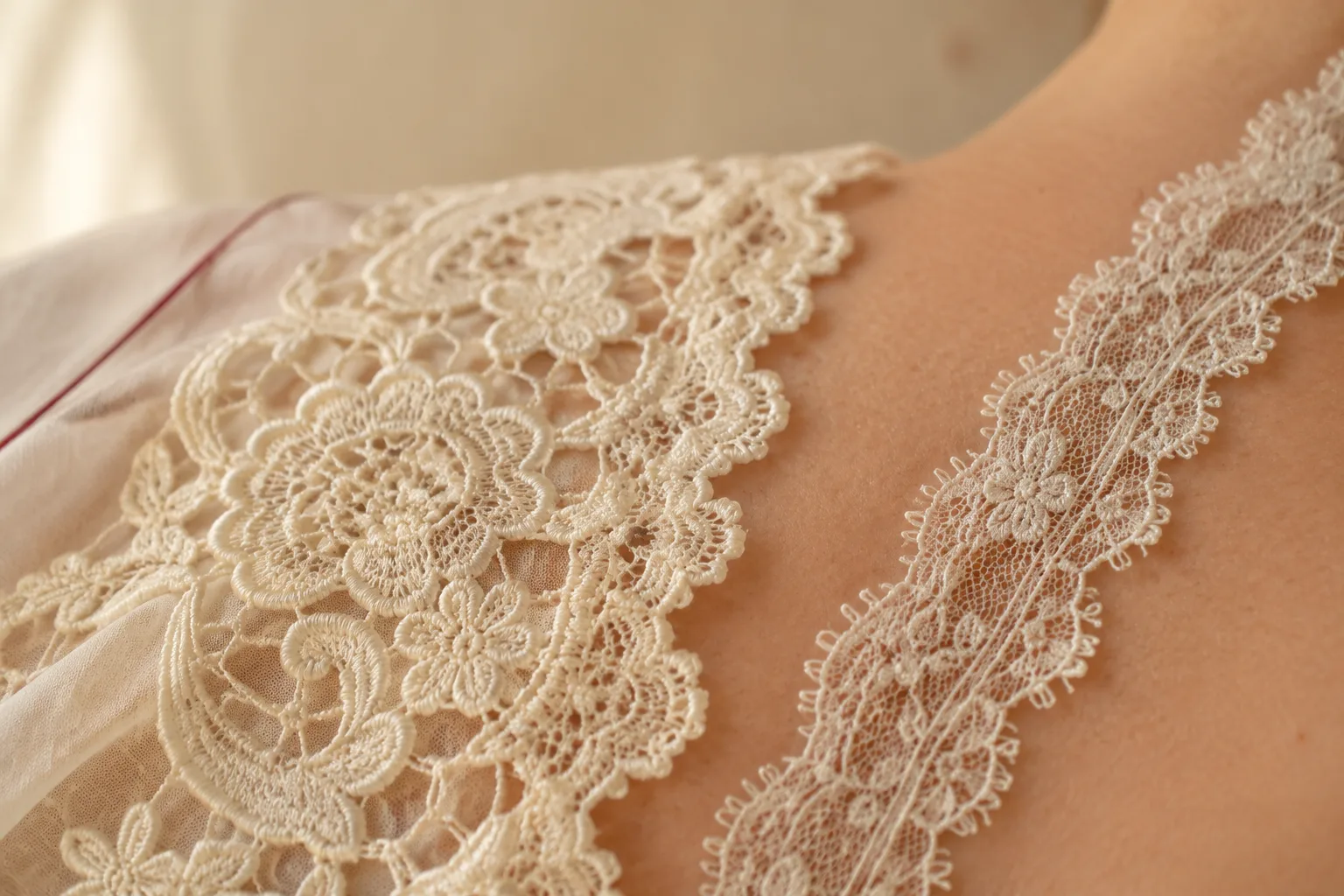
Lace comes in scales, and the scale does most of the stylistic work before any other decision is made. A fine Chantilly-style lace with a motif smaller than a thumbnail reads as delicate at conversational distance. The eye cannot resolve individual flowers, so the fabric presents as texture, a soft haze over the skin. A guipure or macrame lace with motifs the size of a palm reads as architecture. The eye resolves every shape, and the garment announces itself from across the room.
Neither scale is better. They belong to different occasions. The mistake is treating lace as a single category and buying a large-motif piece for a context that calls for small motifs, or the reverse. A person who wants lace for a Tuesday afternoon errand needs the fine scale, something the eye reads as texture rather than pattern. A person who wants lace for an evening event can carry the large scale, because the setting rewards being seen clearly. Match the scale to the viewing distance and half the styling problem disappears.
There is a practical test for this. Pin the lace to a curtain or hold it at arm's length against a window. If the pattern dissolves into a shimmer at that distance, it is fine scale. If the shapes remain distinct and countable, it is large scale. Most people buy lace at close range, in a fitting room mirror, and then wear it at a distance where the pattern behaves completely differently.
Ground cloth determines whether lace whispers or shouts
Lace almost never sits alone. It sits on a ground: a lining, a slip, a contrasting fabric, or bare skin. The ground is the single most controllable variable in the whole equation, and it is the one most often left to chance. A black lace overlay on a black lining reads as a solid dark garment with texture. The same overlay on a nude or champagne lining reads as lingerie, because the eye perceives the lining as skin. The same overlay on nothing at all reads as something else again.
This is why two lace dresses that look identical on the hanger can produce completely different impressions on the body. The difference is not the lace. It is what the lace is doing to the cloth underneath. A wearer who wants lace to read as sophisticated rather than suggestive should pay attention to the contrast between lace and ground. Low contrast reads as texture. High contrast reads as pattern. Zero ground reads as exposure.
The adjustment is often as simple as swapping the slip. A lace skirt that feels too revealing over a bare leg can be completely recast by a bias-cut satin slip in a tone two shades darker than the skin. The lace stays. The impression changes entirely. This is the kind of small adjustment the title promises: not a new wardrobe, just a more deliberate pairing.
Trim width is a proportion decision, not a decoration
Lace trim on a neckline, a cuff, or a hem is usually treated as an ornament added at the end of construction. In practice, the width of that trim is a proportion decision that affects how the whole garment reads. A narrow trim, a quarter inch or less, functions as a border. It says the edge is finished. A wide trim, two inches or more, functions as a panel. It says the edge is a feature.
The mistake is choosing trim width by taste rather than by proportion. A wide lace trim on a petite frame can overwhelm the neckline it is meant to frame. A narrow trim on a garment with a strong shoulder line can disappear entirely. The reliable rule is to measure the trim against the feature it borders. Trim that is wider than a third of the collar depth tends to dominate. Trim narrower than a tenth tends to vanish. Between those, there is room to choose.
There is also a question of direction. Lace trim has a grain, a direction in which the motifs point, and setting it upside down or sideways changes how it catches light. A scalloped edge that points downward reads as a finish. The same scallop turned upward reads as a ruffle. Neither is wrong, but the choice should be made on purpose, and it rarely is.
Skin tone contrast changes what the lace is saying
The relationship between lace and skin is the variable most people feel but cannot name. White lace against deep skin produces a crisp graphic contrast. Ivory lace against fair skin produces a soft, almost tonal effect. Black lace against any skin produces a strong edge. None of these is inherently more elegant. Each produces a different message, and the message should match the intent.
A person who wants lace to read as romantic usually wants low contrast between the lace and the skin it sits against. A person who wants lace to read as graphic or modern usually wants high contrast. The adjustment here is not about which is better. It is about knowing which effect is being aimed at, and then choosing the lace color to produce it rather than choosing by habit.
This is also where the lining decision and the lace color decision intersect. A white lace overlay on a nude lining produces a soft, blended effect on fair skin and a striking contrast on deep skin. The same garment behaves differently on different wearers, which is why lace is so hard to buy secondhand and so rewarding to have altered.
Stiffness controls how the lace holds its shape
Lace has a hand, a stiffness, that determines whether it drapes or stands. Fine leavers lace and Chantilly-style lace fall softly and follow the body. Guipure, macrame, and heavily corded laces hold their shape and stand away from the body. The difference matters most at the edges: a soft lace hem ripples and moves, a stiff lace hem stays where it is put.
Stiff lace is easier to work with and harder to wear. It holds a sculptural shape beautifully on a structured garment and looks costumey on a soft one. Soft lace is the reverse: it needs support to hold a shape and looks effortless when it is allowed to fall. The adjustment is to match the lace hand to the garment's structure. A stiff lace on a fluid silk blouse will fight the blouse. A soft lace on a tailored jacket will collapse at the cuff.
For anyone altering an existing garment, this is the first thing to check. If a lace top feels wrong and the fit is correct, the hand of the lace is probably mismatched to the drape of the surrounding cloth. No amount of styling fixes that. The fix is at the fabric level, which is why lace rewards being chosen carefully at the outset.
The lining seam is where lace garments fail
Most lace garments are constructed with a lining attached at the neckline and the armhole, and the seam where the lining meets the lace is the point of failure. A lining that is cut too short pulls the lace out of shape. A lining that is cut too long bunches under the lace and produces a lumpy silhouette. A lining in the wrong color shows through as a shadow.
The adjustment here is unglamorous but decisive. A tailor can shorten or lengthen a lining, change its color, or replace it entirely for a modest cost. This single alteration rescues more unworn lace garments than any other. A lace dress that feels "off" is very often a dress with a lining problem, and the lace itself is fine.
There is a related issue at the underarm. Lace has no give, and a tight armhole will pull the lace across the chest and distort the pattern. Letting out the side seam by a quarter inch can restore the drape. The lace does not need to change. The seam does.
Layering lace over structure reads as modern
One reliable way to make lace look current rather than period is to layer it over something with structure. A lace top under a blazer, a lace skirt under a knit sweater, a lace camisole under a buttoned shirt: each of these pairings uses the lace as a textural accent rather than the main event. The structure of the outer layer keeps the lace from reading as precious.
This is a small adjustment with a large effect. Lace worn alone tends to read as a statement. Lace worn under something reads as a detail, and details are easier to wear. The same lace blouse that feels like too much on its own becomes effortless under a wool coat. The lace did not change. The context did.
The pairing works best when the outer layer has a contrasting hand: a crisp cotton shirt over soft lace, a smooth wool blazer over corded lace. Contrast in texture makes the lace legible. Matching texture makes it muddy.
The two-inch hem adjustment that rescues a lace skirt
Lace skirts have a specific failure mode: they fall at a length that makes the leg look shorter than it is. The scalloped hem, which is the whole point of the skirt, sits at the widest part of the calf and produces a horizontal line exactly where the eye does not want one. Raising the hem by two inches, so the scallop sits above the calf rather than across it, changes the proportion of the whole body.
This is the kind of adjustment that costs almost nothing and returns a garment to rotation. It also illustrates the general principle: lace is unforgiving of proportion errors and generous with proportion fixes. A half-inch here and a two-inch there are the difference between a piece that hangs in the closet and a piece that gets worn weekly.
A lace skirt that has been hemmed to the right length and paired with a low-contrast slip and a structured knit on top is a different garment from the one that came home from the store. The lace is identical. Everything around it has been tuned. That tuning is the whole practice, and it is available to anyone willing to look at lace as a set of variables rather than a single fabric with a fixed meaning.