

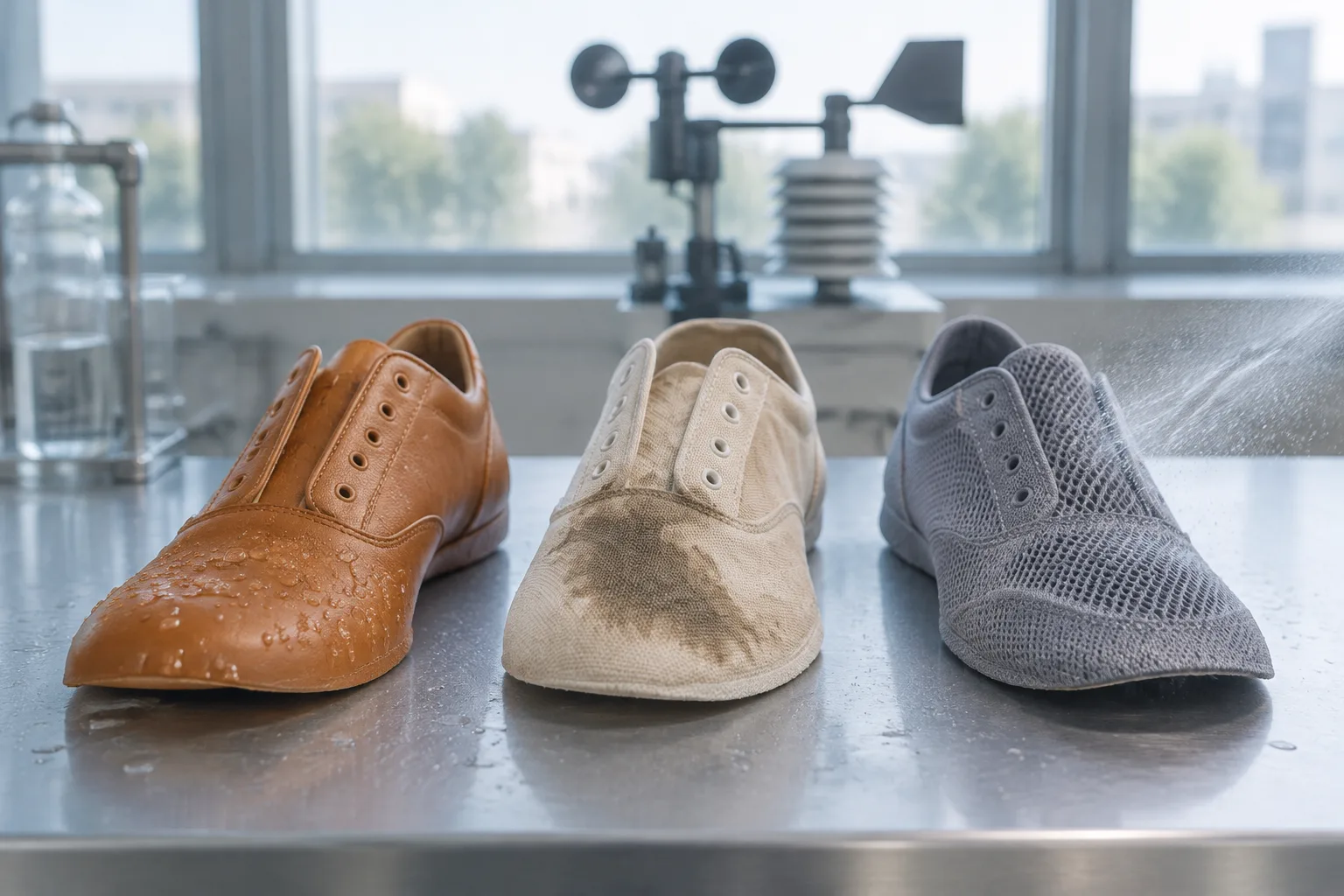
Leather, Canvas, Mesh: Choosing Sneaker Materials That Last
Full-grain leather costs more than canvas. Mesh costs less than both. That hierarchy collapses the moment a sneaker spends a winter in a wet climate or a summer on a hot pavement, which is why material choice rewards a little patience before a single cent gets spent.
The upper of a sneaker is a small piece of engineering with an outsized job. It has to hold a foot steady, flex thousands of times without cracking, shed water or let it through on purpose, and look presentable long after the box has been recycled. Leather, canvas, and mesh each solve that problem differently, and each fails in its own particular way. Knowing which failure is tolerable matters more than knowing which material is theoretically superior.
Most buyers pick a shoe by colorway and silhouette, then discover the material question months later when a seam splits or a toe box goes gray. The better sequence runs backward: decide the conditions first, then let the material follow.
What Full-Grain Leather Actually Does
Leather is skin, tanned and finished, and the grade names describe how much of the original surface survives. Full-grain keeps the outermost layer intact, pores and all. Top-grain has been sanded and corrected. Bonded leather is scraps glued and rolled into a sheet, and it belongs on a bookshelf, not a sneaker.
A full-grain upper is the most forgiving material a shoe can wear. It scuffs and then recovers with a brush and a dab of conditioner. It molds to the shape of a foot over a few months, creasing at the flex point exactly where a natural stride demands. A well-made leather sneaker at year five looks like a leather sneaker that has been worn for five years, which is a different and better thing than looking new.
The cost is real. Full-grain takes longer to break in, runs warmer in summer, and adds weight. Water resistance is decent but not absolute; a soaked leather shoe needs a day to dry and will stiffen if dried near a radiator. The material also demands a minimum of care. Left wet in a closet for a season, it grows a bloom of white mold along the stitching that no amount of brushing fully erases.
There is a reason so many heritage sneakers still use it. Leather is the only common upper material that improves with use rather than simply degrading more slowly.
Canvas: Cheap, Breathable, and Honest About Its Limits
Canvas is cotton or a cotton blend woven into a plain, durable cloth. It has almost no structure of its own, which is why canvas sneakers rely on rubber toe caps and stitching to hold a shape. That flatness is also the appeal. A canvas upper weighs next to nothing, breathes freely, and costs a fraction of leather.
The material has a short, cheerful life. A canvas shoe looks best in its first summer, slightly rumpled by the second, and tired by the third. Dirt works into the weave and stays there. The classic remedy, a washing machine, accelerates the decline: heat and agitation shrink the cotton, yellow the rubber, and loosen the glue at the sole. Hand washing with cold water and a soft brush buys a season or two.
Water is canvas's genuine enemy. A light drizzle beads up briefly and then soaks straight through, and a soaked canvas shoe takes hours to dry and smells like a damp basement in the interim. There is no conditioning, no polishing, no recovery. Canvas is a consumable, and the honest way to buy it is to accept that the shoe has a shelf life measured in warm months.
What canvas does better than anything else is disappear on the foot. For a summer shoe, a knockaround sneaker, or a style that leans on a clean flat silhouette, the material earns its place. Nobody expects a canvas shoe to last a decade, and that lowered expectation is oddly freeing.
Engineered Mesh and the Knit Question
Mesh began as a performance material: an open synthetic weave that moves air and sheds weight. Early versions were fragile, snagging on everything and stretching out at the heel. Modern engineered mesh is a different animal, with denser zones woven into high-wear areas and open zones over the toes. Knit uppers, which are close cousins, take the idea further by forming the entire upper as a single sock-like piece.
The trade is durability for comfort. Mesh wins on breathability and weight, and a knit upper wraps a foot with a softness leather cannot match. It also dries faster than either leather or canvas after rain, which makes it the best of the three for humid climates and long, sweaty days.
Then the failures arrive. Mesh snags. A brush against a rough wall, a zipper, a dog's claws, and a pulled thread begins to run. The material has no way to repair a snag the way leather can be conditioned or canvas can be spot-cleaned. Structural knit shoes also tend to lose their shape at the collar and heel, sagging into a slipper after a year of daily wear. And the synthetic fibers hold odor in a way natural materials do not; a mesh shoe that lives in a gym bag develops a smell that survives every washing.
Hybrid constructions, mesh panels over leather overlays, split the difference. They are common for good reason: the overlays take the abrasion at the toe and heel while the mesh handles ventilation. The catch is complexity, more seams and more glue lines, each of which is a potential failure point.
Suede, Nubuck, and the Middle Ground
Suede is leather sanded on the flesh side, and nubuck is leather sanded on the grain side. Both sit between full-grain leather and canvas on the durability spectrum, softer than the former and more structured than the latter. Suede takes a nap, a directional pile that catches light differently depending on which way it faces, and that nap is both the material's beauty and its vulnerability.
Water spots suede almost instantly. A single raindrop leaves a ring, and a full soaking can stiffen the nap into a crust. The material can be revived with a suede brush and a protective spray applied before the first wear, but it will never again look untouched. Nubuck behaves similarly with a finer, tighter surface.
For a sneaker that lives mostly indoors or in dry weather, suede is a lovely choice with a texture no other material offers. For anything exposed to slush, salt, or regular rain, it is an invitation to regret.
Reading the Stitching and the Sole
The upper gets all the attention, but the parts around it decide how long the shoe survives. A stitched sole outlasts a glued one, because the bond between upper and midsole is mechanical rather than chemical. Look for visible stitching along the welt, the strip where the upper meets the sole. Cemented construction, the industry standard for most sneakers, is fine but finite; heat cycling and flexing eventually peel the layers apart.
Lining matters too. A leather-lined shoe holds its shape and manages moisture better than an unlined one, though it adds cost and warmth. The insole is the most replaceable component and the most overlooked; a removable footbed extends the useful life of any upper by months, because the part that compresses first can simply be swapped.
A shoe built with a stitched sole, a leather lining, and a replaceable insole will outlast a fancier upper glued to a disposable base. Material quality at the top of the shoe is only half the story.
Matching Material to Climate and Wear Pattern
The useful question is not which material is best but which material fits a specific life. A person who walks two miles a day through a rainy city and expects a shoe to last three years should buy full-grain leather with a stitched sole and accept the break-in period. A person who wears sneakers mostly in summer, swaps them often, and values a light foot should buy canvas and treat it as seasonal.
Mesh belongs to the humid and the active: warm climates, gym commutes, long days on feet. It is the wrong choice for anyone who needs a shoe to survive abrasion or look structured after a year.
There is one more variable, and it is the one buyers control least: how they walk. A heavy heel striker grinds through a sole long before an upper gives out, which makes the sole the limiting factor and shifts the calculation toward repairable construction. A person with a light, even stride can keep a leather upper alive for a decade while replacing insoles twice.
The Case for Buying One Material Well
Three pairs of cheap canvas sneakers cost roughly what one good leather pair costs, and the leather pair will still be wearable when the third canvas shoe has gone to the rag bin. That arithmetic holds only if the leather gets conditioned twice a year and kept away from radiators. Material choice sets the ceiling; care determines whether the shoe reaches it.
The reverse is also true. A mesh shoe bought for daily city wear and never cleaned will smell and sag within a year, no matter how well it was engineered. The material was never the whole answer.
A reasonable compromise for many people is one leather pair for the long haul and one mesh or canvas pair for the hot, wet, or messy days. The leather pair handles the years; the second pair handles the weather. Splitting the budget this way means neither shoe is asked to do a job it was never built for.
The last thing worth saying about sneaker materials is the least fashionable: buy the shoe whose failure mode can be lived with. Leather fails slowly and gracefully. Canvas fails quickly and cheaply. Mesh fails unpredictably and often invisibly, at a seam or a snag, long before the sole wears through. A person who knows which of those endings they can tolerate has already made the decision, and the label on the box just confirms it.