

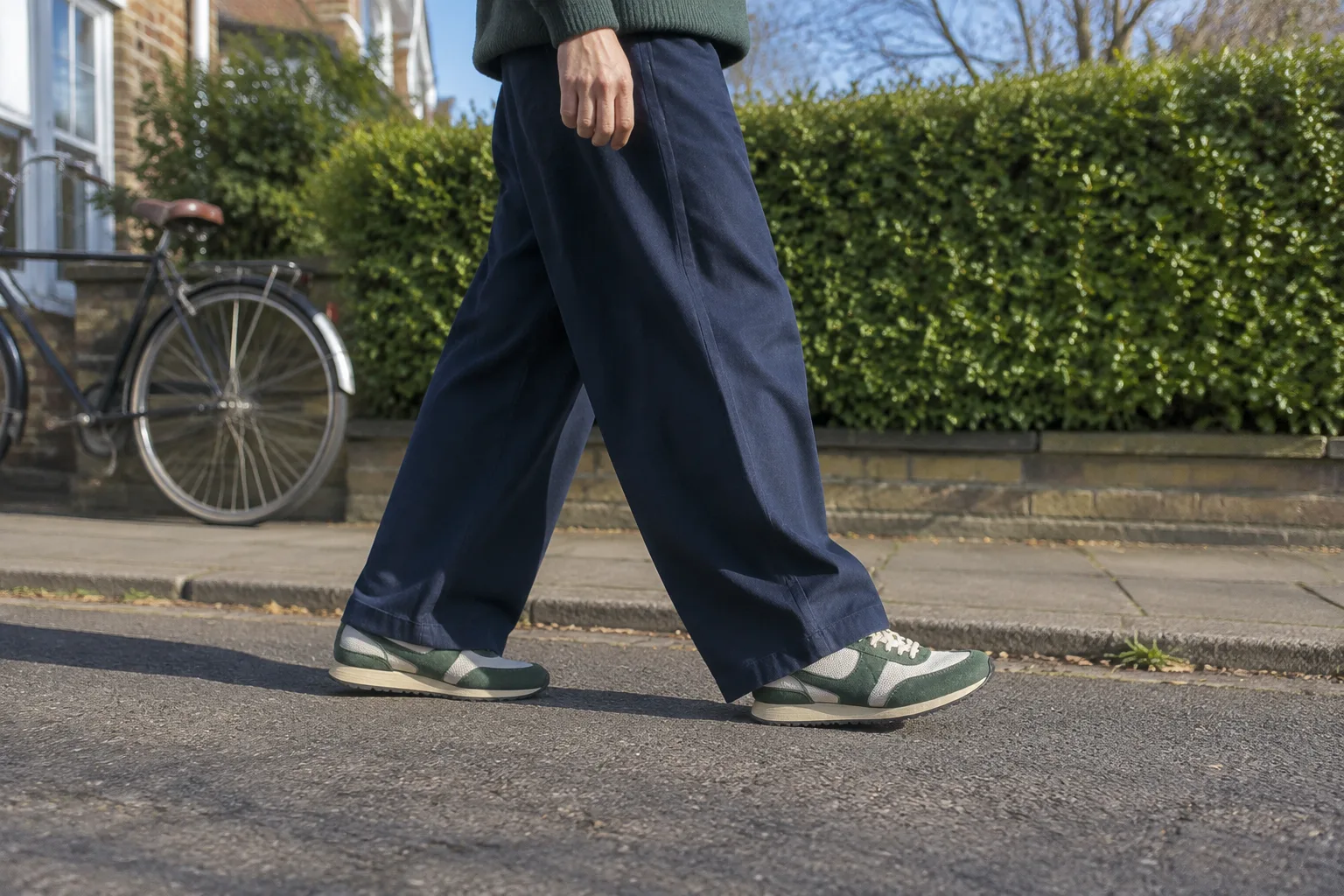
Low-Profile Retro Runners and the Wide Trouser Rule
Somewhere around 2016, a certain kind of shoe stopped being ironic and became correct. The shoe in question is the low-profile retro runner: a flat-soled, slim-toed, mesh-and-suede thing that looks like it was pulled from a 1979 running catalog and dropped on a sidewalk in 2024. Think of the silhouettes that never really left: the Onitsuka Tiger Mexico 66, the Adidas Country, the New Balance 420, the Puma Roma, the Nike Cortez in its quieter colorways. These are shoes with thin midsoles, modest heel drops, and a profile that hugs the ground.
They are also, stubbornly, the best possible partner for wide trousers. That pairing is the whole point of this piece, and it deserves more careful attention than it usually gets.
The pairing works for a reason that has almost nothing to do with fashion and everything to do with proportion. But before getting to the rule, it helps to be honest about what these shoes are and what they are not.
What Counts as a Low-Profile Retro Runner
The category has fuzzy edges, so a working definition helps. A low-profile retro runner is a shoe whose midsole is thin (usually under an inch at the heel), whose toe box is relatively narrow and low, and whose upper is built from mesh, suede, or leather panels in a design language that predates the chunky-shoe era. The midsole is the key measurement. A shoe with a two-inch foam stack is not in this family, no matter how retro the colorway.
This definition excludes a lot of things people mistakenly lump in. The Nike Air Max 90 has retro DNA but a visible air unit that lifts the heel well off the ground. The Adidas Samba and Gazelle are close cousins but technically court and training shoes. The New Balance 990 series is a running shoe with a thick, stabilizing midsole. None of those are wrong to wear. They simply follow different rules.
The shoes that fit the definition share a physical trait: they sit low on the foot and low to the ground. That low stance is the entire reason they work with a wide leg.
The Wide Trouser Problem
A wide trouser is a volume problem. The fabric falls in a straight or slightly tapered line from hip to hem, and the hem opening can run anywhere from nine to twelve inches across. When that much fabric reaches the ankle, whatever shoe sits beneath it either anchors the silhouette or fights it.
Put a chunky sneaker under a wide trouser and the hem has to climb over a bulbous toe and a thick midsole. The fabric bunches. The line breaks. The leg looks like it is resting on a platform rather than finishing at the floor. Put a sleek dress shoe under the same trouser and the opposite problem appears: the hem swallows the shoe entirely, and the outfit reads as formal on top and uncertain at the bottom.
The low-profile retro runner threads between those failures. Its thin sole lets the hem fall close to the ground without stacking. Its narrow toe gives the fabric a clean edge to drape over. And its casual, slightly worn-in character keeps a wide-leg outfit from tipping into costume.
The Hem-to-Sole Ratio
The rule underneath the pairing is simple enough to state: the wider the trouser leg, the lower the shoe profile should be. A generous hem needs a slim foundation. This is a proportion rule, and it holds across fabrics, colors, and budgets.
There is a practical test. Stand in the trousers with the shoes on and look at the side profile in a mirror. The hem should break once, softly, over the top of the shoe, and then fall almost to the sole without folding back on itself. If the fabric piles up in two or three folds above the shoe, the shoe is too tall or the hem is too long. If the hem floats a full inch above the sole with no contact, the trouser is too short for the look. One soft break, hem near the ground: that is the target.
A useful number: a hem opening around nine to ten inches pairs well with most low-profile runners. Push past eleven inches and the shoe starts to disappear, which can be fine if the goal is a deliberate pool of fabric, but it stops reading as a considered pairing and starts reading as an accident of sizing.
Why the Thin Midsole Does the Work
The midsole is where the visual weight of a shoe lives. A thick midsole creates a visual block at the bottom of the leg, and a wide trouser hem sits directly above that block. Two heavy shapes stacked vertically make the whole lower body look bottom-heavy. A thin midsole removes the block, so the eye travels from the trouser hem straight down to the ground with nothing interrupting it.
There is a secondary effect that matters just as much. A low shoe exposes more of the sock and ankle area when the trouser is hemmed to hit just above the shoe. That small gap of visible ankle keeps a wide-leg outfit from looking like a column of fabric with no landmarks. It gives the eye a place to rest between the trouser and the floor.
Color Choices That Keep the Line Clean
The silhouette matters most, but color does real work too. A shoe that matches or closely echoes the trouser color creates an unbroken vertical line from waist to floor, which flatters a wide leg by making the whole leg read as one long shape. A cream trouser with a cream or off-white runner is the most reliable version of this. Charcoal with charcoal, navy with navy, black with black: all forgiving.
A contrasting shoe is a bolder choice and needs a reason. A white runner under a dark trouser draws attention straight to the ankle, which can look sharp or can look like a mistake depending on the hem length. A colored runner (a red suede toe, a green side stripe) gives the outfit a focal point at the bottom, and that only works if the rest of the outfit is quiet enough to let it be the loudest thing in the frame.
The safe move, if the goal is a clean line, is tonal. The interesting move, if the goal is personality, is one deliberate contrast and nothing else competing with it.
Fabric Weight Changes the Calculation
A heavy wool trouser and a lightweight cotton-linen trouser do not behave the same way over a shoe. Heavy fabric holds its shape and falls in a straighter line, which means it can handle a slightly taller shoe profile without collapsing. Light fabric drapes and moves, so it needs a lower shoe to keep the hem from catching and bunching.
In practice: a winter-weight wide trouser can tolerate a retro runner with a slightly thicker sole, maybe a centimeter more stack at the heel. A summer-weight wide trouser wants the thinnest sole in the collection. Getting this wrong is one of the most common reasons a wide-leg outfit looks off in warm weather: the trouser is light and the shoe is too substantial, and the hem keeps snagging on the heel collar.
Sock Visibility and the Ankle Gap
The low-profile runner exposes the ankle in a way a chunky shoe never does, and that changes what goes on the foot. A visible sock becomes part of the outfit. A plain white cotton crew sock, pushed down slightly, reads as casual and intentional. A no-show sock keeps the ankle bare and the line cleanest. A patterned or colored sock is a small flourish that works best when everything else is restrained.
The mistake is a thick, high sock pulled up under a wide trouser hem. It fills the ankle gap with bulk, which defeats the whole purpose of choosing a low shoe. The shoe was picked to keep the bottom of the leg light. A heavy sock puts the weight right back.
Where the Pairing Breaks Down
Not every wide trouser belongs over a retro runner. A wide, sharply creased wool trouser cut for a suit is formal in its line, and a mesh-and-suede runner under it creates a mismatch of register that no amount of styling fixes. The same goes for a wide trouser with a strong taper at the ankle: the narrow hem opening was designed to sit cleanly on a dress shoe or a boot, and a flat runner leaves the hem hovering with nothing to rest on.
The pairing also fails when the trouser is too long. A wide leg that pools on the floor over a low shoe drags the hem across the heel and grinds it down within a season. Low-profile runners have thin soles and exposed heel counters, and a hem that scrapes the ground will wear through both. The fix is a hem that stops just short of the floor, not a different shoe.
A Note on the Shoes Themselves
There is a practical argument for this category that has nothing to do with how it looks. These shoes are usually cheap, usually comfortable for a full day of walking, and usually available in enough colorways that finding a tonal match is easy. They are also, in most cases, not the shoes anyone is trying to protect. A person can wear them through rain, commute in them, and let the suede get scuffed without much grief.
That durability of spirit is part of why the pairing feels right. A wide trouser is a relaxed garment. A shoe that is too precious under it creates tension. A shoe that expects to get dirty matches the mood.
The rule, reduced to its bones: the wider the leg, the lower the shoe, and the closer the hem sits to the ground without touching it. Everything else is color and taste. The proportion is the part that has to be right, and the retro runner is the shoe that makes it easy.