

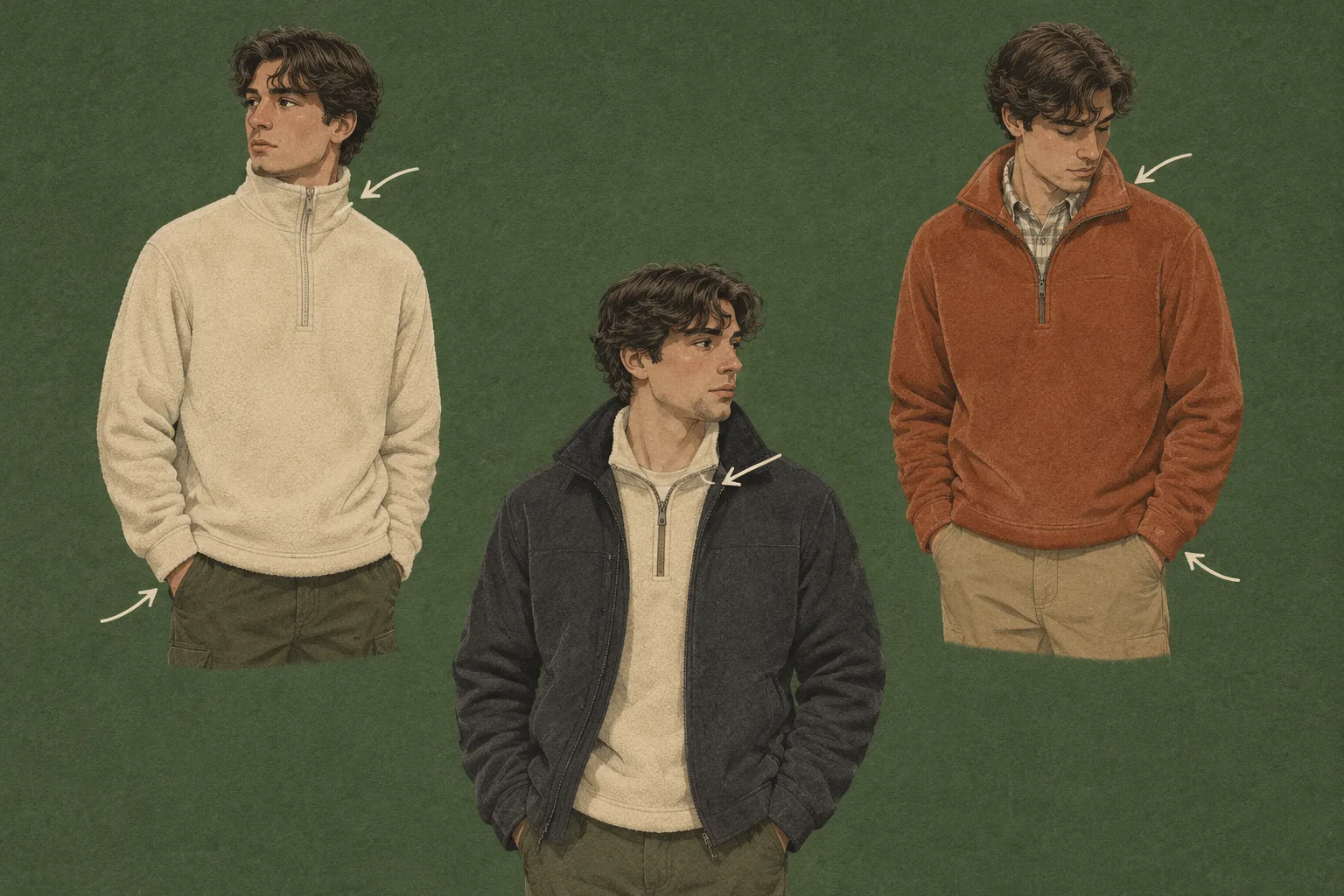
One Quarter Zip, Three Sharp Reads
The quarter zip sits in a strange category of garment: too structured to be a sweatshirt, too casual to be a jacket, and somehow expected to do both jobs at once. It has a collar that stands up but does not close, a zipper that runs a third of the way down the chest, and a hem that usually stops right at the waistband. Most versions are made of cotton fleece or a synthetic blend, and most of them are bought without much thought. That is the problem. The quarter zip rewards thought more than almost any other layer in a closet, because it is the piece most likely to be worn three or four times a week and the piece most likely to look wrong in ways the wearer cannot quite name.
Three things separate a quarter zip that earns its hanger space from one that gets shoved to the back of the drawer. The first is the collar. The second is the zipper pull and where it lands when open. The third is the fabric weight relative to the season it will actually be worn in. None of these are complicated. All of them are routinely ignored.
The Collar Has to Stand Without Help
A quarter zip lives or dies by its collar. When the zipper is pulled all the way up, the collar should hold its shape against the neck without folding over or collapsing forward. When the zipper is down, the collar should still stand, framing the throat rather than flopping against the chest like a spent sail.
This is a structural question, and it comes down to interlining. A good collar has a fusible or sew-in stiffener between the outer fabric and the lining. A cheap one has nothing, or has a stiffener so thin it gives up after a handful of washes. The difference is visible in the store: pinch the collar between thumb and forefinger. If it folds in half with no resistance, it will look tired within a month. If it holds a curve, it has a chance.
There is a second collar issue that gets less attention: height. A collar that stands two inches tall looks deliberate. A collar that stands three and a half inches tall looks like a turtleneck that gave up. The sweet spot sits somewhere between two and two and three-quarter inches for most builds, and it should taper slightly toward the front so the points do not dig into the jaw when the zipper is fully up.
Watch what happens at the gym or the coffee shop. The quarter zips that look sharp on the person wearing them almost always have a collar with visible structure. The ones that look like pajamas have collars that have already surrendered. That is not a coincidence, and it is not about body type or color. It is about whether the maker spent an extra dollar on interlining.
Where the Zipper Stops Matters More Than the Zipper Itself
The zipper pull is a small piece of hardware with an outsized effect on how the garment reads. A cheap pull, the kind stamped from thin metal with sharp edges, catches light in a way that looks unfinished. A good pull has some heft and a rounded edge. This is a two-second check in the store and a daily irritation if gotten wrong.
The more important question is where the zipper stops when it is open. A quarter zip that opens to mid-chest creates a V of exposed shirt underneath, which is a useful frame for a collared shirt or a plain tee. A quarter zip that opens only to the base of the throat does almost nothing when unzipped, and the wearer ends up leaving it closed all day, which defeats the purpose of the zipper entirely.
Roughly eight to ten inches of zipper is the useful range for most adults. Shorter than that and the piece might as well be a pullover. Longer and it becomes a different garment, closer to a half zip or a light jacket, with a different set of rules. The quarter zip's particular charm is that it can be worn three ways: fully closed for warmth, half open for ventilation, and fully open as a light outer layer over a shirt. A zipper that stops too high removes the third option.
There is also the question of the zipper garage, the small pocket of fabric at the top of the zipper channel that the pull tucks into when closed. A garage that is too shallow lets the pull rattle against the throat. One that is too deep swallows the pull and makes it hard to grab. The best ones are just deep enough to cover the pull and no more, and they are lined so the metal does not touch skin.
Fabric Weight Decides the Season, and Most Buyers Get It Wrong
Quarter zips come in three rough fabric weights, and the labels rarely make the distinction clear. The lightest is a thin cotton or cotton-poly blend, often around seven to eight ounces per square yard, which drapes close to the body and works as a summer evening layer or a gym cover-up. The middle weight sits around ten to twelve ounces, substantial enough to hold shape but light enough to wear indoors. The heaviest is a brushed fleece or a heavy knit, thirteen ounces and up, which behaves more like a light jacket.
The mistake most buyers make is grabbing the heaviest version because it feels like more garment for the money. It is not. A heavy quarter zip worn indoors becomes a sauna by mid-morning, and the wearer ends up pushing the sleeves up and unzipping it all the way, which looks exactly as awkward as it sounds. A mid-weight version worn over a shirt does the same job with more flexibility.
Climate matters here, and so does the wearer's own internal thermostat. Someone who runs warm will get more use out of the light version than the heavy one, even in winter, because the quarter zip is almost always worn indoors or in transitional weather. Someone who runs cold will want the mid-weight and will leave the heavy version for actual outdoor wear, at which point a proper jacket does the job better.
There is a texture question folded into the weight question. Brushed fleece pills. Smooth cotton interlock does not. French terry, the looped-back fabric used in higher-end sweatshirts, sits in between: it holds up well but shows wear at the cuffs and elbows over time. None of these are dealbreakers, but they determine how the piece will look after a year of regular wear, and a year is the realistic horizon for a garment worn this often.
The Fit Problem Nobody Talks About: Shoulders and Hem
Quarter zips are cut two ways: athletic and relaxed. Athletic cuts taper through the waist and sit close to the shoulder. Relaxed cuts drop the shoulder seam and run straight down. Both are legitimate, but the fit has to match how the piece will be worn. An athletic cut worn over a button-down shirt will pull at the chest and ride up at the hem. A relaxed cut worn over a t-shirt will bunch at the waist and look sloppy.
The shoulder seam is the tell. On a well-fitting quarter zip, the seam sits at the edge of the shoulder bone, not hanging off the arm and not creeping toward the neck. Dropped shoulders are a style choice, and they work on relaxed cuts, but they make the piece look borrowed if the rest of the fit is close.
The hem is the other tell. A quarter zip hem should hit at or just below the waistband of trousers, not at the hip and not floating above the navel. Too short and the piece rides up every time the wearer reaches for something. Too long and it looks like a tunic. The ribbed band at the hem should have some recovery, meaning it snaps back after stretching, because a hem that has gone slack will hang lower on one side within a few months.
Cuffs deserve a mention too. Ribbed cuffs that are too tight leave marks on the wrist. Cuffs that are too loose slide down over the hand. The right cuff sits snug without pressure and stays put when the sleeve is pushed up to the forearm, which is how most people end up wearing a quarter zip by mid-afternoon anyway.
Color and the Question of the Third Piece
Most quarter zips are bought in navy, gray, or black, and there is nothing wrong with that. These colors work with everything and hide wear. The problem is that a closet full of navy quarter zips produces a uniform, and the piece stops doing any work.
A quarter zip in a color that sits one step off the basics, a deep olive, a faded brick, a muted mustard, gives the rest of the outfit something to push against. It also makes the piece easier to wear as a standalone layer rather than a default. The rule of thumb is simple: if the color would look at home on a hiking trail or in a fall catalog, it will probably work. If it looks like it belongs on a team uniform, it will probably sit in the drawer.
Pattern is a harder sell. A subtle texture, a marled yarn, a faint stripe, can add interest without turning the piece into a statement. A bold print or a large logo turns the quarter zip into a billboard, and billboards do not layer well. The point of this garment is that it disappears into the outfit and makes everything around it look more considered. A loud quarter zip does the opposite.
Care Instructions That Actually Extend the Life
Most quarter zips are washed too often and dried too hot. The fabric does not need a wash after every wear, especially the mid-weight and heavy versions, which are usually worn over a shirt and pick up very little. Airing the piece overnight and spot-cleaning the collar and cuffs will keep it fresh for several wears between washes.
When it does get washed, cold water and a low spin cycle protect the interlining in the collar and the ribbing at the cuffs and hem. Heat is the enemy: a hot dryer will shrink the cotton, degrade the elastic in the ribbing, and cause the zipper tape to pucker. Laying the piece flat to dry takes longer but adds months to its life. Hanging it wet stretches the shoulders, which is the one place a quarter zip cannot afford to lose shape.
The zipper needs its own attention. Zipping it closed before washing keeps the teeth from snagging other garments and keeps the pull from scratching the inside of the drum. A small bar of wax or a pencil rubbed along the teeth every few months keeps the zipper running smoothly, which matters more than it sounds like it should, because a sticky zipper on a quarter zip is the fastest way to stop wearing it.
The collar, finally, benefits from being shaped by hand while damp and left to dry standing up. This is a thirty-second habit that keeps the interlining from folding along the same crease every time, which is what causes a collar to develop a permanent slump. A quarter zip with a collar that still stands after two years of wear is a rare and useful thing, and it almost always belongs to someone who took the thirty seconds.
The One in the Drawer That Gets Worn Every Week
Every closet has a quarter zip that gets reached for without thinking. It is rarely the most expensive one and almost never the loudest. It has a collar that stands on its own, a zipper that opens to a useful depth, and a fabric weight that matches the weather the wearer actually lives in. The seams sit where they should, the hem stays put, and the color works with everything else in the drawer.
That piece exists because someone, at some point, checked three things before buying it. The collar, the zipper, the weight. The rest is maintenance, and maintenance is mostly a matter of not putting it in the dryer. The quarter zip is not a complicated garment. It is just easy to buy badly, and the difference between the one that gets worn every week and the one that gets donated after a season comes down to a handful of details that take less than five minutes to check in the store.