

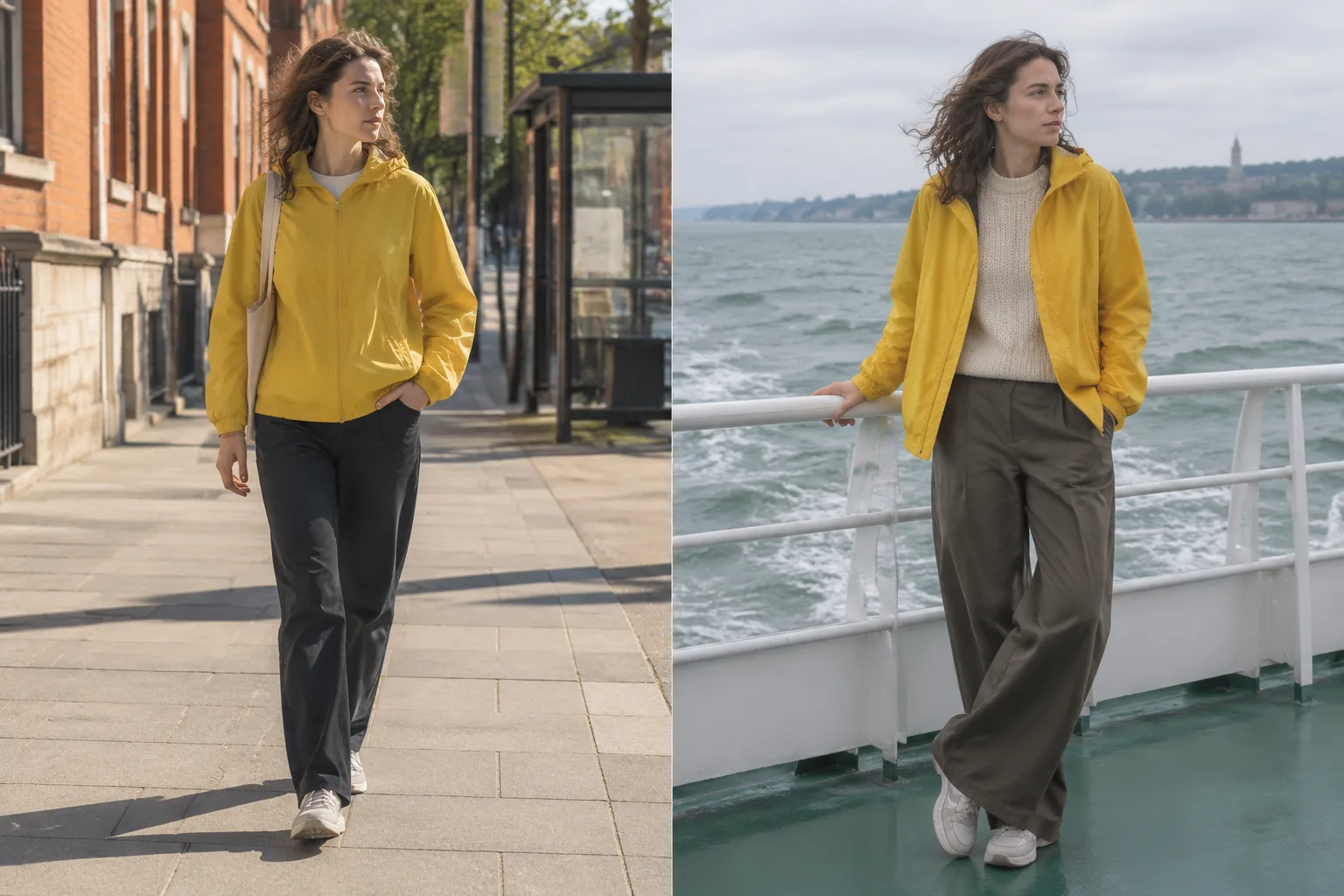
One Windbreaker, Many Outfits: A Choosing Guide
A windbreaker is the most underestimated piece of clothing in the average closet. It weighs almost nothing, folds into a pouch the size of a paperback, and yet it can carry an entire outfit through a cold morning, a windy ferry ride, a sudden shower, and an over-air-conditioned train carriage. Most people own one and wear it with exactly one pair of trousers, which is a waste of a garment that has more range than almost anything else hanging in the hall.
The problem is that windbreakers get bought as emergency gear. They are stuffed in a bag until the sky turns, then thrown over whatever is underneath, and the result often looks like a raincoat worn indoors: functional, slightly apologetic, a little bit camping. The fix is not a more expensive jacket. It is choosing the right one for the clothing it will actually be worn with, and then learning a handful of combinations that work reliably.
This is a guide to that choice. Not a ranking of brands, and not a treatise on technical membranes. A windbreaker, for these purposes, is a light unlined or lightly lined shell with a hood or collar, a front zip, and some resistance to wind and drizzle. The goal is to pick one that earns its place across many outfits rather than one that only makes sense on a hiking trail.
The shell has to match the silhouette underneath
The single most common windbreaker mistake is a mismatch of volume. A boxy, stiff shell worn over a slim merino sweater and tailored trousers reads as a borrowed garment. A trim, short-shell worn over a chunky knit and wide-leg trousers looks pinched and undersized. The shell does not need to match the outfit exactly, but it has to belong to the same family of shape.
For outfits built on close-fitting layers (fine knits, crisp shirts, straight-leg trousers, slim jeans), look for a trim windbreaker with a shorter body that ends at the hip bone and sleeves that finish at the wrist without pooling. For outfits with more volume (heavy sweatshirts, wide trousers, layered tees), a slightly longer, roomier shell sits better, because it echoes the looseness rather than fighting it.
Length matters more than most buyers expect. A shell that ends mid-thigh over slim trousers can look elegant, almost like a light car coat. The same shell over wide trousers can look like a tent. A cropped shell over wide trousers looks deliberate. A cropped shell over slim trousers can look like a shrunken jacket. The rule is simple even if it takes a moment to internalize: the hem of the windbreaker should sit at a different visual level from the widest part of the trousers.
Color decides how many outfits it can join
A windbreaker in a bright primary color is a statement piece, and it will work with maybe four outfits before the eye starts to notice the repetition. A windbreaker in a muted, mid-tone color works with nearly everything. The useful palette is narrower than the fashion press suggests: olive drab, navy, charcoal, stone, sand, and a deep forest green. Black is fine but shows every fleck of lint and reads a little formal for a garment that is essentially a plastic bag with sleeves.
There is a case for a single loud shell, provided it is treated as outerwear with a personality rather than as a neutral. A tomato-red or mustard-yellow windbreaker over an all-grey outfit is a genuinely good look, and the color does the work. The mistake is buying the bright shell as the only shell and then discovering it clashes with half the wardrobe.
For a first or only windbreaker, the muted mid-tone is the choice that will be worn most often. For a second, the loud one can join the rotation. The muted shell disappears into an outfit; the bright one leads it. Both are useful, but they play different roles, and buying the loud one first tends to lead to a jacket that sits unworn for most of the year.
Fabric weight separates a shell from a coat
Windbreakers range from tissue-thin ripstop that packs into a fist to heavier bonded shells with a fleece backer. The lighter the fabric, the more it behaves like a layer and the less it behaves like a coat. A very light shell can be worn over a t-shirt in summer and over a sweater in autumn, and it drapes rather than stands away from the body. A heavier shell provides warmth and structure, but it also limits the outfits it can join, because it adds bulk that has to be accounted for.
For maximum outfit range, the sweet spot is a light-to-mid-weight shell with a slight drape. It should fold small enough to live in a bag, hang cleanly over a knit, and not rustle like a crisp packet every time an arm moves. The rustle is worth paying attention to during a try-on: a very crinkly fabric announces itself in quiet rooms and reads as sportswear even when the rest of the outfit is not.
Heavier shells have their place, particularly in cold, wet cities where the windbreaker functions as a winter coat over a mid-layer. But they are a different garment in practice, and they should be bought with a specific cold-weather outfit in mind rather than as an all-purpose shell.
Hood or collar changes the neckline of everything
A hood is the most practical feature on a windbreaker and the most disruptive to an outfit. A hood bunched at the back of the neck adds bulk, hides the collar of a shirt, and makes the shoulders look rounder. A stand collar without a hood keeps the neckline clean and lets a shirt collar, a scarf, or a crew neck sit properly underneath. Neither is better in the abstract; they serve different outfits.
For outfits with a visible collar (an oxford shirt, a polo, a turtleneck), a hoodless shell or a shell with a hood that stows flat is the better partner. For casual outfits built on t-shirts and sweatshirts, a hood is fine and often improves the look by adding a bit of texture at the neck. A hood also reads younger and more casual, which can pull a slightly formal outfit in the wrong direction.
Pockets, cuffs, and drawcords are where outfits get ruined
Small hardware decisions have an outsized effect on how a windbreaker reads. A jacket with four zip pockets, contrast zipper pulls, and a cinched elastic hem looks technical, which is fine over hiking trousers and wrong over wool. A jacket with two clean hand pockets, a simple front zip, and a plain hem reads as a light coat and can go almost anywhere.
Cuffs matter too. Elasticated cuffs grip the wrist and look sporty; they also prevent sleeves from sitting cleanly over a knit. A simple snap or a plain hem lets the sleeve fall naturally. Drawcords at the hem and hood are useful in wind but tend to dangle and catch, and on a jacket worn over tailoring they look out of place. For a shell meant to cross categories, fewer visible features is almost always better.
Four outfits that a single shell can carry
The test of a windbreaker is not how it looks on a hanger but how many complete outfits it can finish. A muted olive shell in a light ripstop, hip length, hoodless, with two pockets, can plausibly finish all of the following without looking out of place in any of them.
First, over a fine-gauge navy crew neck and grey wool trousers, with leather derbies. The shell reads as a light car coat and the outfit works for a cool-weather commute. Second, over a white t-shirt, straight blue jeans, and canvas sneakers, with the shell open. This is the default casual look and the shell disappears into it. Third, over a chunky oatmeal sweater and wide-leg cotton trousers, with the shell zipped to the chest. The volume of the sweater and the looseness of the trousers need a shell long enough to cover the hip, and the muted color keeps the outfit calm. Fourth, over a striped long-sleeve tee and black tapered trousers, with the shell worn open and the sleeves pushed to the forearm. The shell adds a layer without adding bulk.
The common thread is that the shell is doing the same job in each case: blocking wind, adding a light layer, and finishing the silhouette at the hip. It is not the star of any of these outfits, and that is precisely why it works across all of them.
When a second shell is genuinely worth buying
One windbreaker covers most of the year for most people, but there is a real case for a second, and it is not a color variation. The second shell should differ in weight or in form. A light packable shell for warm-weather travel and a heavier bonded shell for cold, wet winters are two different tools, and owning both means the windbreaker category covers the full year rather than half of it.
Alternatively, the second shell can differ in length. A hip-length shell and a longer, mid-thigh shell serve different outfits, and the longer one can stand in for a light coat over tailoring in a way the short one cannot. What the second shell should not be is a near-duplicate in a different color, because that jacket will sit in the closet while the first one gets worn.
The try-on that settles the decision
Before buying, wear the shell over the heaviest outfit it is likely to cover, not over a t-shirt in a fitting room. Zip it up, sit down, reach forward, and check whether the hem rides up and whether the shoulders pull. Then wear it open over the lightest outfit it will cover and check whether it looks like a borrowed coat. A shell that passes both tests, in a muted color, with clean hardware and a length that sits at the hip, will earn its place across more outfits than any other jacket in the closet. The rest is repetition, and repetition is what a good windbreaker is for.