

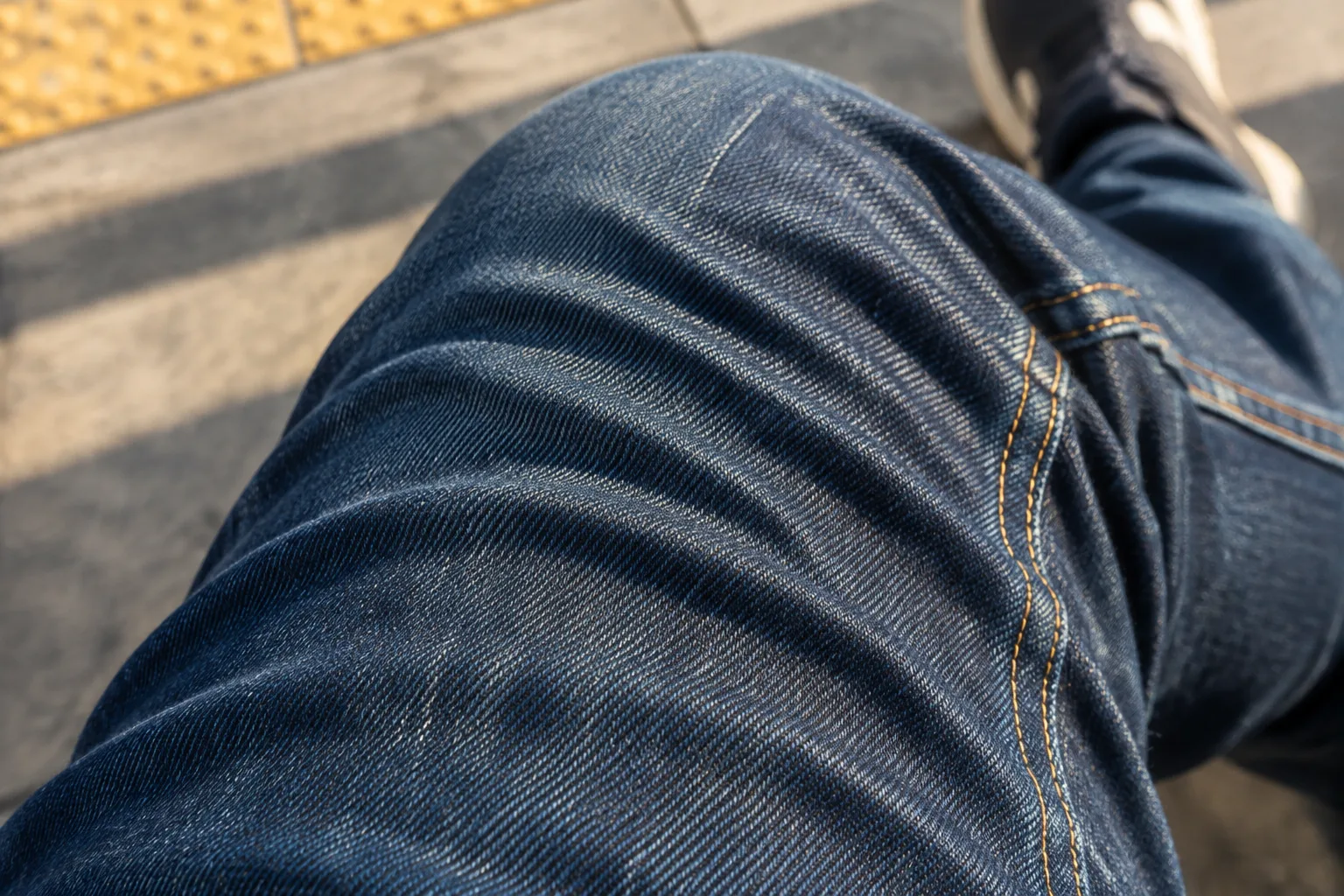
Performance Meets Pavement: Fabrics That Work Twice as Hard
Denim was never designed to breathe. The original Levi's cloth, the kind that outfitted miners and railroad crews, weighed in around 14 ounces per square yard and behaved like a windbreak that happened to fit a human body. It kept cold out and abrasion at bay. Moisture management was not on the spec sheet. A century and a half later, most of the denim sold still inherits that logic: dense, stiff, and honest about the fact that it is a wall between the wearer and the weather.
Yet denim is also the fabric people commute in, cycle in, climb stairs in, and stand on concrete platforms in for forty minutes at a stretch. The garment has stayed roughly the same. The use case has changed underneath it. That gap is where the most interesting textile work of the past decade has happened, and it explains why a pair of jeans can now cost three figures and still feel like they were engineered for a job the wearer never signed up for.
The fabric category that has absorbed the most pressure is stretch denim, and the way it performs on pavement is worth understanding rather than dismissing.
What Elastane Actually Does to a Cotton Twill
A conventional twill is a mechanical structure. Cotton yarns cross at a diagonal, and the fabric's give comes from the weave geometry, which is why broken-in jeans loosen at the knee and seat but never truly bounce back. Add 1 to 3 percent elastane, a synthetic polyurethane fiber, and the cloth gains memory. It stretches on movement and recovers when the body stops.
The tradeoff is real. Elastane weakens under heat, and a household dryer is the most reliable way to destroy it. A pair of stretch jeans tumble-dried on high two or three times a week will start to bag at the knees within a season, and no amount of washing brings the recovery back. Line drying is not a gentle suggestion in this category. It is the maintenance schedule.
Fabric mills have spent the last several years trying to solve the recovery problem without leaning entirely on elastane. Dual-core yarns, where a cotton sheath wraps both an elastane core and a rigid filament, hold shape better and resist the sag that single-core stretch is prone to. The feel is slightly firmer on the first wear and noticeably more stable by month six.
The Rise of the Commute-Proof Trouser
Meanwhile, a parallel category has grown up around trousers that look tailored and behave like athletic wear. These are usually built from a polyester-elastane blend with a brushed interior, sometimes with a mechanical stretch woven in rather than added as a fiber. The pitch is four-way stretch, wrinkle resistance, and a drape that reads as business casual from across the room.
On pavement, the performance is genuine. A four-way stretch trouser handles a bicycle commute, a stairwell, and a full day of sitting without the knee-bagging that ruins a cotton chino. The fabric also dries quickly, which matters more than most people admit on a humid morning.
The catch sits in the hand-feel. Polyester has a faint slickness that shows up under office lighting, and after a dozen washes the brushed interior can pill at the thigh. A person who spends the money on this category should expect a two-year garment, not a ten-year one. The economics only work if the trouser replaces something the wearer would otherwise ruin faster.
Selvedge Denim's Case for the Long Haul
At the other end of the market, raw selvedge denim has quietly become the anti-performance choice, and its argument is worth taking seriously. Selvedge refers to the finished edge of the cloth, woven on shuttle looms that produce a narrow bolt with a clean self-finished border. The fabric is dense, unsanforized in many cases, and starts stiff enough to stand on its own.
What it lacks in immediate comfort it makes up for in durability and form. Raw denim molds to the body over months of wear, creasing at the hip and knee in patterns specific to the person wearing it. The indigo fades along those creases. After a year of daily wear, the garment is a record of how its owner moves.
None of that is performance in the technical sense. It is performance in the older sense, the way a leather boot or a canvas bag performs: by absorbing use and improving because of it. A pair of 14-ounce raw jeans will outlast three pairs of stretch denim. The wearer pays for that longevity in the first six weeks, when the fabric is unforgiving and the waistband leaves a mark.
Where the Two Philosophies Collide
The most interesting fabrics now sit between these poles. Mills have developed stretch selvedge, which pairs the shuttle-loom edge with a small percentage of elastane, and the result is a jean that fades like raw denim but does not fight the wearer for the first month. A handful of Japanese and American mills produce it, and it has become a favorite of people who want the patina without the penance.
The compromise is not free. Stretch selvedge fades slightly less sharply than pure cotton, because the elastane disrupts the indigo uptake in the yarn. The whiskers at the lap are softer, the honeycombs behind the knee less pronounced. A purist will notice. Most wearers will not, and they get a garment that works on a bike and still looks like denim at the end of the ride.
This is the category where the "works twice as hard" claim is most defensible. The fabric does the job of a technical trouser during the commute and the job of a heritage jean on the weekend, and it does both without announcing which one it is doing.
The Care Regimen Nobody Talks About
Fabric performance collapses at the laundry stage more often than at the mill. A few habits separate a garment that lasts five years from one that lasts eighteen months, and none of them require special products.
Wash denim inside out, in cold water, on a short cycle, with a mild detergent and no fabric softener. Softener coats the fibers and reduces the abrasion resistance that makes denim worth wearing. Skip the dryer entirely for anything with elastane; hang the garment to dry in shade, because direct sun fades indigo unevenly.
Raw denim follows a different schedule. Many wearers go six months before the first wash, which lets the creases set and the fades develop. After that, cold soaks with a gentle detergent, no agitation, and air drying preserve the indigo and the shape. The fabric will shrink slightly on the first soak, which is why unsanforized pairs are usually bought one size up.
Washing less is the single highest-leverage decision. Every cycle removes a little indigo and a little fiber. A pair of jeans worn five days a week can go two to three weeks between washes if aired out overnight and spot-cleaned at the cuff and pocket. The nose is a better guide than the calendar.
The Price of Getting It Wrong
The failure mode in this category is not a garment that falls apart. It is a garment that never quite worked and gets worn anyway, because it cost enough to feel obligated. A stretch trouser that pills at the thigh after a season, a raw jean that was bought too tight and never broke in, a technical fabric that reads as gym wear in a meeting: each of these is a small ongoing tax on the wearer's attention.
The way out is to match the fabric to the actual week. Someone who cycles twelve miles a day and sits at a desk should own four-way stretch trousers and accept the two-year lifespan. Someone who drives, walks a few blocks, and wants a garment that ages with them should buy raw denim and commit to the break-in. Someone who does both should look for stretch selvedge and pay the premium.
There is no single fabric that works twice as hard for everyone. There is a fabric that works twice as hard for a specific week, and the honest work is figuring out which week is being dressed for.
The Cuff, the Hem, and the Pavement
One detail gets overlooked in every conversation about denim performance: the hem. A raw or selvedge jean that drags on pavement will fray within weeks, and the damage climbs up the leg faster than most people expect. A proper hem, taken to the top of the shoe with a slight break, is the cheapest performance upgrade available.
The cuff matters too. A single fold of selvedge denim adds weight to the bottom of the leg and reduces the drag that grinds the hem against concrete. It also shows the self-finished edge, which is the whole point of the cloth. A double cuff on a stiff raw jean will stand away from the ankle and look deliberate in a way that reads as costume; a single roll sits flat and earns its keep.
Watch the pavement at the end of a long day. The hem is where the fabric tells the truth about whether it was built for the commute or only styled for it. A jean that still has its edge after a year of city walking was made by someone who understood that performance starts at the ground and works upward.