

Quarter Zip or Hoodie? A Layering Decision Worth Thinking Through
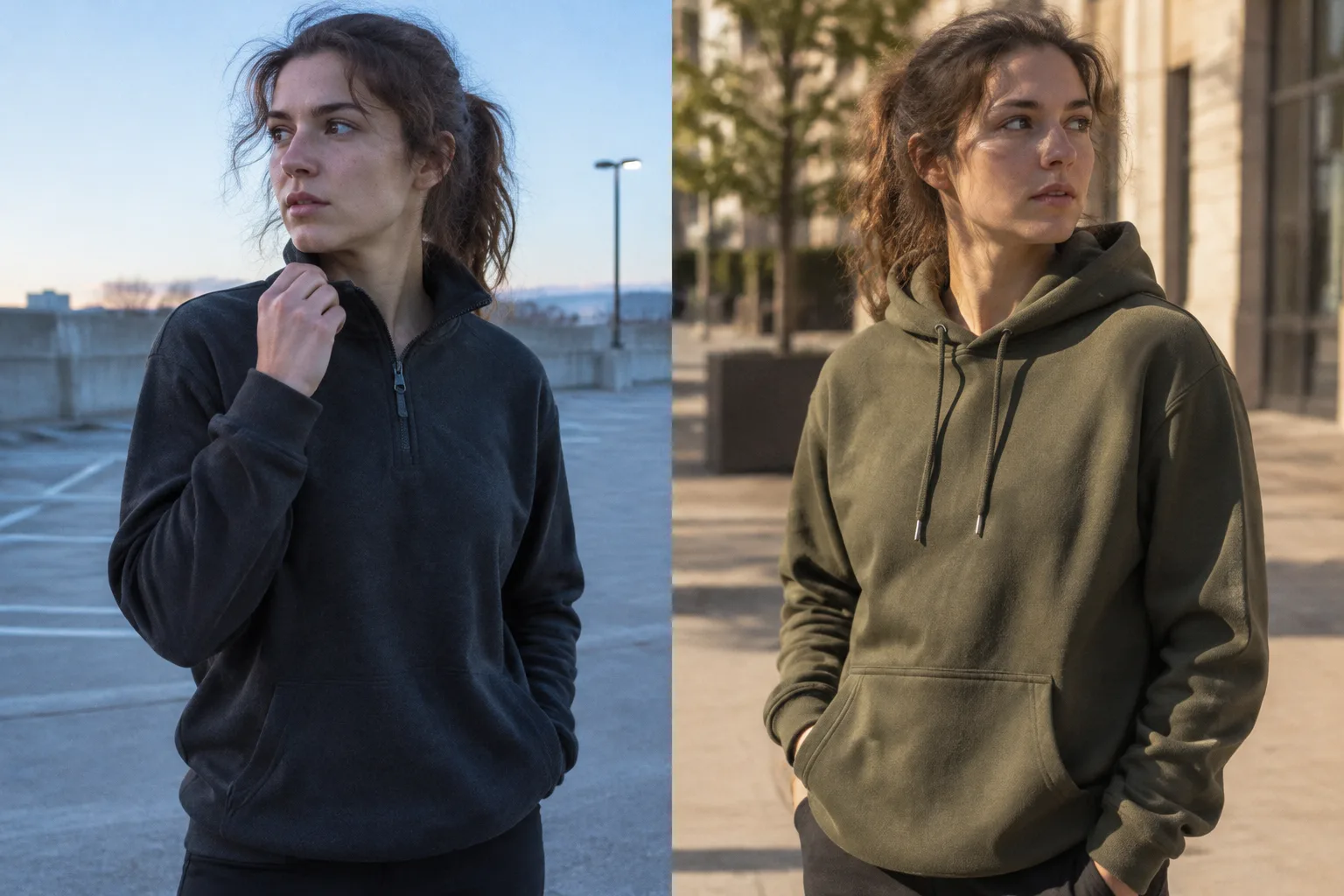
Two garments hang in the same closet for the same reason and solve entirely different problems. A quarter zip and a hoodie both promise warmth with a little extra coverage at the neck, and both get marketed as the obvious casual layer. The similarities end at the zipper pull. One is a piece of engineering with a specific job, and the other is a piece of clothing with a specific attitude. Choosing between them is less about style preference and more about understanding what each one actually does when the temperature drops and the day refuses to cooperate.
The quarter zip exists to be adjusted. That sounds trivial until a person spends a morning walking from a cold parking lot into a warm office and back out again for lunch. The zipper runs from the collar to the sternum, and that short track of metal teeth gives the wearer a thermostat that a hoodie simply does not have. Crack the zip at the bottom of the stairs, close it on the walk back to the car. The garment responds to the body's shifting temperature without being removed. A hoodie has no such mechanism. Its neckline is fixed, and the only way to cool down is to push the sleeves up or take the whole thing off.
The hoodie, meanwhile, exists to be pulled on and forgotten. There is no adjustment because there is no need for one. The fabric is typically heavier, the fit looser, the hood a small private room for the back of the head. It is the layer a person reaches for on a Saturday when the plan is a couch, a coffee, and absolutely nothing else. The quarter zip is the layer a person reaches for on a Tuesday when the plan involves three meetings and a train.
What the Zipper Actually Buys
That short zipper is the whole argument. A quarter zip, worn over a t-shirt, lets the collar sit flat against the chest or stand up against the wind, and the difference between those two positions is roughly the difference between a comfortable commute and a miserable one. Watch a person in a quarter zip on a chilly morning: the hand goes to the zipper before it goes anywhere else. The gesture is automatic, a small calibration.
The zipper also changes how the garment reads across the chest. A closed quarter zip pulls the fabric into a clean line from collar to sternum, which is why the style has migrated from athletic wear into offices that would never tolerate a hoodie. Open it an inch and the collar falls into a soft V, framing a collared shirt underneath. There is a reason quarter zips have become standard issue in finance, tech, and the kind of workplaces that want to look relaxed without actually being relaxed. The zipper is doing the work of a necktie's knot, suggesting structure without demanding it.
The Hoodie's Unfair Advantages
No zipper can compete with a hood on a genuinely cold day. The hood blocks wind from the back of the neck, which is where cold air does its most efficient work. A person standing at a bus stop in February with a quarter zip and no scarf will feel the wind find the gap between collar and skin within seconds. A hoodie wearer pulls the hood up and the problem disappears. For raw weather defense at the neck, the hoodie wins without a contest.
Then there is the pocket. The kangaroo pocket on a hoodie is not decorative. It is a hand warmer, a phone holster, and a place to stash keys during a run, all at once. The quarter zip usually offers two side pockets, sometimes zippered, sometimes not, and they are fine for a wallet but useless for warming hands. On a cold morning when the gloves have been left at home, the difference between the two pocket designs is immediate and physical. Fingers go numb in a quarter zip. They do not in a hoodie.
The hoodie also carries a social signal that no quarter zip can replicate. It reads as leisure, as a day off, as a garment that has not been chosen for anyone else's benefit. There is a reason the hoodie became the uniform of the tech founder and the startup engineer, and it is not just comfort. It says the wearer has enough standing to dress as if the meeting does not require costume. A quarter zip, for all its versatility, never quite escapes the feeling of being a compromise between a sweater and a jacket.
Where the Quarter Zip Fails
The quarter zip's weakness is the same as its strength: it is a middle garment. It is not warm enough alone for real cold, and it is too warm to wear indoors over a heavy shirt in a heated building. The zipper helps, but a person who runs hot will find the quarter zip a fussy companion, constantly adjusted and never quite right. The garment demands attention in a way a hoodie does not. It wants to be managed.
There is also the collar problem. A quarter zip's stand-up collar, when zipped to the top, can bunch under a jacket or push against the chin. Wearers with shorter necks often find the collar rides up and looks awkward, a small fit issue that no amount of styling fixes. The hoodie's hood, when down, lies flat against the back and causes no such trouble. When up, it frames the face and leaves the chin free.
The Fabric Question Nobody Asks
Most quarter zips are made from a fine-gauge knit, often a cotton-poly blend or a merino wool for the pricier versions. The knit is smooth, thin, and drapes cleanly over a shirt. It is designed to look presentable, which means it sacrifices some warmth for a better line. The hoodie is usually made from a heavier fleece, brushed on the inside, with a loft that traps air. The fabric is thicker and softer and warmer per ounce, and it shows its wear: pilling at the cuffs, a faded patch where the pocket rubs, a hood that softens with every wash.
That difference in fabric tells a person which garment will survive a decade and which will look tired in two years. A good merino quarter zip can be worn under a blazer, over a button-down, and to a dinner that requires a reservation. It ages gracefully because the knit is dense and the construction is usually more careful. The hoodie ages like a favorite pair of jeans: it gets better in the first year and then slowly becomes a garment for the house only. Neither trajectory is wrong. They are just different lifespans for different jobs.
Building the Layer Underneath
The garment on top gets the attention, but the layer underneath decides whether either piece works. A quarter zip demands a collared shirt or a clean t-shirt, because the open neckline exposes whatever is beneath it. A sloppy undershirt ruins the line. The hoodie is more forgiving: a plain tee, a flannel, even nothing at all works, because the hood and the kangaroo pocket draw the eye away from the neckline.
This has a practical consequence. The quarter zip is the better choice for a day that starts casual and ends somewhere that requires a little more polish, because the layer beneath can be upgraded without changing the outer garment. The hoodie is the better choice for a day that never changes register, when the plan is fixed and the outfit only needs to be comfortable. A person who owns both and understands the difference will reach for the quarter zip on transition days and the hoodie on stationary ones.
The Weather That Decides for You
Below about 40 degrees Fahrenheit, the hoodie's hood and heavier fleece make it the obvious pick for anything outdoors. Between 40 and 60, the quarter zip's adjustability wins, because the day will warm and cool and the zipper is the only tool that handles both. Above 60, neither garment is necessary, and the choice becomes purely aesthetic. A person who plans to be outside all day in cold weather should reach for the hoodie without hesitation. A person who plans to move between indoors and outdoors all day should reach for the quarter zip.
The wind matters as much as the temperature. A quarter zip under a windproof shell is a superb combination, because the shell handles the weather and the knit handles the warmth. The hoodie under the same shell becomes bulky and the hood bunches at the back of the neck. For anyone who layers under a jacket, the quarter zip is the more cooperative partner. It was designed to be a middle layer, and it behaves like one.
What the Mirror Shows at the End of the Day
A quarter zip, worn well, makes a person look like they thought about the day. The collar sits up, the zipper is set at the right height, the knit drapes cleanly. It is a garment that rewards a little attention and punishes sloppiness. A hoodie, worn well, makes a person look like they did not think about the day at all, and that is the entire point. The hood frames the face, the pocket holds the hands, the fleece softens every line. It is a garment that rewards nothing and punishes nothing. It simply is.
The decision comes down to what the day demands. A quarter zip is the right layer for a day with edges: a commute, a meeting, a dinner, a temperature that moves. A hoodie is the right layer for a day without edges: a couch, a walk, a coffee, a plan that never quite forms. The closet can hold both, and most people who own one eventually buy the other, because the two garments cover the full range of what a casual layer needs to do. The mistake is treating them as interchangeable. They are not. One is a tool with a zipper, and the other is a small room for the head and hands. The person who knows which day they are having will know which one to grab. The person who grabs the wrong one will spend the afternoon adjusting a collar or wishing for a hood, and the garment will never quite let them forget it.