

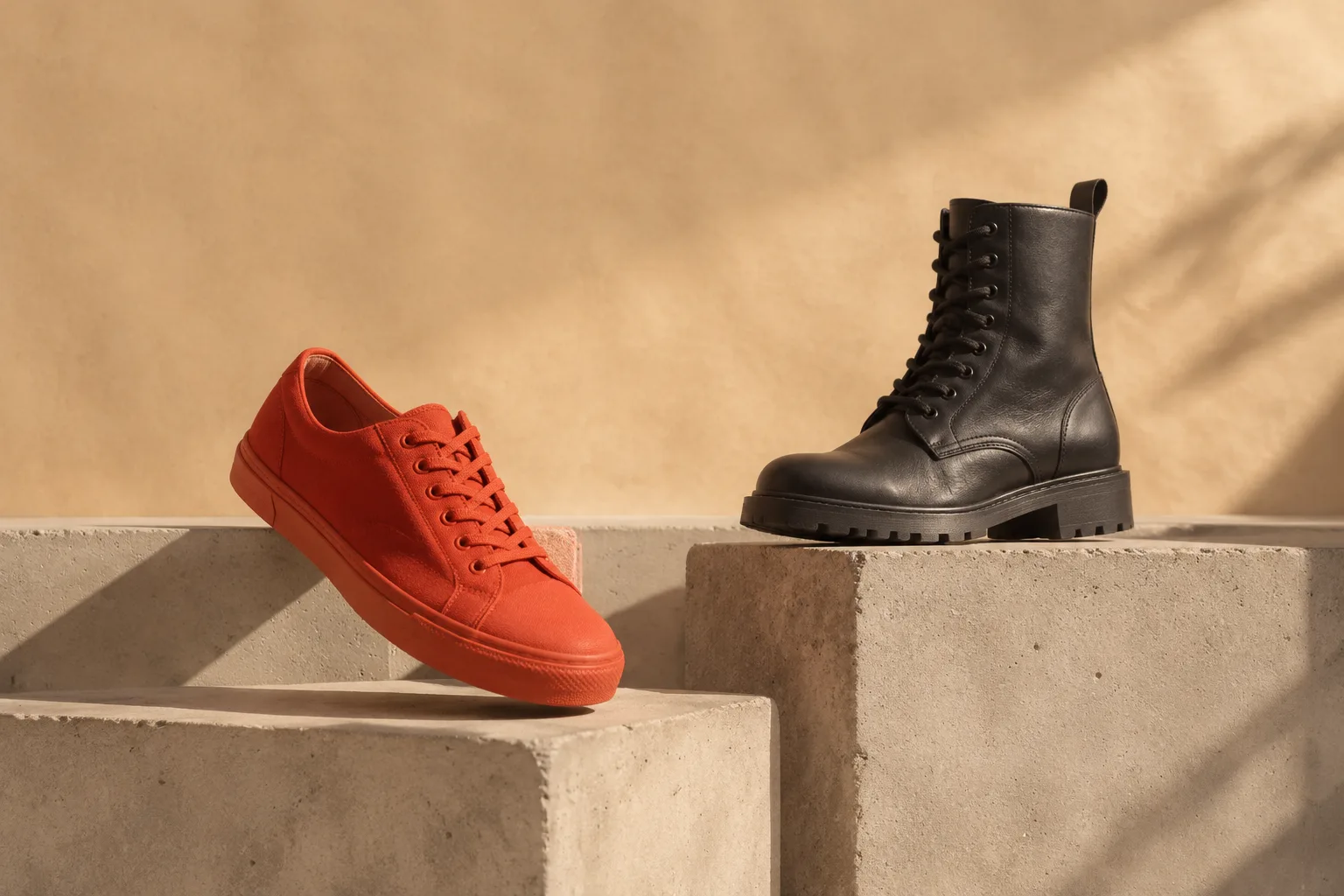
Sneakers or Boots? A Sporty Shoe Decision
The sneaker and the boot have been quietly trading territory for a decade, and the swap shows no sign of settling. What used to be a clear split, athletic shoes for moving fast and boots for standing ground, has blurred into a single silhouette that claims both jobs. The result is a category of footwear that has convinced a large share of the walking public that one pair can handle a morning run, a wet commute, and a dinner reservation without embarrassment.
That claim deserves a hard look. A sporty shoe and a boot are built around opposite physics. One is tuned for forward motion and light weight; the other is tuned for weather, ankle support, and the refusal to be destroyed by a curb. When a shoe tries to do both, something has to give, and the interesting question is what.
The middle of the market has settled on a recognizable recipe: a knit or mesh upper, a chunky molded sole, a collar that climbs just past the ankle bone, and a set of laces that runs high enough to suggest function while mostly serving decoration. Call it the sneaker-boot. It is everywhere, from the trail-inspired brands to the fashion houses that borrowed the look and softened it.
What the midsole actually does under a heavier upper
Start with the part nobody photographs. A running shoe's midsole is a slab of foam engineered to compress and spring back, tuned to a body in motion at speed. Put a heavier, taller upper on top of that same foam and the geometry changes. The ankle collar adds material above the foot, the sole has to be thicker to keep proportion, and the whole stack gets taller than the foam was designed for.
Taller stack means a higher center of gravity. On a flat sidewalk this is invisible. On a wet curb, a gravel path, or a staircase in a dim hallway, it is the difference between a foot that plants and a foot that rolls. The foam is still soft, still cushioned, and still comfortable in a straight line. Comfort in a straight line is a low bar, and it is the one most of these shoes clear easily.
None of this makes the sneaker-boot dangerous. It makes it a compromise, and a specific one: the wearer gets athletic cushioning underfoot and a boot-like silhouette above, at the cost of the lateral stability a real boot builds in through a stiffer shank and a lower, more grounded sole.
The collar height problem, and why it rarely delivers ankle support
Ankle support is the most overpromised feature in footwear. A collar that rises two inches above the ankle bone looks protective. It can provide support, but only when the upper is stiff enough to resist a roll and the lacing system can lock the heel down. Most sneaker-boots use a soft knit or a thin synthetic that flexes with the ankle rather than bracing it.
The consequence is a shoe that feels supportive when laced tightly and behaves like a low-top the moment the lace pressure loosens. The collar becomes a cuff, and a cuff is decoration. A hiking boot earns its support from a firm heel counter, a stiffer upper, and a lacing pattern that runs far enough up the instep to actually hold the foot. The sneaker-boot borrows the height and skips the structure.
For flat pavement and short errands, none of that matters. For uneven ground, long days on foot, or anyone whose ankle has a history, the difference between a stiff collar and a soft one is worth knowing before the shoe gets chosen for a trip.
Water resistance that holds for one puddle and then quits
Boots exist partly because weather is real. A leather boot with a sealed seam and a treated upper can shrug off rain for years with occasional care. A sneaker-boot typically carries a water-repellent coating on a knit upper, and that coating is a thin layer that wears away at the flex points, usually the toe crease and the sides of the forefoot.
The first rain, the shoe beads water and looks impressive. By the fifteenth wear, the same shoe soaks through in a minute. The coating can be reapplied, and some wearers do, but the upper itself is not built to stay dry; it is built to feel light and breathe. Breathability and waterproofing pull in opposite directions, and a sporty shoe almost always favors the former.
There is also the matter of the sole interface. Water enters low on a shoe through the seam where the upper meets the midsole, and that seam on a sneaker-boot is often glued rather than stitched. Glue fails at the flex point over time. A stitched welt on a proper boot is slower to make and slower to fail.
Where the sneaker-boot genuinely wins
The honest case for the hybrid is weight and walking economy. A leather boot can run heavy, and weight on the foot costs energy with every step. A sneaker-boot at roughly half the weight of a traditional work boot makes a long city day feel shorter. The cushioning is real, the break-in period is close to zero, and the shoe is comfortable from the first wear.
There is also the matter of versatility in a wardrobe sense. The silhouette reads as intentional with jeans, with technical trousers, with a coat. It slips into an office that tolerates casual shoes and into a weekend that involves a train, a museum, and a lot of standing. A person who owns one pair of shoes and needs it to cover most of life will find the sneaker-boot a reasonable answer.
The category also solved a real problem for people who found traditional boots stiff and unforgiving. Plenty of wearers who would never buy a lace-up leather boot will happily wear a cushioned high-top, and that is a net gain in comfort for a large group.
The trail-runner crossover and its odd descendants
A separate branch of the family descends from actual trail running shoes. These carry a lugged outsole, a rock plate under the forefoot, and a more aggressive tread pattern. On dirt and gravel they perform well, and on wet grass they grip. The trouble arrives on polished concrete and tile, where hard rubber lugs have less contact area than a flat sole and can feel slick.
The fashion versions of this shoe often keep the lug pattern and drop the rock plate, which leaves the look of traction without the engineering. A buyer can usually tell by flexing the sole: a real trail shoe resists bending at the midfoot, while the fashion copy folds like a sock.
How to tell a good hybrid from a bad one before buying
Three checks separate a well-built sneaker-boot from a costume. First, twist the shoe along its long axis. A good one resists torsion through the midfoot; a flimsy one twists like a dishrag, which signals a missing shank and poor lateral control.
Second, press the heel counter, the stiff cup at the back of the shoe. It should hold its shape under thumb pressure. A counter that collapses will let the heel slide, and heel slide is the start of blisters and instability.
Third, look at the outsole compound. Hard, shiny rubber lasts long and grips poorly on wet surfaces. Soft, matte rubber grips well and wears faster. Neither is wrong; the buyer should know which trade the shoe made, because the marketing copy rarely says.
The case for owning both, and the case against
The pragmatic answer for most people is two pairs, each doing its own job. A cushioned sporty shoe for the days that are mostly walking, and a proper boot for weather, rough ground, and the days that require standing firm. The two together cover more situations than any single hybrid can, and each lasts longer because it is not being asked to be something it is not.
The case against two pairs is space, money, and the mental overhead of choosing. For a small apartment and a tight budget, one pair that handles eighty percent of life is a rational purchase. The sneaker-boot is that pair for a lot of people, and the compromise it makes is acceptable when the terrain is mostly flat and the weather is mostly mild.
What does not work is expecting the hybrid to replace the boot on the days the boot was built for. A snowy morning, a muddy trail, a job that involves ladders: these are boot days, and a knit upper with a worn coating will not keep feet dry or ankles steady no matter how good the marketing photos look.
A simple rule for the shoe rack
The decision comes down to terrain and weather more than style. If most days are pavement, mild, and full of walking, a well-made sporty shoe with a stable midsole is the smarter buy, and it will feel better at the end of a long day than a stiff boot ever could. If the days include wet ground, uneven surfaces, or long stretches of standing, a boot earns its place.
And if only one pair is possible, pick the hybrid with the stiffest midfoot and the firmest heel counter the budget allows. Those two features are the ones that separate a shoe that merely looks capable from one that actually holds up when the sidewalk ends and the gravel begins.