

Sneakers or Boots: Choosing a Sporty Shoe
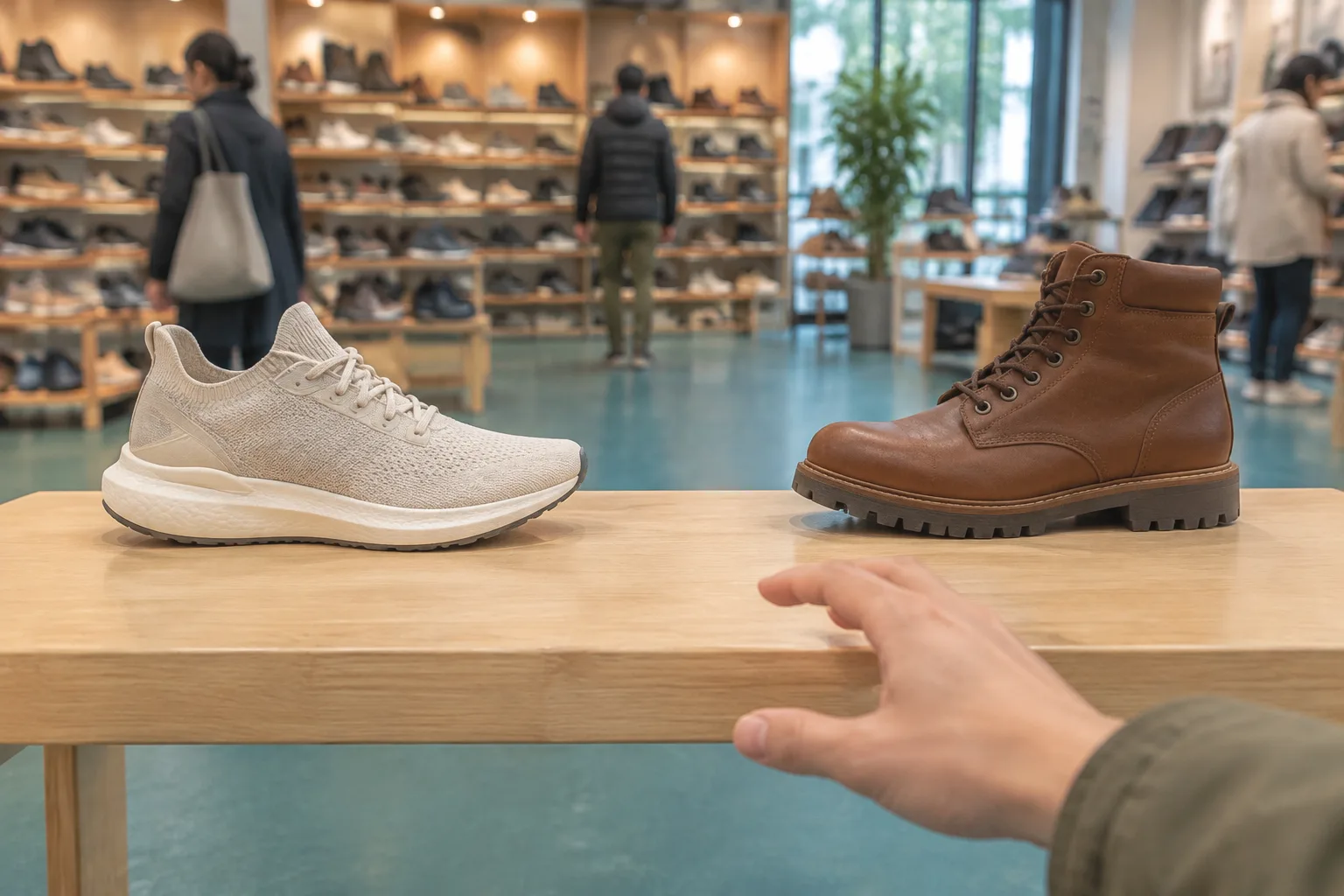
The clerk at the running store pulls a shoe off the wall and sets it on the bench. It has a knit upper, a foam midsole, and a rocker curve at the toe that tilts forward like a rocking chair. On the shelf next to it sits something that looks like a boot: ankle-height, leather, lugs deep enough to grip wet pavement. Both are sold as shoes for people who move. The shopper picks up the boot, turns it over, and asks a question that sounds simple and is not. Which one is better?
The answer depends on a distinction the sporty shoe industry has spent two decades blurring. Sneakers and boots are both footwear, both athletic in some sense, and both marketed with the same vocabulary of support, cushioning, and performance. But they solve opposite problems. A sneaker is engineered to return energy and reduce impact. A boot is engineered to block the ground out. Understanding which problem a person actually has is the whole decision, and it is usually decided before anyone walks into a store.
The foam midsole is the sneaker's entire argument
Strip a modern sneaker down and the case for it rests on one component: the midsole. Ethylene-vinyl acetate, or EVA, is the standard foam, and it is cheap, light, and springs back. Newer formulations add thermoplastic polyurethane or polyether block amide to do the same job with more bounce and a little less weight. The numbers are not marketing fiction. A pair of everyday running shoes can come in under 250 grams per shoe, and the foam under the heel compresses several millimeters on foot strike before pushing back.
That compression is the point. On hard surfaces, a person's foot lands with a force that can feel like several times body weight for a fraction of a second. Foam smears that spike into something longer and lower. The shoe absorbs the peak and gives a little back on toe-off. This is why a commute on asphalt, a walk across a hospital floor, or eight hours standing at a counter feels different in a running shoe than in anything with a stiff sole.
The trade-off is stability and durability. Foam compresses, so a sneaker with a tall stack can feel wobbly on uneven ground. The knit uppers that make modern sneakers breathe also offer little in the way of abrasion resistance. A foam midsole will break down with mileage, and that breakdown is not visible from the outside until it has already started to change how the shoe feels underfoot.
What a boot does that a sneaker cannot
A boot starts from a different premise. The ground under a trail, a job site, or a winter sidewalk is not a smooth surface to be cushioned. It is a variable surface to be managed. Boots answer with a stiffer outsole, a protective plate or shank under the arch, and an upper that wraps the ankle. The lugs on a hiking boot or a work boot are not decorative. They dig into mud and loose gravel so the foot does not slide, and the stiffer sole spreads pressure across the whole foot instead of concentrating it under the heel.
Ankle coverage is the other distinction. Sneakers sit below the ankle bone for a reason: freedom of motion. Boots rise above it, and that extra height does two things. It limits side-to-side roll on uneven ground, and it keeps debris, snow, and water away from the foot. A leather or synthetic boot upper can shrug off scuffs that would shred a knit sneaker in a week.
The cost is weight and stiffness. A leather hiking boot can run well over 500 grams per shoe, and that weight sits farther from the ground, which makes the leg work harder on every step. Break-in periods are real. A boot that feels stiff in the store will stay stiff for the first several outings, and the sole does not flex the way foam does, so the foot has to do more of the work.
The surface underfoot decides more than the shoe does
Most footwear advice starts with the person and works outward. The more useful starting point is the ground. Sidewalk, track, gym floor, and paved road are predictable surfaces. They do not shift, they do not hide rocks, and they reward the cushioning a sneaker provides. A person who spends the day on concrete and only touches grass on weekends has almost no reason to own a heavy boot.
Trail, gravel, mud, and snow are the opposite. They move underfoot and they punish a soft, tall midsole. A sneaker on a wet root or a loose scree field is a rolled ankle waiting to happen, because the foam compresses unevenly and the low collar gives nothing to brace against. This is where a boot earns its weight. The stiffer platform and higher collar turn a wobbly surface into a manageable one.
The middle ground is the hardest. A gravel path in a city park, a packed-dirt rail trail, a rainy commute that ends on a slick set of stairs. These surfaces are firm enough that a boot feels like overkill and loose enough that a pure road sneaker feels skittish. A trail running shoe, which is a sneaker with a lugged outsole and a slightly stiffer rock plate, sits in this gap. It is a compromise, and compromises are usually where the real answer lives.
Weather turns the choice into a one-way street
Rain, snow, and cold narrow the field fast. A knit sneaker is a sponge. It holds water against the foot, loses its insulation, and takes hours to dry. Waterproof membranes help, but they also trap heat and reduce breathability, which is why a waterproof sneaker is a strange hybrid that works for short wet walks and not much else.
A boot handles weather by design. The upper is a closed material, the seams are sealed or minimal, and the collar sits high enough to keep splash out. In slush and salt, a boot is the only sensible choice. In a light drizzle on a warm day, it is a heavy, sweaty answer to a small problem.
Cold adds a second variable. Foam stiffens as it gets colder, so a sneaker midsole that feels springy at room temperature can turn firm and dead below freezing. Boot rubber is formulated to stay flexible in low temperatures, which is part of why winter boots feel different from summer hiking boots even when the shape is identical.
The gym floor is a sneaker's home turf
Indoor training makes the case for sneakers almost absolute. A gym floor is flat, clean, and predictable, and the movements on it are lateral, explosive, and repetitive. A boot's stiff sole and high collar fight all three. A person cannot cut, pivot, or jump comfortably in a hiking boot, and the extra weight turns a set of lunges into a chore.
Court shoes and training shoes are built for this. A flatter, wider platform keeps the foot stable during side-to-side movement, and the cushioning is tuned for short bursts rather than long miles. A running shoe is a poor substitute for a court shoe on a basketball court, because the tall, soft heel that feels good on a straight run rolls badly on a hard cut.
This is the clearest case where the sporty shoe wins without argument. The gym is a controlled environment, and control is what a sneaker is designed to deliver.
Fit and break-in behave differently in each category
Sneakers are bought close to the foot. The upper should hold the midfoot without pinching, and there should be about a thumb's width of space at the toe. Too much room and the foot slides forward on descents; too little and the toes jam. Most sneakers need almost no break-in. A person can wear a new pair for a short walk the same day.
Boots are bought with a little more room and a lot more patience. The leather or synthetic upper will soften and mold over the first dozen wears, and a boot that feels snug at purchase can become comfortable. A boot that feels tight at purchase often stays tight. The heel should lock down, the toe box should not press, and the first few outings should be short.
Socks matter more with boots. A thicker sock changes the fit by a half size or more, and a person who plans to wear wool socks in winter should try boots on with those socks, not thin cotton ones. Sneakers are more forgiving, but a thin sock in a loose sneaker causes blisters just as reliably as a thick sock in a tight boot.
The two-shoe solution is usually the honest one
Most people who ask the sneaker-or-boot question are trying to buy one pair that does everything. That pair does not exist, and the search for it is where most bad footwear decisions come from. A single shoe that is soft enough for a long walk on pavement and stiff enough for a rocky trail ends up mediocre at both. It is too heavy for the road and too flexy for the mountain.
The honest answer is a small rotation. A neutral running or walking sneaker covers the pavement, the gym, and the daily commute. A trail shoe or a light hiking boot covers the weekend trail and the wet walk. A person who lives in a city with real winters adds a weatherproof boot and stops there. Three pairs, each doing a narrow job well, beat one pair doing everything poorly.
The cost is real, but so is the mileage. A dedicated running sneaker worn only for running lasts far longer than a hybrid worn for everything, because the foam is not being flattened by hours of standing and the upper is not being scraped by gravel. Rotating shoes also gives each pair time to dry and decompress between wears, which extends the life of the foam.
When the boot is the only shoe that fits the day
There is a category of day where the sneaker does not get a vote. A hike with a loaded pack, a shift on a site with loose material underfoot, a walk through deep snow, a trail that climbs over wet rock. On those days the boot is not a style choice. It is the only footwear that keeps the ankle intact and the foot dry, and the extra weight is a fair price for the protection.
The tell is the pack and the terrain together. A light daypack on a groomed trail does not require a boot. A heavy pack on a rough trail does, because the load raises the center of gravity and the ankle has to work harder to keep the foot flat. That is the moment the high collar and stiff sole stop feeling like overkill and start feeling like the reason the boot exists.
So the bench question has an answer, and it is not the one the shopper wanted. The sneaker wins on pavement, in the gym, and on any surface that stays put. The boot wins on ground that moves, in weather that soaks, and under a load that shifts. The person who buys one pair for both is buying a shoe that is wrong for each. The person who buys the right pair for the ground under their feet that day is the one who walks out of the store with something that actually works.