

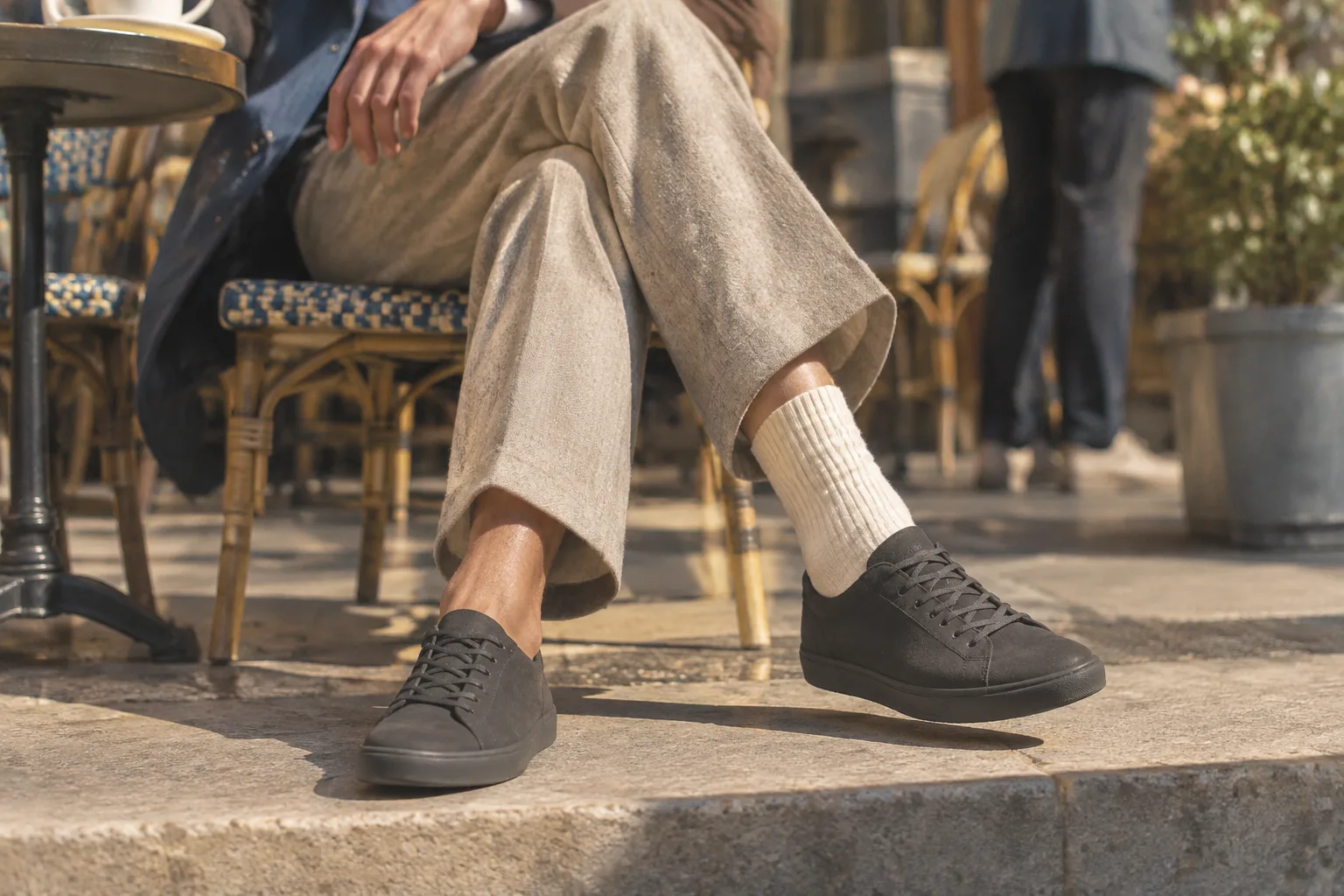
Sock Length, Style Language: Ankle Versus Crew
Two millimeters of fabric decides whether a man looks like he dressed with intent or grabbed the first pair from the drawer in the dark. That is the whole argument between ankle socks and crew socks, and it sounds absurd until the moment it isn't. The difference sits at the exact seam where trouser hem meets shoe collar, a zone most people never consciously consider and every eye reads instantly.
Sock length is a grammar. It tells the rest of the outfit which decade it belongs to, which season it assumes, and how seriously it takes itself. Ankle socks announce lightness, bare skin, a certain casualness that can read as effortless or as careless depending on everything around them. Crew socks pull the trouser leg into a longer vertical line and bring a weight that feels deliberate. Neither is correct in the abstract. Both are disastrous when chosen for the wrong context.
The Bare Ankle Problem and What It Actually Signals
Ankle socks, the kind that vanish below the shoe collar, solve one problem beautifully and create another quietly. They keep the leg looking continuous from knee to shoe, which flatters a cropped trouser and a low-cut sneaker. The exposed skin above the heel creates a break that reads as relaxed, summery, and young. On a warm day with a linen trouser and a canvas slip-on, the effect is clean and specific.
The trouble arrives with the wrong shoe. A bare ankle above a leather derby in February reads as a man who forgot something. The same bare ankle above a chunky trainer in a business-casual office reads as a man who misjudged the room. The sock is doing invisible work, and when it disappears entirely the outfit loses a beat it needed.
There is also the practical matter of the shoe itself. An ankle sock inside a low-cut sneaker stays hidden. Inside a loafer, it holds. Inside a dress shoe with a high vamp, the sock edge can peek above the collar with every step, a small betrayal that repeats all day. The wearer notices it around the third block of walking and never stops noticing it after.
Why the Crew Sock Refuses to Stay in Its Lane
The crew sock, cut somewhere between the ankle and the calf, has spent the last several years migrating across every style register available. It appears under tailored trousers in fashion editorials, under shorts on basketball courts, and under pleated skirts on teenagers who have decided it is the correct answer to a question nobody asked. This range is unusual for a garment so plain.
The reason is structural. A crew sock creates a visible band of color or texture between the trouser hem and the shoe. That band is a design decision made visible. A grey wool crew under a charcoal flannel trouser and a brown leather shoe lengthens the leg and adds a quiet formality. A white cotton crew under a navy short and a retro trainer signals athletic nostalgia. The same garment, two entirely different sentences.
Crew socks also solve a problem ankle socks cannot: they hold the trouser hem in place. A straight-leg wool trouser tends to break over the shoe, and a crew sock fills the gap so the break lands where it should. The trouser hangs better. The line from hip to floor stays unbroken. This is the kind of detail that separates an outfit that photographs well from one that merely looks fine in the mirror.
The Proportion Rule Nobody Teaches
Most style advice treats sock length as a matter of taste. It is closer to a matter of proportion. A short man in a cropped trouser and an ankle sock gains a few visual inches of leg. The same man in a crew sock and a long trouser can look stocky because the sock adds a horizontal band low on the leg that breaks the vertical line. A tall man has the opposite problem: an ankle sock under a long trouser can make his leg look like it ends abruptly at the shoe, while a crew sock carries the line down to the floor.
The shoe matters as much as the body. A low-profile sneaker with a thin sole wants an ankle sock or a very short crew. A chunky shoe with a thick sole wants a crew sock with enough weight to balance it. Put an ankle sock inside a heavy boot and the leg looks like it is floating above the shoe. Put a thick wool crew inside a canvas slip-on and the shoe disappears under the sock.
There is a simple test that requires no mirror and no second opinion. Stand in the full outfit and look at the gap between the trouser hem and the top of the shoe. If that gap is filled with sock, the outfit reads as one continuous thought. If that gap is filled with skin, the outfit reads as a deliberate pause. Both are valid. Only one will match the rest of what is being worn.
Season, Fabric, and the Sock That Fights Back
Wool crew socks in winter behave like insulation and like structure at the same time. They hold their shape, they absorb moisture, and they keep the trouser hem from clinging. Cotton ankle socks in summer do the opposite work: they disappear, they breathe, and they let the shoe do the talking. The mistake is wearing the summer sock in winter because it feels lighter, or the winter sock in summer because it looks more considered.
Fabric weight changes the silhouette more than most people expect. A thin mercerized cotton crew sits close to the calf and reads as dressy. A thick ribbed wool crew adds visible bulk and reads as casual or workwear. The same length, two different messages. A person choosing a crew sock has actually chosen two things: the height and the weight, and both need to agree with the rest of the outfit.
Ankle socks have a narrower range. The thin ones work in summer and with slim shoes. The slightly thicker ones, cut just above the shoe collar, work in spring and autumn with a low sneaker. Beyond that, the ankle sock runs out of options. It is a specialized tool, and it performs best when treated as one.
The Office, the Weekend, and the Grey Zone Between Them
A tailored wool suit with a leather oxford and a visible bare ankle is a look that requires confidence and a specific kind of workplace. In most offices it reads as a costume. The same suit with a thin grey or navy crew sock reads as competence. The sock is doing the work of a tie without the tie's ceremony.
Weekend dress reverses the calculation. A cropped chino, a canvas sneaker, and a white ankle sock is a clean, easy combination that has survived every trend cycle since the 1980s. Swap in a crew sock and the same outfit tilts toward skate or collegiate, which may or may not be the intent. The sock has moved the outfit across a cultural line in a single step.
The grey zone is where most wardrobes actually live: smart casual, business casual, the Friday office, the dinner that is not quite formal. Here the crew sock wins more often than the ankle sock, because it can carry a trouser and a leather shoe without demanding attention. A dark crew sock under a navy chino and a brown loafer is invisible in the best way. It supports the outfit and then gets out of the way.
What the Sock Drawer Reveals About the Wearer
Open a man's sock drawer and the ratio tells a story. A drawer full of identical black ankle socks belongs to someone who has decided that socks are a problem to be solved once and forgotten. A drawer with crew socks in grey, navy, charcoal, and one questionable pair of striped wool belongs to someone who thinks about the gap between hem and shoe, even if only for a second each morning.
The most useful drawer contains both, in quantities that match the actual wardrobe. Three pairs of ankle socks for the warm-weather sneaker days. Six pairs of crew socks in colors that match the trousers and shoes already owned. The ratio should follow the outfits, not the other way around. Buying a dozen crew socks before buying the trousers they will sit under is the same error as buying a tie before buying the shirt.
Sock length is a small decision that compounds. Get it right and the outfit disappears into the person wearing it. Get it wrong and the eye keeps returning to the same two millimeters of fabric, wondering what is off. The ankle sock and the crew sock are both correct answers. The question is which one the rest of the outfit is asking.