

Soft Meets Structured: Activewear With Tailoring
Drawstring waistbands have been quietly migrating out of the gym bag and onto trousers that cost more than a month of rent. The fabric is still nylon or polyester, often a four-way stretch blend with a brushed interior, but the cut has changed: a pressed crease down the front, a tapered ankle, a waistband that sits at the natural waist rather than the hips. Activewear with tailoring is the term that has settled around this hybrid, and it describes something narrower than it sounds.
The core idea is simple. Take the material properties that make athletic clothing work, the stretch, the moisture management, the packability, the freedom of movement, and apply them to the silhouette of a tailored garment. The result is a pair of trousers that can survive a red-eye flight and a client lunch, or a blazer that moves with a shoulder rather than fighting it. This is not athleisure in the old sense, the leggings-and-hoodie uniform of the pandemic. It is a more deliberate proposition, and it has a steeper set of problems to solve.
The Specific Garments That Show Up Most
The category has a recognizable inventory. At the top of the list sit the stretch trousers: a flat-front or single-pleat cut in a fabric that reads matte rather than shiny, with enough elastane to let a full squat pass without a seam complaint. Lululemon's Commission and ABC trousers built a following on exactly this premise and remain the reference point many competitors measure against. Banana Republic, Uniqlo, and a long tail of direct-to-consumer labels have followed with their own versions, usually in a polyester-elastane or nylon-elastane blend.
Next come the unstructured blazers. These are jackets with the shoulder padding removed or reduced to a whisper, no canvas in the chest, and a fabric with a soft hand. They drape rather than sculpt. A traveler can fold one into a carry-on and shake it out on arrival, and the creases that would ruin a worsted wool jacket will mostly hang out overnight. The third piece is the tailored jogger, which is the jogger reborn with a proper rise, a clean front, and a cuff that ends at the ankle bone instead of the top of the shoe.
Then there are the knit blazers and the ponte trousers, the travel shirt in a technical poplin, and the dress made from a stretch jersey cut with a defined waist. The inventory is wide, but it shares a single logic: the garment must pass as tailored from a few feet away and behave like sportswear up close.
Why the Materials Actually Matter
The reason this category exists at all comes down to fiber. Wool trousers from a traditional tailor are beautiful and unforgiving. They hold a crease, they breathe, and they also wrinkle the moment a person sits in a car for forty minutes. Cotton chinos have the same problem with less drape. The technical fabrics that activewear brought to market solve for the wrinkle, the moisture, and the range of motion at once, which is why the hybrid has gained traction with people whose days are long and whose schedules are unpredictable.
The trade-off is real, though. A high-performance synthetic fabric can look flat in photographs and can hold odor in a way wool does not. The better versions in this category blend in a natural fiber, often merino or a small percentage of wool, or use a mechanical stretch rather than relying entirely on elastane, which tends to relax over time and lose its snap. A pair of stretch trousers with 8 percent elastane will feel wonderful in the fitting room and bag at the knee after a few months of wear. A pair with 2 to 4 percent, combined with a woven structure that has some give, tends to hold its shape longer.
The hand feel is the second battleground. Shiny is the enemy. A technical fabric that reflects light like a track jacket will read as athletic no matter how sharp the cut. The fabrics that work in this category have a matte finish, a slight pebbled or twill texture, and enough weight to hang cleanly. A good test is to hold the fabric to a window: if the light passes through it with a sheen, the garment will look cheaper than it costs.
The Fit Problems Nobody Warns About
Stretch changes the way a garment fits, and most of the fit advice borrowed from traditional tailoring fails here. A wool trouser has a fixed shape, so a tailor can take in a waist or let out a seat and the result is predictable. A stretch trouser has a shape that moves, which means a fit that feels snug in the store may relax into something sloppy by the end of a workday, and a fit that feels loose at the waist may sag once the fabric warms to body temperature.
The waistband is where this bites hardest. Elastic waists disguised as tailored waistbands are common in this category, and they behave differently from a proper waistband with a hook and bar closure. The elastic version is comfortable but tends to roll or bunch when a person sits, and it can leave a visible ridge under a tucked shirt. A half-elastic construction, where the back of the waistband has give and the front is fixed, is the compromise that most brands reach for, and it works reasonably well.
The rise is the other quiet failure. Tailored trousers traditionally sit at the natural waist, which is the narrowest point of the torso. Many activewear-derived trousers borrow a lower rise from athletic pants, and the result is a garment that reads as casual no matter how crisp the fabric. A higher rise does more for the tailored impression than any other single detail.
Where the Hybrid Fails
There are settings where this category simply does not belong. A courtroom, a formal wedding, a meeting with a client who has flown in from a culture that reads dress codes strictly: these are places where the stretch trouser will not pass, and the wearer who tries will feel the mismatch even if no one comments. The tailored activewear look works best in environments that are business casual at most, and it works because it is a considered choice within that register rather than a way to sneak past a formal dress code.
The other failure is stylistic. A stretch trouser with a sharp crease, a technical blazer, and a pair of clean white sneakers is a coherent outfit. The same trouser with a dress shirt, a silk tie, and a leather oxford is a costume. The category rewards restraint: one tailored element at a time, the rest of the outfit kept simple. A person who stacks a technical blazer, a stretch trouser, and a performance shirt into a single look ends up dressed as a tech conference keynote rather than as someone with somewhere to be.
How to Read a Label Before Buying
The fiber content tells most of the story. A blend that is majority polyester with a small elastane percentage will perform well on stretch and wrinkle resistance but may hold odor and feel less substantial over time. A blend with wool or a significant cotton content will breathe better and look more expensive, but may wrinkle more and require gentler care. Nylon tends to be more durable than polyester and dries faster, which matters for travel.
The construction details matter as much as the fiber. Look for a waistband with a real closure, either a hook and bar or a button, rather than a purely elastic waist. Check the seam allowances inside the waistband and the crotch: a well-made stretch trouser uses a flatlock or overlock stitch that will not fray when the fabric stretches. A cheap version will show loose threads and uneven stitching at the stress points, which are exactly the places that fail first.
The weight of the fabric is the other number worth checking, though it is rarely printed on the label. A trouser fabric in the range of 250 to 320 grams per square meter will hang with enough body to read as tailored. Lighter than that and the garment will cling and show every line of what is underneath. Heavier and it will feel stiff and warm, which defeats the point of a performance fabric.
The Care Routine That Keeps the Shape
Stretch fabrics have a shorter useful life than wool, and the way a garment is washed and dried determines how long it holds its shape. Heat is the enemy. A tumble dryer on high will relax the elastane and leave a trouser with a bagged knee and a stretched waistband within a season. Air drying flat or hanging is the single habit that extends the life of this category most reliably.
Washing matters too. A gentle cycle in cold water, with the garment turned inside out and zipped or buttoned, protects the surface finish and the seams. Fabric softener should be avoided; it coats the fibers and reduces the moisture-wicking performance that justified the purchase in the first place. A technical detergent, or a small amount of a gentle one, is enough.
Pilling is the visible sign of wear in this category, particularly at the inner thigh and the seat where friction is highest. A fabric shaver removes the pills, but the pilling itself is a signal that the fiber blend is struggling. A trouser that pills within the first few months was likely made with a short-staple fiber that was never going to hold up.
The Price Ladder and What It Buys
At the low end, roughly under eighty dollars, the stretch trouser is usually a polyester-elastane blend with a bonded waistband and a simple construction. It will look acceptable for a season and then show its age at the seams and the knee. In the middle band, roughly one hundred to two hundred dollars, the fabrics improve, the waistband construction gets more thoughtful, and the cut is more likely to have been tested on real bodies rather than a single fit model.
Above that, the category starts to overlap with technical tailoring from brands that treat the garment as a piece of engineering. The gains are real but incremental: a better drape, a more refined finish, a fabric that resists odor more effectively. A person who wears the garment four days a week will feel the difference. A person who wears it once a month will not.
What the Category Gets Right About Modern Dressing
The deepest argument for tailored activewear is that it matches how a lot of people actually live. A workday that starts with a school drop-off, moves through a desk, includes a walk between buildings, and ends with a dinner that runs late does not fit neatly into a wardrobe divided into work clothes and gym clothes. The stretch trouser and the unstructured blazer acknowledge that reality without asking the wearer to look like they just left a fitness class.
The category also quietly corrects an old imbalance. Traditional tailoring has always been built around a narrow set of bodies and a narrow set of movements: standing still, sitting upright, walking at a measured pace. The activewear influence brings a wider range of bodies and a wider range of motion into the tailored silhouette, which is a small but genuine improvement in who gets to look polished.
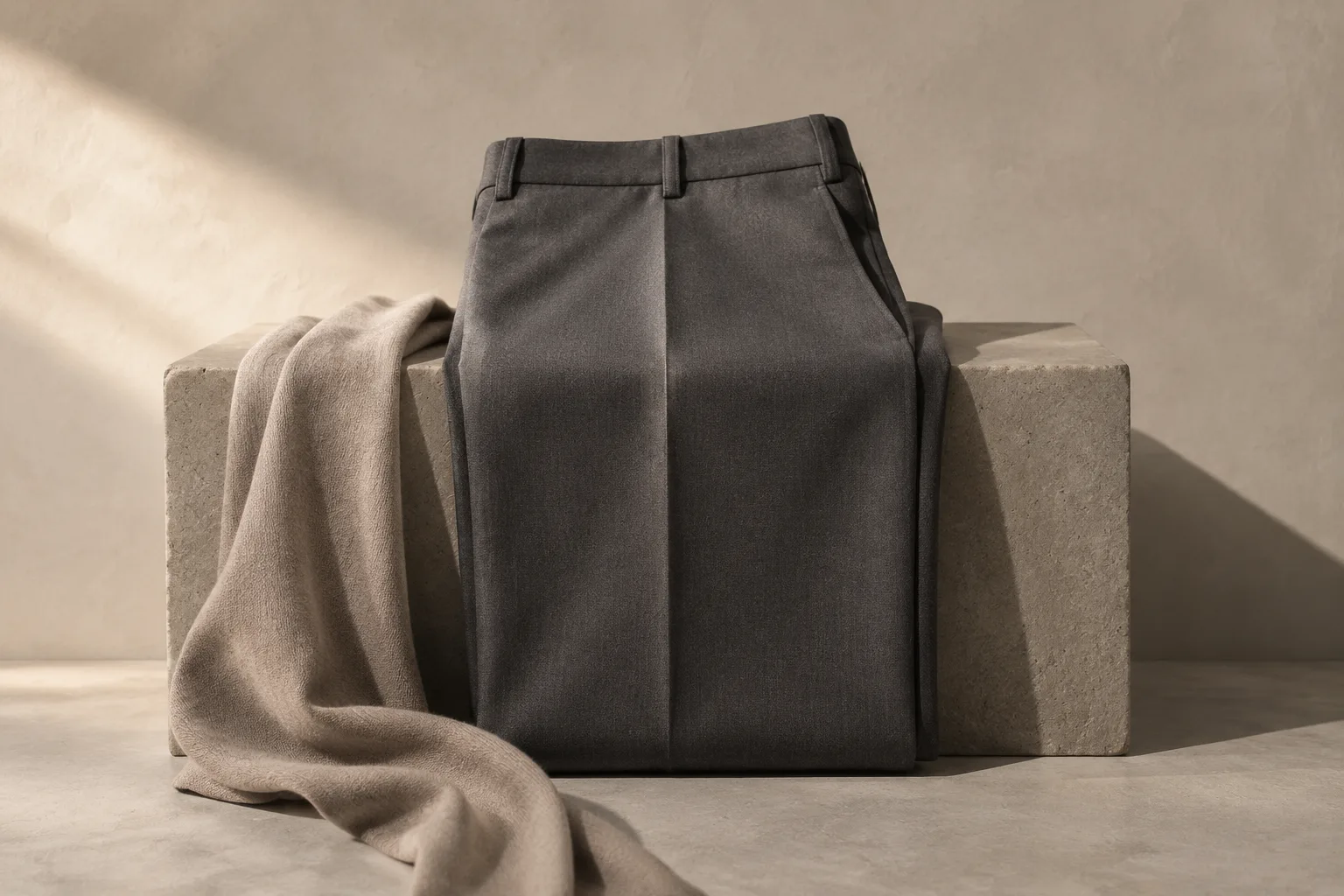
A single garment can carry the whole idea. A pair of charcoal stretch trousers, cut with a clean front and a rise that sits at the natural waist, paired with a plain knit and a pair of leather sneakers, is the outfit that makes the case better than any argument. It looks like a decision. It moves like a Saturday. The seam down the front is the tell that someone thought about it, and the fabric is the reason it survives the day.