
Sports Bra, Styled: Wearing It Beyond the Studio
Lululemon sold roughly $1.6 billion worth of women's bras in a recent fiscal year, and the company has been explicit that a growing share of those sales are not for the gym. That figure sits behind a quiet wardrobe shift: a piece engineered for downward-facing dog has slipped into brunch, into the office on casual Friday, into the school pickup line, into a flight across the Atlantic. The sports bra left the studio. The studio has not gotten it back.
The question is no longer whether it looks acceptable outside the studio. It is how to style the thing so it reads as deliberate. A sports bra worn with running shorts is a person going to the gym. The same bra worn with a pressed trouser and a button-down thrown over it is a person who knows something about proportion. The gap between those two looks is small, and it is almost entirely about what goes on top and what goes on the bottom.
The bra already looks like a crop top, so treat it like one
Most sports bras sold today are not the racerback compression garments of a decade ago. The current silhouette is a longline band, a scooped neckline, often a seam or a strap detail that reads as intentional design. That is a crop top. It happens to be built with high-stretch fabric and bonded seams, which is why it sits flatter under a blazer than most cotton crops do.
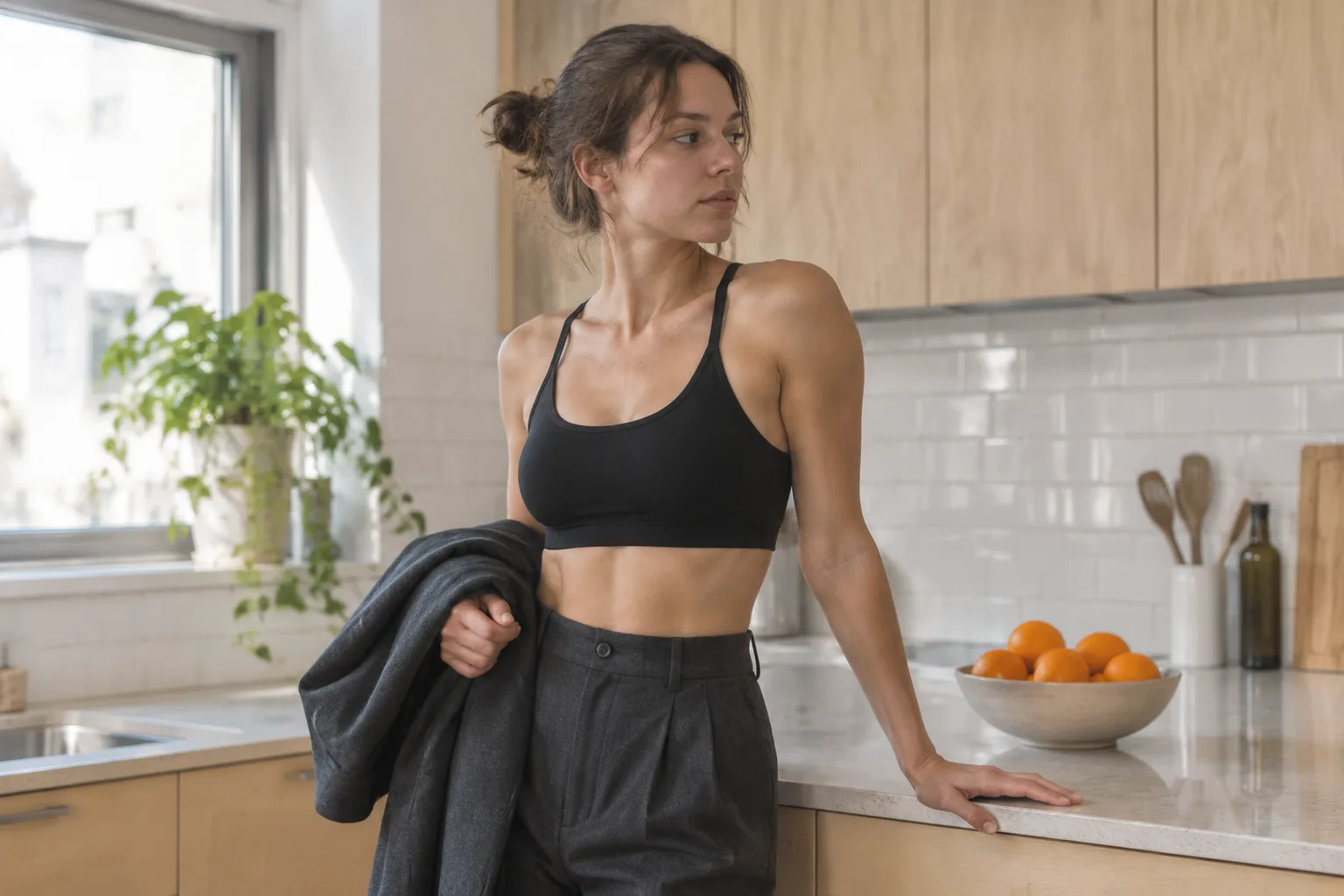
The styling move follows from that. A crop top is styled by pairing it with something high-waisted on the bottom and something structured on top. Start there. A bra with a high-waisted wide-leg trouser and an oversized linen shirt left open is the whole formula in one sentence. Everything below is a variation on it.
One caution: compression bras with thin straps and no structure read as underwear the moment they leave the gym. The longline, medium-support shapes carry the most styling range. A high-impact bra with a keyhole front is a different garment with a different job. It belongs under a loose tee to the track, and it looks misplaced over a skirt.
The blazer move and why the fabric weight matters
The most reliable transition is a blazer. Not a soft knit blazer, which reads as loungewear, and not a cropped puff-sleeve number. A real blazer with a little shoulder structure, in a matte fabric, worn open over the bra. The contrast between the tailored shell and the athletic bra is the entire effect. If the blazer is too soft, the outfit collapses into athleisure. If it is too stiff, it looks like a mistake in a corporate video.
The bra's own fabric weight matters here. A slick, shiny spandex bra under a wool blazer looks like swimwear under a suit. A matte, brushed knit bra with a visible seam line holds its own next to tailoring. That is the difference between an outfit that looks styled and one that looks like a wardrobe failure discovered at noon.
And the fit has to be right in a way it never has to be at the gym. A bra that gapes at the band or digs at the shoulder is fine under a loose tank. Under a blazer, with nothing else between the bra and the jacket, every fit flaw is on display. The band should sit flat against the ribs without riding up when the arms lift. Strap tension should be even. The cups should not buckle at the neckline when the shoulders roll forward.
This is where the transition costs money. A sports bra worn for styling has to fit like a piece of clothing, not merely like support. The fit tolerance shrinks.
Layering pieces that add coverage without hiding the bra
The open shirt is the workhorse of the whole look. A cotton poplin, a linen button-down, a chambray, anything with a collar and a bit of body, worn unbuttoned over the bra. The shirt does two jobs at once: it covers the shoulders and arms for a setting that calls for more coverage, and it frames the bra as the deliberate center of the outfit rather than an accidental exposure.
A sheer or mesh long-sleeve worn underneath the bra is a different move and a riskier one. It works in editorial photographs and on a certain kind of person at a certain kind of party. In daylight, in a coffee shop, it tends to read as a costume. The open shirt is more forgiving and more versatile, and it costs less.
The overshirt in a men's cut, sized up two sizes, is the most reliable single layer in this category. It has a straight hem, a real collar, and enough fabric to fall past the hips. Worn open over a sports bra with the sleeves rolled twice, it lands somewhere between a gallery opening and a very good airport outfit. That is the target register: dressed enough to be taken seriously, relaxed enough to look unbothered.
A cropped cardigan or a short boxy knit is the third option, and the one that reads most like actual clothing rather than a styling trick. The crop length matters: it should hit at or just below the bra band, not above it, or the layering gets busy at the waist. A fine-gauge knit in a tone close to the bra color makes the whole thing look considered.
Bottoms that carry the outfit instead of competing with it
The bottom half decides whether the outfit is athleisure or a real look. Leggings under a sports bra and an open shirt is a recognizable genre and a perfectly good one, but it is not the look that crosses into the office or a dinner reservation. For that, the bottom needs some weight.
High-waisted wide-leg trousers in a fluid drape, in a neutral, are the strongest pairing. The high waist meets the bra band or sits just under it, so the midriff exposure is a deliberate strip rather than an accident. The wide leg balances the fitted top. The drape keeps it from looking like a uniform. A denim version, a chino version, a light wool version for cooler months, all work. The key is the rise. A mid-rise trouser with a sports bra leaves a strange gap at the side waist that no layering fixes.
Midi skirts are the unexpected winner. A bias-cut satin or a pleated midi in a solid color, worn with a sports bra and a cropped knit, is a genuinely good outfit and one that nobody expects. The athletic top against the soft skirt is the contrast that makes it work. The bra should be a simple shape for this, no busy straps, no color blocking. The skirt does the talking.
Tailored shorts, the kind with a pressed crease and a real waistband, work in summer the same way the trouser does. Denim cutoffs do not, and the reason is texture. The bra is already casual. The bottom has to pull the other direction.
Color and the one rule that keeps it from looking like gym clothes
The fastest way to make a sports bra look like gym clothes is to wear it with other athletic pieces in athletic colors. A black bra with black leggings and a gray hoodie is a gym outfit. A black longline bra with cream wide-leg trousers, a navy overshirt, and a leather loafer is not. The bra is the only athletic element in the second outfit, and that isolation is what makes the styling read as intentional.
So the rule is one athletic piece per outfit. If the bra is the athletic piece, everything else should be non-athletic. If the leggings are the athletic piece, the top should be a real shirt. Wearing a sports bra with joggers and a windbreaker is fine, but it is a different assignment. The studio-to-street look works because of the tension between the bra and the rest, and that tension disappears when the whole outfit is technical fabric.
Color is the second lever. A bra in a color that does not exist in activewear, a deep olive, a rust, a cream, a slate blue, reads as a top rather than as equipment. Neon and heathered gray read as equipment. This is a small decision with an outsized effect.
What to put on the feet and what to leave at home
Footwear is where the outfit either commits or hedges. A running shoe with a sports bra and wide-leg trousers is a hedge, and it drags the whole look back toward the gym. A flat leather sandal, a loafer, a clean white sneaker in a non-athletic silhouette, a low boot in cooler months. The shoe should look like it was chosen for the outfit, not for the commute.
The white sneaker is the tricky one. A chunky performance sneaker is athletic. A low-profile leather sneaker is not, and it works. The distinction is sole height and upper material. Anything with a foam midsole and a mesh upper is gym footwear, and it undercuts the trousers and the blazer every time.
Accessories do more work here than usual because the outfit has few pieces. A structured bag, a belt if the trouser has loops, a single piece of jewelry at the neck or the ear. The bra has no collar and no sleeve, so the neck and the arms are exposed. That is where the styling lives. A thin chain, a pair of small hoops, a watch with a leather band. All of it signals that the outfit was assembled rather than thrown on.
The office version has a narrower window
The office is the hardest setting, and it deserves its own note because the rules tighten. A sports bra in a business-casual workplace works only with substantial coverage over it: a blazer that closes at least at the top button, a shirt buttoned to the sternum, a high-necked knit. The bra shows as a strip at the neckline or the waist, the way a camisole would. The outfit reads as a layered top, not as underwear on display.
What does not work in an office is the open blazer with a full midriff of bra beneath it. That is a look for a Saturday, a creative workplace with a very loose code, or a dinner. The distinction between the dinner version and the office version is one button. That single button is the whole difference, and it is worth respecting, because the outfit only survives in a professional setting if nobody has to decide whether it is appropriate.
The sports bra has already crossed over. The only question left is whether the person wearing it looks like she planned the outfit or grabbed the nearest clean thing. The answer is almost always in the trousers, the overshirt, and the shoes, which is to say in everything except the bra itself.