

Styling a Jersey Without the Game-Day Energy
A soccer jersey on a hanger is a promise of ninety minutes of noise, sweat, and tribal feeling. A soccer jersey on a body headed to a coffee shop on a Tuesday promises something else entirely, and most people who own one never quite solve the problem of what that something is. The garment is loud by design. It carries a crest, a sponsor, a number, sometimes a name across the shoulders. None of that disappears when the stadium does.
What follows is a working method for wearing one in ordinary life, drawn from the specific failures and small successes of that attempt. The jersey does not need to be tamed. It needs context.
The Crest Is Louder Than the Color
People blame the brightness. A fluorescent away kit, a two-tone stripe, a pattern that looked reasonable in a photograph of a stadium at dusk: these get named as the reason a jersey reads as costume. The real culprit sits over the left breast. A crest is a compressed piece of institutional identity, and it does not read as decoration. It reads as allegiance, and allegiance outside a stadium reads as a statement the wearer may not have intended to make at 9 a.m. on a Saturday.
This is why plain training tops and warm-up shirts work so easily in casual outfits. No crest, no sponsor, no number. Just a color and a cut. The moment the badge appears, the garment starts speaking, and the rest of the outfit has to answer.
The practical move is to build around the crest rather than pretend it isn't there. A jersey with a large, busy badge wants quiet neighbors. Charcoal trousers, a plain overshirt, a single leather shoe. The badge becomes the loudest thing in the frame and the outfit organizes itself around that fact.
Sponsor Logos and the Problem of Scale
Modern kits have a second front-of-shirt problem: the sponsor. A betting company's wordmark across the chest can be six inches tall and in a typeface chosen to be legible from the back row of a stadium. In a bar or a train car, that wordmark sits at eye level for anyone standing nearby.
Older shirts from the 1990s and early 2000s often had smaller, more restrained sponsor marks, sometimes embroidered, sometimes no larger than the crest. Those are easier to wear for the obvious reason. They also tend to have boxier, shorter cuts that read more like vintage sportswear than modern athletic kit, which helps them sit inside a casual outfit rather than on top of it.
If the sponsor is the loud part, the rest of the outfit should not compete. That means no graphic tee underneath, no patterned trousers, no second logo on the shoes. A plain white undershirt visible at the collar, dark denim, and a plain sneaker. The jersey is doing all the talking anyway.
The Fit Issue Nobody Warns About
Match-day shirts are cut for movement, which means they hang in ways that look wrong in a photograph taken outside a stadium. The hem sits low, the sleeve is wide, the shoulder seam drops. On a body standing still in a coffee line, that silhouette reads as borrowed clothing.
Two adjustments fix most of this. The first is the tuck: a shallow, deliberate tuck at the front only, letting the back hang. That shortens the visible line of the jersey and gives the waist some shape. The second is the layer: an open overshirt, a light jacket, a cardigan, something with structure worn over the jersey so the drooping shoulder line is partly hidden.
A jersey worn open over a plain tee is a different garment entirely. The front panels fall away from the body, the crest sits at an angle, and the whole thing reads as a light layer rather than a shirt. This is the single most reliable move for warm weather, and it costs nothing.
What Goes Underneath Changes Everything
An athletic jersey against bare skin looks like what it is: sportswear in transition. A plain crew-neck tee underneath, in white or a color pulled from the kit, gives the jersey something to sit on. It also solves the transparency problem that thin polyester has under certain light.
The undershirt should be fitted, not loose. A baggy tee under a baggy jersey doubles the volume and produces a shape with no edges. A close-fitting cotton crew in a neutral tone keeps the jersey as the outer silhouette and the body as the inner one.
Collar choice matters here too. A jersey with a proper polo-style collar, the kind found on rugby shirts and some retro football kits, wears well over a plain tee. A simple crew-neck jersey with a ribbed neckline looks better with nothing visible at the collar at all, or with a thin turtleneck in cold weather. Mixing a crew-neck jersey over a collared shirt reads as a mistake in almost every case.
The Trouser Question
Joggers are the obvious pairing and the wrong one for most situations. Jersey plus joggers reads as a warm-up, which is fine if the plan is a gym or a run, and confusing if the plan is lunch. The outfit has no tension, no contrast, nothing to make the jersey feel chosen rather than defaulted to.
Straight-leg denim, dark and clean, is the safest partner. A mid-rise, slightly relaxed cut in indigo or black gives the jersey a structured bottom half to sit against. Chinos work too, especially in olive, stone, or navy, and they push the outfit toward something closer to smart casual.
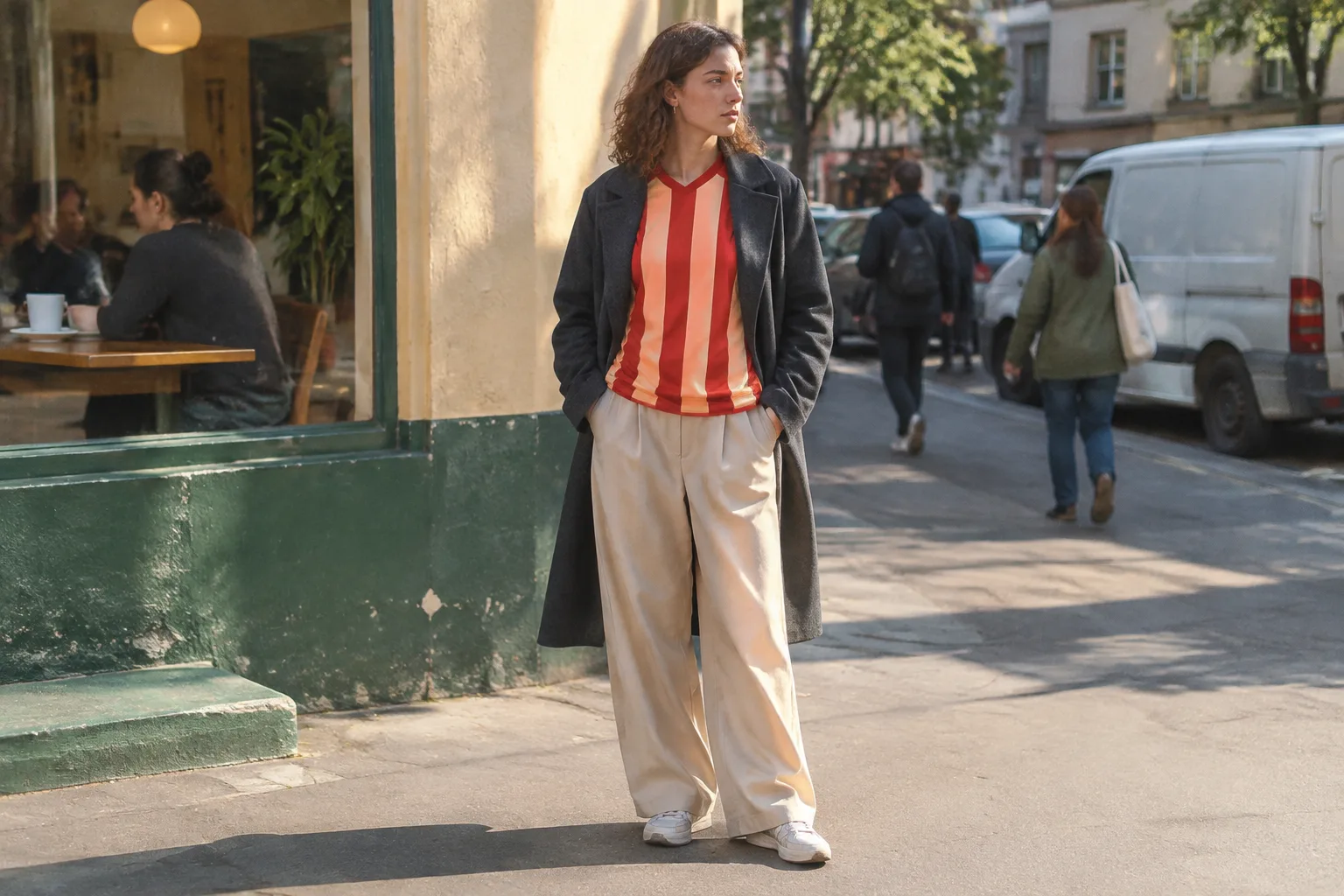
Tailored trousers are the more interesting bet. A pair of pleated wool trousers in grey or brown, worn with the jersey tucked at the front and a plain leather shoe, produces a combination that reads as deliberate. It is the outfit that gets the most second looks, and the looks are usually curious rather than hostile.
Shorts are a separate calculation. A jersey with tailored shorts and a clean sneaker works in summer. A jersey with board shorts does not, mostly because the shirt is doing competitive work and the shorts have given up.
Shoes Pull the Whole Thing Together or Apart
Running shoes with a football jersey produce the full kit effect, which is to say the outfit looks like the wearer is on the way to a match and got lost. That can be a good look, but it has to be committed to. Half-committed is the failure mode.
A plain leather sneaker, white or black, is the neutral answer. It keeps the outfit casual without pushing it toward athletics. A suede loafer or a derby shoe pushes it the other way, toward something more considered, and works especially well with the tailored trouser pairing.
Canvas shoes, the classic low-top kind, sit in the middle. They read as casual without reading as sport, and they pair naturally with denim and chinos. The one shoe to avoid is the technical runner with visible cushioning and a mesh upper, because it doubles the athletic signal and the outfit stops being an outfit.
Outerwear Does the Disguise Work
A jersey under an open jacket is the most forgiving version of this whole exercise. The jacket provides structure, hides the shoulder line and the hem, and frames the crest and sponsor as details rather than headlines. A denim jacket, a chore coat, a Harrington, a bomber: any of these work, and the choice of jacket sets the register of the outfit.
A chore coat in canvas or twill pushes the look toward workwear and grounds the jersey in something sturdy. A Harrington or a bomber keeps it closer to mod and casual. A denim jacket in a mid wash is the most neutral option and the easiest to get right.
Cold weather opens up the overcoat. A long wool coat over a jersey, with the crest peeking out at the chest and the hem of the jersey visible below the coat's closure, is a combination that has been quietly working for years in cities with cold winters and strong football cultures. It requires the jersey to be relatively plain, ideally without a giant sponsor, and it requires the coat to be long enough to cover the hips.
When the Jersey Is the Only Loud Thing
The cleanest rule for styling a jersey in ordinary life: let the shirt be the single point of visual interest and keep everything else quiet. A jersey is already a statement garment. It does not need help. It needs room.
That means the rest of the outfit runs in neutral tones, simple textures, and clean lines. No competing graphics, no second sports reference, no logos on the shoes or the bag. The jersey gets to be the thing people notice, and the wearer gets to look like someone who chose it on purpose rather than someone who forgot to change after the match.
The best version of this look is not the one that hides the jersey. It is the one that treats the jersey as the reason for the outfit, builds a quiet frame around it, and lets it be exactly what it is. A football shirt on a Tuesday, worn with intention, is a good garment. It just needs the rest of the outfit to agree.