
Summer Sneakers: Breathable Picks That Hold Their Shape
Canvas sneakers have a shape problem in summer. The upper softens with sweat, the toe box creases into a permanent frown, and by August a pair that looked crisp in May reads like a sock with a sole. The breathable options that solve the heat problem often make the collapse problem worse: mesh stretches, knit sags, and thin cotton uppers give up their structure the moment the temperature climbs past 80 degrees. Finding a pair that lets air move and still holds a line is a narrower search than the marketing suggests.
The tension is old. Leather holds shape because it is stiff; stiff materials trap heat. Anything porous enough to vent moisture is also porous enough to lose its geometry. Shoe designers work this seam constantly, and the results split into a few recognizable families, each with its own trade-off. Knowing which family a pair belongs to matters more than reading the spec sheet.
Engineered mesh that keeps a backbone
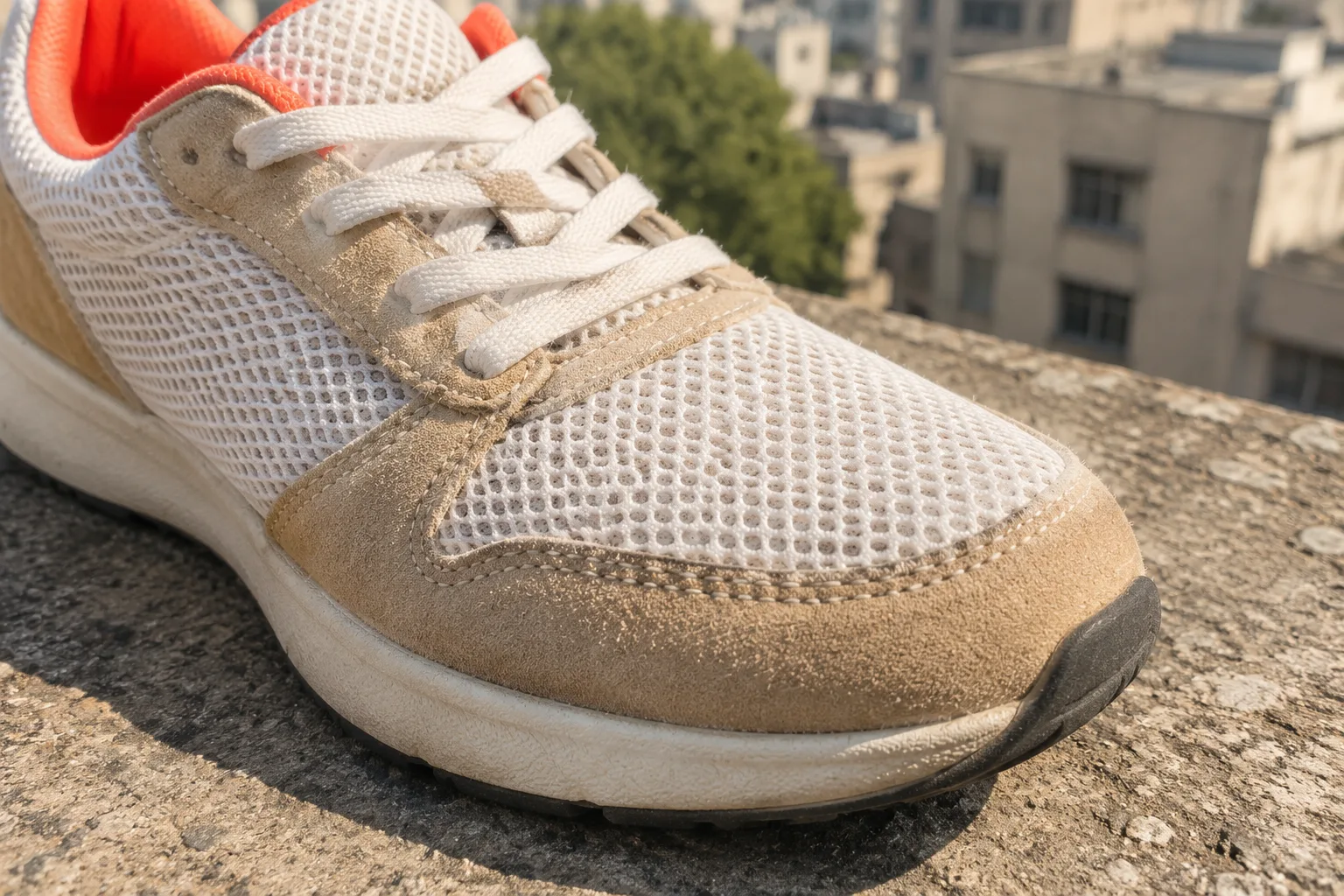
The most common summer construction is engineered mesh: a woven upper with denser zones around the heel and midfoot and open zones over the toes. The good versions do not feel like mesh at all. They feel like a thin fabric with a hidden skeleton, because that is essentially what they are. A thermoplastic frame or a reinforced heel counter keeps the back of the shoe from folding inward when a foot slides in.
The failure mode here is a mesh so soft it acts like a hammock. A person can test this in the store in about ten seconds: press a thumb into the heel counter from the outside. If it caves with almost no resistance, the shoe will collapse under a heel strike by midsummer. A firm counter that springs back has a chance. The same test works on the lateral side of the midfoot, where cheap mesh bags out and expensive mesh holds.
Nike's Flyknit and Adidas's Primeknit sit at the sagging end of this family in their softest iterations, but both brands make firmer versions for stability models. The distinction is not brand loyalty. It is whether the knit has been fused, taped, or backed with a stiffer yarn at the load points. A shoe with visible reinforcement strips around the eyelets and heel is usually the one that survives a summer of daily wear.
The open-knit trap
Open knits breathe beautifully. That is the entire pitch, and it is true. A loose, single-layer knit moves air like a window screen. The problem arrives around week six, when the collar has stretched wide enough that the shoe slips at the heel, or when the toe has sagged into a shape that no longer matches the foot inside it.
There is a way to buy into this category without the collapse: look for a knit shoe with a separate, structured heel clip molded from hard plastic or a composite. The knit can do its breathable work over the forefoot while a rigid piece handles the back third, where most of the shape loss happens. Shoes built this way tend to cost more, and they tend to last a full season rather than half of one. The split construction is the tell.
Single-piece knit uppers, where the entire shoe is one continuous sock with a sole glued on, are the riskiest buy for anyone who wants the shoe to still look like a shoe in September. They are comfortable for the first month. After that, the collar gapes and the whole thing reads as a house slipper that wandered outside.
Leather that has been perforated, not thinned
A perforated leather upper is the quiet answer that gets overlooked in breathability conversations. The material holds shape because leather holds shape; the perforations, small punched holes across the vamp and side panels, let heat escape. The result is a shoe that vents adequately and keeps its lines through a full season.
The distinction that matters is whether the leather has been perforated or merely thinned. Perforation removes small circles from a full-grain or suede hide; the surrounding material stays thick. Thinning shaves the hide down to a papery sheet and punches it, and the result creases and wrinkles within weeks. A person can spot the difference by looking at the edges of the holes: clean, sharply punched circles mean structural leather; ragged or stretched holes mean the hide was already weak.
Perforated leather runs warmer than mesh in absolute terms. On a 95-degree day with high humidity, a leather shoe will feel hotter than a knit one. But it does not collapse, and for a lot of wearers that trade is worth making. The shoe works for an office commute, a restaurant dinner, a weekend that involves more standing than sprinting. It is the summer sneaker for people who have already been burned by a sagging knit.
Suede and the perforation question
Suede is a summer material more often than people admit, provided it is the right suede. A good pigskin or goat suede with perforations breathes reasonably and holds shape superbly, because suede has a dense fibrous structure that resists stretching. The catch is rain. A summer thunderstorm will spot a suede upper, and repeated soakings stiffen the nap into something closer to cardboard.
For a dry climate, though, a perforated suede sneaker is one of the most durable summer options available. It does not crease the way smooth leather does, it holds its shape through heat, and the nap gives it a texture that reads more considered than mesh. The shoe is not for everyone, but it is the pick for a wearer who wants a summer sneaker that still looks like footwear in October.
What a heel counter actually does
The heel counter is the single most important structural element in a summer sneaker, and it is the one most shoppers ignore. It is the stiff piece inside the back of the shoe that cups the heel. Without it, the upper folds inward on every step, and once that fold sets, the shoe is finished. A good counter is firm enough to resist a thumb press and shaped to wrap the heel rather than sit flat behind it.
Summer constructions often skimp here because a rigid counter adds weight and cost. Mesh shoes in the $60 to $90 range frequently use a soft foam or fabric counter that provides no real structure. Shoes in the $120 to $160 range more often use a molded thermoplastic counter that keeps the heel locked. The difference is visible: a firm counter holds the back of the shoe upright when the shoe sits on a shelf, while a weak one slumps forward.
A wearer can check this without taking the shoe home. Set it on a flat surface and look at the back from the side. If the heel leans or sags, the counter is soft. If the back stands straight, the shoe has a chance of holding its shape through the summer.
The collar and tongue decide comfort in heat
Two small zones get overlooked in breathability discussions: the collar and the tongue. A padded collar traps heat against the ankle, and a thick tongue does the same across the top of the foot. Summer sneakers that breathe well through the upper can still run hot because of overbuilt padding in these spots.
The right summer construction uses a thin, unpadded collar with a soft lining and a tongue that is either perforated or made from a single layer of breathable material. This is where a lot of performance running shoes get it right, and where a lot of lifestyle sneakers get it wrong. A shoe with a plush, pillow-like collar is built for cool-weather comfort, not for July.
The trade-off is that thin collars can rub. A wearer who has had blister problems with unpadded shoes should look for a collar with a smooth, seamless lining rather than a thick one. The goal is fewer layers, not more padding.
Insole choices that affect shape as much as smell
The insole is a structural element disguised as a comfort feature. A thick, soft foam insole compresses over a summer of wear, and once it flattens, the foot sits lower in the shoe, which changes how the upper creases and where the heel counter loads. A thin, firmer insole holds its thickness longer and keeps the foot at the height the shoe was designed for.
Removable insoles are the better bet for summer because they can be pulled out and dried, which cuts odor and extends the life of the shoe. A sneaker with a glued-in, thick foam insole is a shoe that will feel noticeably different by August. A sneaker with a thin, removable insole over a firm board last is a shoe that will feel about the same in September as it did in June.
Some wearers swap in a thin aftermarket insole for summer, keeping the original for cooler months. It is a small ritual that adds years to a pair.
The rotation that saves a summer shoe
No summer sneaker holds its shape through daily wear in heat. Moisture from sweat softens the upper, and the softening compounds if the shoe never dries fully between wears. A single pair worn five days a week will lose its structure faster than the same pair worn every other day, regardless of how well it was built.
The practical move is a two-pair rotation: one breathable knit or mesh shoe for hot, active days, and one perforated leather or suede shoe for cooler, more formal days. Each pair gets a full day to dry. The uppers recover, the insoles air out, and the shoes last a full season instead of half of one. This is the single most effective thing a wearer can do, and it costs nothing beyond a second pair.
Cedar shoe trees help, but only mildly. The bigger factor is time off the foot. A shoe that has been worn hard and set by the door overnight will still be damp in the morning, and repeated damp wear is what turns a structured upper into a collapsed one.
A pair that survives to September
The summer sneaker that holds its shape is not a single product. It is a set of choices: a firm heel counter, a reinforced upper at the load points, a thin collar, a removable insole, and a rotation that gives the shoe time to dry. A wearer who checks those five things before buying will end up with a pair that still looks like footwear when the leaves turn, which is more than most summer shoes manage.
The shoe on the shelf in September, still upright, still creased in the right places and not the wrong ones, is the one that was built with structure in mind and worn with a little restraint. That is the whole trick. The rest is marketing.