
The Care Routine That Keeps Sneakers Looking New
A pair of white leather sneakers, worn four days a week for a year, can still pass for new. The evidence sits in the details: the eyelets stay bright, the toe box holds its shape, the midsole has no gray crescent along the edge where it meets the upper. Most people assume that outcome requires rotation, a shelf of five pairs, and a willingness to baby the shoes. The actual routine is smaller and more frequent than that. It asks for about fifteen minutes a week and one ten-minute deep clean every season, and it depends far more on timing than on products.
What kills sneakers is rarely the wearing. It is the waiting. Dirt that sits on leather overnight bonds to the finish and starts to abrade it. Moisture trapped inside a shoe after a rainy walk feeds odor and breaks down the lining. A scuff left for a month becomes a permanent mark, because the pigment under the surface has already oxidized. The care routine that keeps shoes looking new is, in practice, a routine of not letting small damage sit.
The weekly wipe beats the monthly scrub
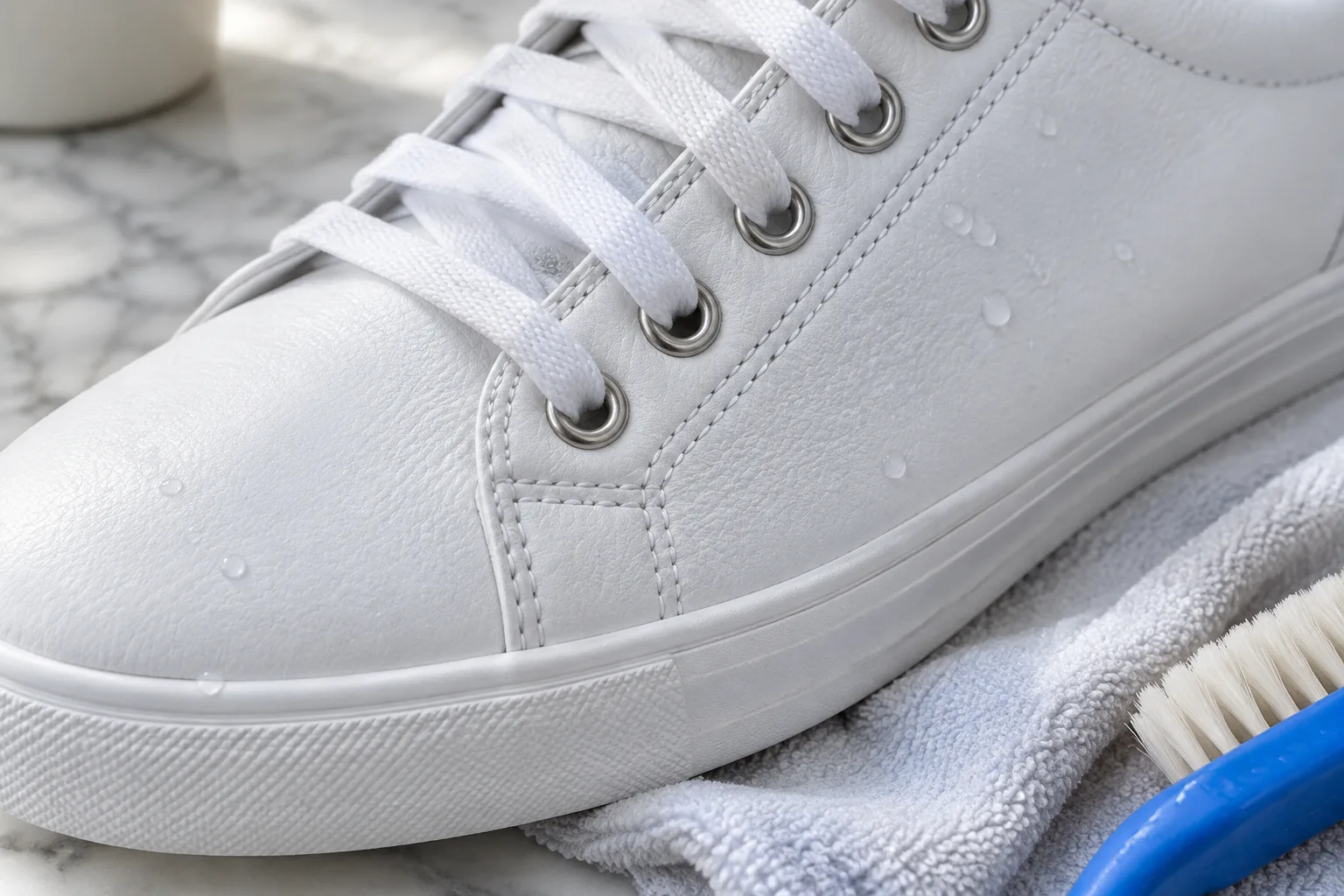
Fifteen minutes once a week, ideally the same evening each time, does more than a two-hour deep clean every other month. The weekly pass is simple: a soft, barely damp cloth over the upper, a dry cloth immediately after, and a quick look at the midsole and the outsole edge. That is it. No soap, no brush, no product. The purpose is to remove fresh grit before it works into seams and stitching.
Soft cotton works better than microfiber for leather uppers. Microfiber grabs lint and can drag across a matte finish. An old cotton T-shirt, cut into squares, is close to ideal. Wring the cloth until it stops dripping. A wet cloth held against leather for even a minute can leave a water ring, and on untreated leather that ring is nearly impossible to remove evenly.
The midsole deserves separate attention because it is white on most casual sneakers and it yellows. A dry magic eraser, used lightly and only on the rubber, lifts scuffs that a cloth cannot. It works by abrasion, so it should be used sparingly. Twice a month on the worst spots is plenty. Pressing hard on a rubber midsole slowly removes the smooth surface and leaves it more porous and more likely to stain next time.
Suede and canvas need different handling entirely
The wipe-and-wait routine works for leather. Suede is a different material with different failure modes. Water is the enemy, and so is brushing too hard. A suede brush, used dry, in one direction, restores the nap after a day of wear. A suede eraser handles scuffs on the upper. Neither should be applied to wet suede. If the shoe gets soaked, the correct move is to stuff it with newspaper, let it dry away from heat, and brush once it is fully dry, not before.
Canvas is more forgiving but stains differently. A canvas sneaker that gets wet and is not cleaned will show a tide line where the water evaporated. The fix is to clean the whole panel, not just the spot, with a mild soap solution and a soft brush. A toothbrush works well at the seam between canvas and rubber. Rinse with a clean damp cloth, not under a tap.
One rule crosses all three materials: never put a sneaker in a washing machine. The agitation breaks down the midsole foam, distorts the upper, and can warp the shape permanently. A canvas slip-on might survive one cycle and look fine, then fail six months early because the cushioning has been crushed.
The ten-minute deep clean at the change of season
Four times a year, roughly at the change of each season, the weekly routine expands into a short deep clean. Laces come out and go into a bowl of warm water with a drop of mild detergent. Insoles come out and get aired. The upper gets a proper clean with a leather-safe solution and a soft brush, working in small circles and wiping as it goes.
The deep clean is also the moment to condition leather. A small amount of leather conditioner, worked in with a finger or a soft cloth, keeps the upper from drying and cracking at the flex point, which is where the first visible aging shows up. Too much conditioner softens the leather and makes it sag. A pea-sized amount per shoe is generally enough. Let it absorb for ten minutes, then buff off the excess with a dry cloth.
Laces take about an hour to air-dry. Insoles need longer, ideally overnight, and should be placed somewhere with airflow rather than on a radiator. Heat warps foam. A pair of insoles left on a warm surface will come back slightly curved and never sit flat again.
Drying is where most routines go wrong
The single most common mistake in sneaker care is drying them badly. Shoes left near a radiator, on a sunny windowsill, or in a hot car will crack at the flex point and shrink slightly at the toe. Leather dries at room temperature over about twelve hours. Foam takes longer, sometimes a full day. Patience here prevents most of the damage that a deep clean is meant to fix.
Stuffing the shoe with newspaper serves two purposes: it holds the shape while the material dries and it pulls moisture out from the inside. Change the paper once after a few hours if the shoe was soaked. Cedar shoe trees work even better for leather, because cedar absorbs moisture and holds form, but they are optional. Rolled-up paper works well enough.
Air circulation matters more than air temperature. A shoe left in a closed closet after a wet walk can develop mildew inside the lining within a day. Leaving it near an open window or a fan for an hour before storing it makes a visible difference over a season.
What goes on the leather and what stays off it
The product shelf for sneaker care is crowded, and most of it is unnecessary. A leather-safe cleaner, a conditioner, a suede brush, a suede eraser, and a dry magic eraser for the midsole cover almost every situation. That is the whole kit. Everything else, from waterproofing sprays to color-restoring creams, solves a specific problem most shoes never develop.
Waterproofing sprays deserve a caveat. A fluoropolymer spray applied once at the start of a wet season can help a suede shoe survive a drizzle, but it changes the surface feel and needs reapplication. On smooth leather, it is largely redundant, because leather is already fairly water-resistant when conditioned. On canvas, it helps with light rain and does nothing for a downpour.
Some products should stay off leather entirely. Bleach, even diluted, strips the finish. Baking soda paste, a popular internet remedy for odor, leaves a white residue in stitching that is hard to rinse out. Rubbing alcohol can lift a scuff but will also lift dye if used too freely. A little goes a long way, and on colored leather it is safer to test on the inside of the tongue first.
Odor is a moisture problem, not a smell problem
Sneakers that smell are usually sneakers that stay damp. The fix is not a stronger deodorizing spray. It is letting the shoe dry fully between wears and rotating pairs when possible. A shoe worn two days in a row never fully dries, and the bacteria that cause odor thrive in that environment. The single best odor routine is a day of rest between wears and an occasional airing in sunlight, which is mildly antimicrobial.
For persistent odor, a sprinkle of baking soda inside the shoe overnight, shaken out in the morning, helps. So does replacing insoles once a year, because foam insoles trap odor at a level that cleaning cannot reach. Cedar insoles or cedar shoe trees also help, but they work by absorbing moisture, not by perfuming the shoe. A shoe that smells of cedar and a shoe that is dry are two different things, and only the second one stays fresh.
Storage and rotation add years, not months
A sneaker stored in a dark, dry place with cedar inside holds its shape and its finish longer than one tossed into a pile by the door. The pile matters more than people realize: shoes pressed against each other for weeks develop creases at the sides and transfer color between uppers. A cheap shoe rack solves this entirely.
Rotation is the other lever. Two pairs worn alternately will each last noticeably longer than one pair worn every day, because each gets a full drying cycle between wears. The math is not perfectly one-to-one, but the difference is real and shows up within the first year at the flex point and the heel lining. For anyone who wears sneakers most days, two pairs is the minimum sensible rotation, and three is better.
The deeper point is that sneaker care is mostly a question of small, frequent actions rather than occasional heroics. A pair that gets wiped on Sunday evening, aired overnight, and stored with a little cedar will outlast a pair that gets scrubbed once and then left by the door for a month. The shoes do not need much. They need attention before the damage sets, and they need it on a schedule that fits into an ordinary week.