

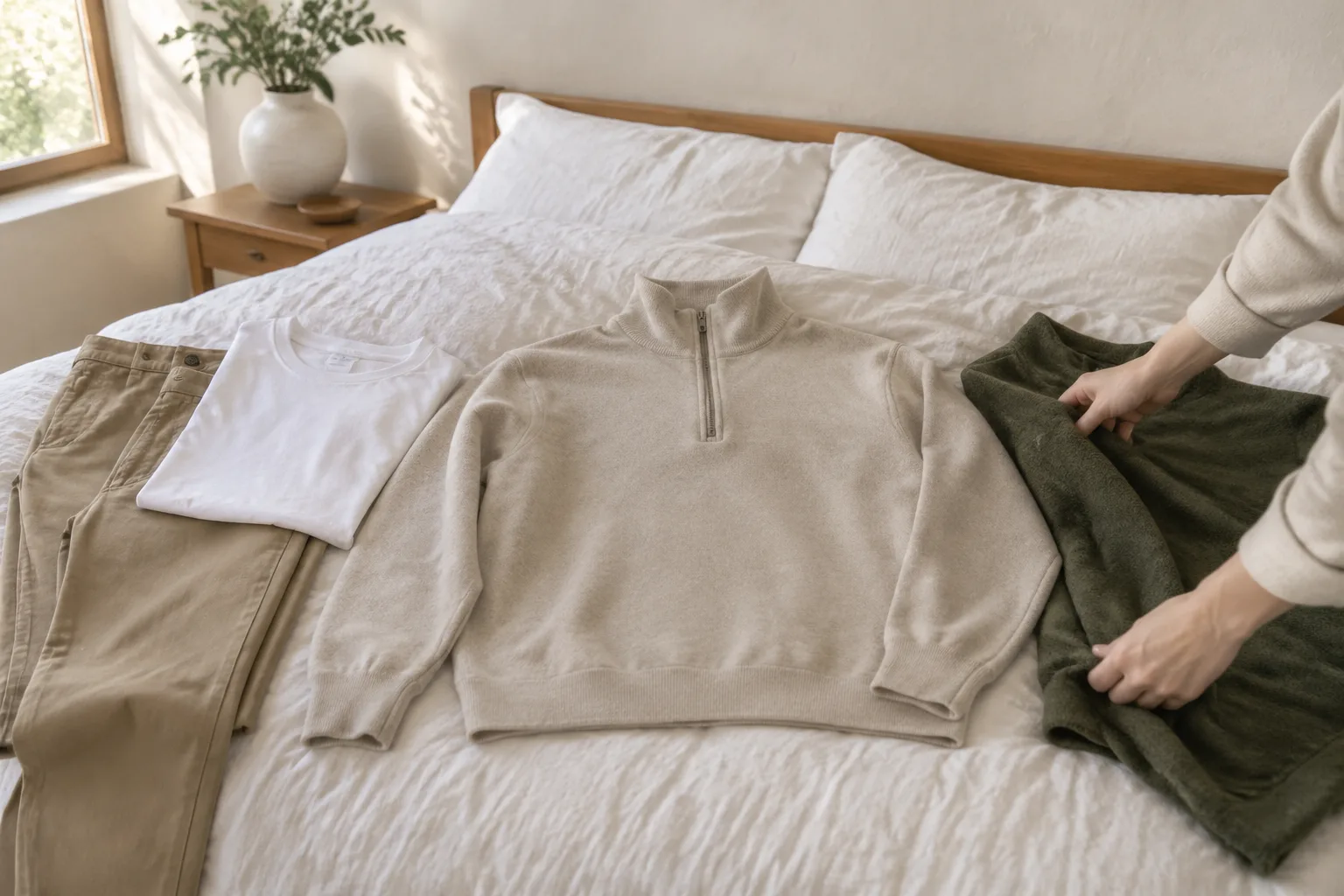
The Half-Zip, Worn Three Ways
Three outfits hang in a closet in late October, and all three begin with the same garment: a half-zip pullover in a wool blend, oatmeal colored, with a collar that stands up on its own. The zipper runs from the sternum to the chin, and the pull sits somewhere between a sweater and a jacket on the warmth scale. It is not a hoodie, though it borrows the ease. It is not a quarter-zip in the technical sense, though the two get confused at the register. The half-zip is a specific animal, and it earns its keep by doing three separate jobs, each one requiring a different set of decisions about what goes underneath, what goes over, and how far the zipper travels.
The garment's history is shorter than people assume. The half-zip as a civilian staple arrives from sportswear, from cycling jerseys and ski midlayers, and it still carries that lineage in the way the collar stands and the zipper stops short of the waist. What makes it useful in ordinary life is exactly what made it useful on a bike: ventilation without removal. A full-zip jacket can be opened all the way and taken off; a pullover cannot be opened at all without disturbing the whole outfit. The half-zip splits the difference. The chest stays covered, the neck breathes, and the hands never leave the sleeves.
The Zipper as a Thermostat
Watch how people actually wear the thing and the zipper is almost never at the same height twice. In a heated office it sits at the collarbone, open two or three inches, collar folded flat. On a platform at 7:40 in the morning it is pulled to the chin, collar up, the metal tab cold against the throat for the first minute. The zipper is a thermostat with about six positions, and each position changes the silhouette: zipped high, the collar frames the jaw and the shoulders look narrower; open wide, the front panels fall apart and the layer reads as a vest with sleeves. Most wearers find one setting and stay there for years, which is a waste of the garment's only moving part.
The fabric matters more than the cut. A half-zip in a cotton fleece is a weekend object, soft and slouchy and prone to pilling under the arms. A half-zip in a fine-gauge merino is a different class of thing entirely: thin enough to sit under a blazer, warm enough to replace a sweater, and it holds the collar upright without any interfacing. The wool blend in that closet is the second kind, and it has survived four winters because the collar has structure and the zipper pull is metal rather than plastic. The plastic pulls on cheap versions fail first, usually at the base of the teeth, and once a zipper separates at the bottom it is finished.
Way One: The Office Layer Over a Shirt
The first outfit is the one with the least room for error: a half-zip worn to an office where the dress code is business casual and the building's heating is unreliable. The shirt underneath is a light blue oxford, collar points out, top button open. The half-zip goes over it with the zipper pulled down to mid-chest, which lets the shirt collar sit outside the knit collar and creates a clean V of blue against oatmeal. The trousers are charcoal wool, the shoes are brown leather, and the whole thing takes about ninety seconds to assemble.
The trick in this version is proportion. A half-zip worn over a shirt should hit at the hip bone, not the thigh, or the shirt tails will peek out below the hem and the line will break. The sleeves need to end at the wrist bone so the shirt cuff shows a half inch. And the collar of the pullover must be soft enough to lie under a jacket but structured enough to stand on its own when the jacket comes off, which it will, because the meeting room is always ten degrees warmer than the corridor.
What makes this outfit read as deliberate rather than accidental is the restraint. One color for the layer, one for the shirt, one for the trousers. No pattern. The half-zip is the only textured element, and the zipper itself provides the single line of metal that keeps the whole thing from looking like a school uniform. In a room of men in quarter-zips over polo shirts, the oxford collar and the slightly lower zipper pull separate the wearer from the crowd without anyone being able to say exactly why.
Way Two: The Weekend Layer Over a Tee
The second outfit is the one that gets worn on Saturdays, and it is the most common version of the half-zip in the wild. A white heavyweight cotton tee, untucked, with the half-zip over it and the zipper pulled down to the sternum. Dark jeans, broken-in sneakers, maybe a canvas tote. The collar of the tee sits inside the collar of the pullover, and the neckline stays open enough to show the white cotton at the throat. This is the version that appears in every fall lookbook, and it works because the tee provides a clean, neutral base that lets the knit do the talking.
The failure mode here is the tee that is too thin. A cheap white tee under a half-zip will show every seam and every fold, and the collar will collapse within an hour. A heavyweight tee holds its shape and gives the neckline a crisp edge. The other failure is the zipper pulled too high, which closes the collar around the throat and makes the whole thing look like a golf garment. The zipper at the sternum, open four inches, is the correct setting: it shows the tee, it ventilates, and it keeps the collar from swallowing the neck.
This version is also where color does the most work. Oatmeal over white is quiet. Charcoal over white is sharper. A deep green or a rust over white is the version that gets compliments, because the tee provides a bright field and the knit provides the color. The half-zip in this outfit is doing what a sweater does, but with the added benefit that it can be opened when the afternoon sun hits the patio and closed again when the shade moves. The tee underneath never has to be adjusted.
Way Three: The Cold-Weather Layer Under a Coat
The third outfit is the one that gets the least attention and does the most work: the half-zip as a midlayer under a topcoat or a field jacket, in weather cold enough that a sweater alone will not do. Here the half-zip is zipped nearly to the chin, the collar standing up against the neck, and the coat goes over it with the lapels open. The hem of the half-zip sits below the coat's waist, and the sleeves are long enough to reach the base of the hand so no wrist is exposed when the cuff rides up.
This is the version that reveals whether the half-zip is any good. A thin merino works because it adds warmth without bulk, and the coat still hangs cleanly from the shoulder. A bulky fleece does not work, because it fights the coat's armhole and makes the whole silhouette look stuffed. The collar is the key detail: a structured collar that stands on its own will hold its shape under a coat lapel, and when the coat comes off indoors the wearer still looks put together. A floppy collar collapses under the coat and looks like a folded-down shirt collar when revealed.
The zipper setting in this version is almost fully closed, which is the only time the half-zip functions as a true neck covering. The metal tab sits just below the chin, and the collar covers the throat. This is the setting that makes the garment worth owning in January, when a crewneck sweater leaves a gap at the neck and a scarf is one more thing to lose. The half-zip closes that gap without the bulk of a turtleneck, and it opens again the moment the wearer steps into a warm room.
What the Three Outfits Share
All three versions depend on the same two decisions: the collar and the zipper pull. The collar must have enough structure to stand when it needs to and enough softness to lie flat when it does not. The zipper must be metal, smooth, and short enough that it never reaches the waist. A half-zip that gets these two things right will work in all three outfits. One that gets them wrong will only work in the weekend version, and even then it will look tired by the second season.
The garment also rewards a specific kind of restraint in the rest of the outfit. In all three versions, the half-zip is the only piece with a visible mechanism, the only piece with a metal detail, and the only piece that can change its shape during the day. The shirt, the tee, the trousers, and the coat all stay the same from morning to evening. The half-zip is the one thing that adapts, and that adaptability is the reason it earns a place in the closet rather than a drawer.
The Zipper Pull That Fails First
There is a small, specific failure that separates a half-zip that lasts five years from one that lasts one. It happens at the base of the zipper, where the two halves of the tape meet the slider. On a cheap garment, the plastic pull and the thin tape create a stress point that gives way after a few hundred cycles, and once the slider separates from the tape the zipper cannot be repaired without replacing the whole thing. On a good garment, the metal pull and the reinforced tape at the base absorb that stress, and the zipper outlasts the fabric.
This is why the half-zip is one of the few garments where spending more actually buys something measurable. The difference between a forty-dollar version and a two-hundred-dollar version is not the label or the color; it is the zipper, the collar structure, and the seam at the base of the tape. A person who wears the garment three times a week will cycle that zipper a thousand times a year, and the cheap version will fail inside eighteen months. The expensive version will still be cycling when the elbows wear through.
The Collar Folded Down, and Why It Rarely Works
There is a fourth way to wear the half-zip that almost never works, and it is worth naming because so many people try it: the collar folded down flat, zipper open, the whole thing worn like a cardigan. The problem is that the collar of a half-zip is cut to stand, which means it has interfacing or a double layer of fabric that does not drape. Folded down, it creates a stiff ridge around the neck and a visible line where the fold sits. The garment looks like it is fighting itself.
The exception is a very soft merino half-zip with a lightly structured collar, worn open over a collared shirt, where the fold is only an inch deep and the collar lies almost flat. Even then, the fold tends to creep back up within an hour, and the wearer spends the day pushing it down. The half-zip wants to be zipped at least partway. Fighting that instinct is the fastest way to make the garment look wrong.
One Garment, Three Settings, One Closet Hook
The three outfits in that closet share a single hanger, which is the practical argument for the half-zip over any of its cousins. A crewneck sweater cannot be ventilated. A full-zip jacket is too casual for the office and too warm for the weekend. A quarter-zip in the technical sense is cut for sport and looks wrong with wool trousers. The half-zip sits in the middle of all three, and the zipper is the mechanism that lets one garment cover three different rooms, three different temperatures, and three different levels of formality without changing anything but the pull.
By the end of October, the oatmeal half-zip has been worn to a Tuesday meeting with the zipper at mid-chest, to a Saturday market with the zipper at the sternum, and to a cold walk home with the zipper at the chin. The collar has stood up and lain flat and stood up again. The metal pull has cycled more times than the wearer can count. It hangs on the same hook it has hung on for four winters, and it will hang there for a few more, which is the only review that matters.