

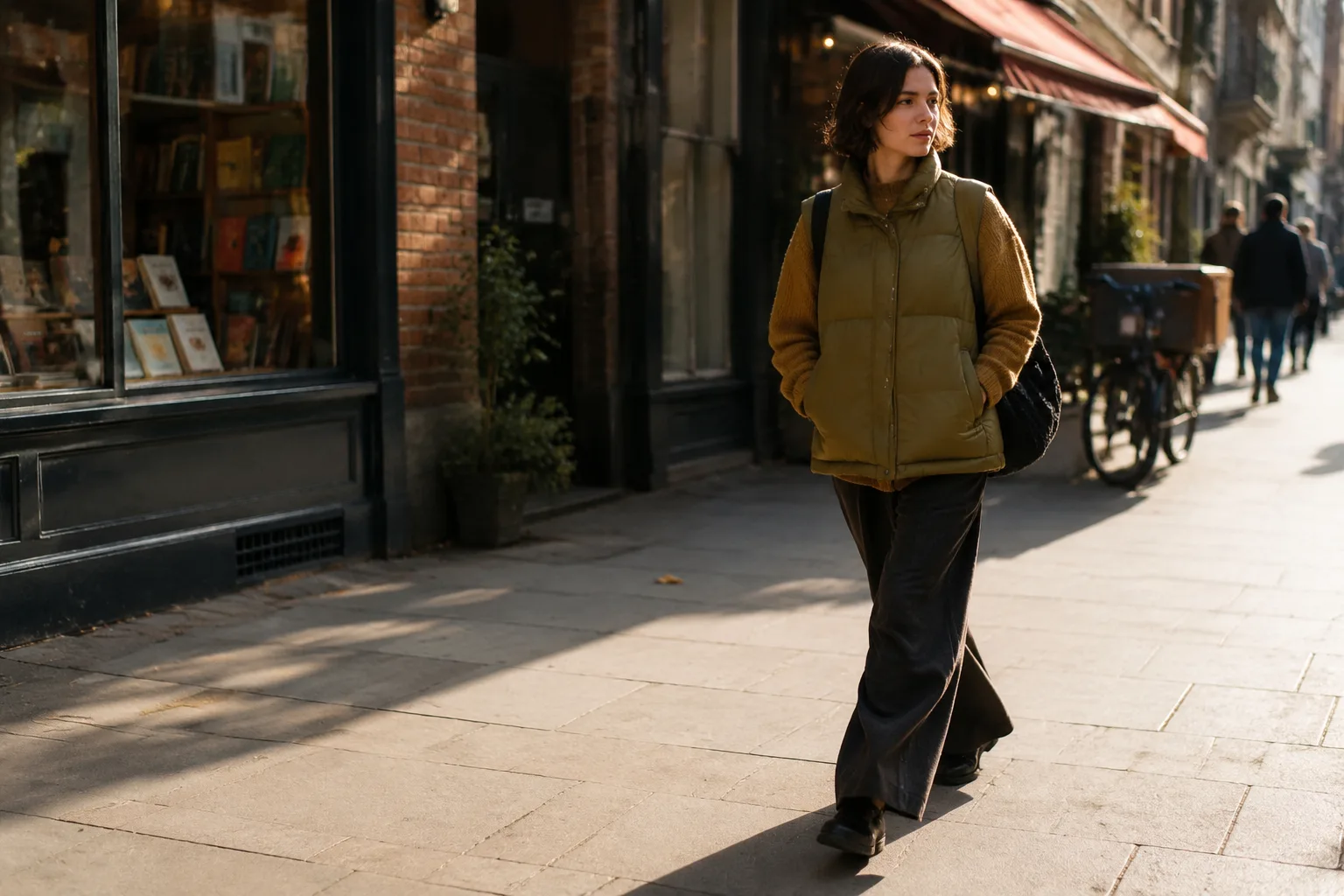
The Puffer Vest, Taken Into Town
The puffer vest has a reputation problem, and it is mostly a geography problem. In the mountains, on the ski lift, at the trailhead, the vest is obvious equipment: a core-warmer that leaves the arms free for poles, ropes, or a camera. In town, on a Tuesday, on the walk from the parking garage to a lunch counter, the same garment invites a squint. It reads as a costume of the outdoors worn indoors, a piece of gear that wandered off the mountain and got lost among the brick.
That squint is unfair, and it is also useful. The vest is one of the few garments that can carry a whole outfit if it is chosen with the same care as a jacket, and it can sink an outfit just as fast if it is treated as a last-minute addition. The difference between the two outcomes has almost nothing to do with brand and almost everything to do with three things: the baffle, the proportion, and the town.
What the Baffle Is Actually Doing
Most puffer vests sold today are built from the same basic recipe: a shell of nylon or polyester, a fill of down or synthetic insulation, and horizontal stitching that creates the puffy tubes called baffles. The baffle is the whole design. A vest with tight, narrow baffles looks technical and lean, almost like a fleece with ambitions. A vest with wide, deep baffles looks like a sleeping bag with armholes, and it wears that way.
Narrow baffles tend to sit closer to the body and read as more urban. Wide baffles trap more air and read as more alpine. Neither is better in the abstract. A person walking a dog through a cold city park in February does not need the same insulation as someone standing still on a belay ledge. The mistake is buying the alpine version for the park and then wondering why the mirror looks like a rescue sled.
There is also the question of fill. Down compresses smaller and lofts higher for its weight, which matters if the vest will be stuffed into a bag. Synthetic holds warmth when damp and costs less, which matters if the vest will be worn in drizzle or snow that turns to slush. For town use, synthetic is often the smarter buy. A vest worn over a sweater on a wet commute does not need expedition-grade down, and the price difference is real.
The Proportion Problem Nobody Warns About
A puffer vest adds bulk exactly where the eye goes first: the torso. It stops at the waist or hip, which means it creates a hard horizontal line across the middle of the body. That line is the whole game. If the vest ends at the widest part of the hips, it makes the wearer look wider there. If it ends just above the hip bone, it can make the legs look longer. If it ends mid-thigh, it becomes a different garment entirely, closer to a sleeveless coat, and it needs a different set of clothes underneath.
The most forgiving length for town is the one that hits at the high hip, roughly where a jean pocket starts. It clears the widest part of the body and leaves the legs visible. A vest that stops at the natural waist works too, but it demands high-rise trousers or a skirt that sits at the same line, otherwise a strip of shirt shows and the whole thing looks accidental.
Then there is the shoulder. Puffer vests have no sleeves, so the armhole is the seam that decides whether the vest looks tailored or borrowed. A armhole that cuts too far in pinches the chest and makes the vest ride up. One that hangs too low swallows the shoulders and turns the torso into a rectangle. The fix is simple and unglamorous: try the vest on over the thickest sweater it will ever be worn with, then raise both arms. If the hem climbs past the belt, size up or walk away.
Layering Underneath Is Where the Outfit Is Won
The vest is a frame, and the frame is only as good as the picture inside it. A puffer vest over a plain T-shirt looks like a vest over a plain T-shirt. A puffer vest over a chunky cable knit, a flannel, or a hoodie looks like a decision. The layer underneath provides texture, and texture is what keeps the vest from reading as a single flat balloon of nylon.
For cold town days, a mid-weight sweater in wool or a wool blend is the reliable choice. It adds warmth without adding much bulk, and its surface breaks up the sheen of the vest shell. A hoodie underneath is the casual version, and it works if the hood is thin enough not to bunch at the neck. A flannel shirt works in fall and early spring, but only if the vest is sized to accommodate the extra fabric at the chest.
The layer below the waist matters just as much. Skinny jeans under a puffy vest create a silhouette like a mushroom, wide on top and thin below. Straight-leg or relaxed trousers balance the volume. A wide-leg wool trouser under a narrow-baffle vest is one of the more convincing town outfits available, and it costs nothing extra if the trousers are already in the closet.
The Color Question, Settled Badly
Puffer vests come in two color families: the ones that look like equipment and the ones that look like clothing. The equipment family is black, navy, olive, and a very specific orange that only works on a mountain. The clothing family is broader: rust, cream, forest green, a dusty rose, a deep burgundy. The equipment colors are safer and duller. The clothing colors are more interesting and harder to wear.
A black vest is the default for a reason. It disappears into almost any outfit and it does not ask for attention. The cost is that it also does not give any. A rust or forest vest over a grey sweater and dark trousers gives the outfit a center, a reason to look. The risk is that a strong color in a puffy shape can tip into costume, especially in a bright shade. The middle path is a deep, muted color: olive that leans brown, burgundy that leans black, a navy so dark it reads as charcoal until the light hits it.
Shiny shells are their own problem. A high-gloss nylon vest catches every overhead light and makes the wearer look like a wrapped piece of candy. A matte or semi-matte finish reads as fabric rather than plastic and sits better in a town setting. This is one of the few places where the cheaper synthetic shell often beats the expensive one, because the expensive shells tend to be glossier.
Where the Vest Belongs in a Town Outfit
The vest works best in town when it replaces a jacket rather than layering under one. Worn over a sweater with a scarf at the neck, it handles a dry cold day from roughly freezing to the mid-forties. Worn over a hoodie, it handles the same range with a more casual result. Worn under a wool coat, it becomes a hidden mid-layer and stops being a fashion object at all, which is fine but defeats the purpose.
It does not work in rain. The shell will shed a light drizzle, but a real downpour soaks the seams and the fill, and a wet puffer vest is a heavy, sad thing. It does not work in wind that cuts through nylon, which is most serious wind. And it does not work over a suit jacket, no matter how many photos suggest otherwise. The armhole will not accommodate the jacket sleeve, and the result is a bunched, uncomfortable mess that photographs better than it feels.
The best town use is the transitional one: the walk to the train, the school pickup, the Saturday market, the outdoor lunch that starts in sun and ends in shade. The vest is a garment for moving between temperatures, and town in fall and spring is a sequence of temperature changes. That is its natural habitat, more than the mountain.
The Boot and the Hem
Footwear decides whether the vest reads as gear or as clothes. A puffer vest over trousers with a leather boot or a clean sneaker reads as a considered outfit. The same vest with a heavy hiking boot reads as a person who came from a trail and forgot to change. That is not a judgment of hiking boots; it is a note about coherence. The vest is already the most outdoorsy thing in the outfit, and piling a second outdoorsy thing on the feet doubles the signal.
The hem of the trousers matters too. A cuff that breaks once over the shoe keeps the line clean. A cuff that pools adds visual weight at the bottom, which fights the volume at the top. A cropped trouser that shows the ankle under a puffer vest is a summer move applied to winter, and it looks cold because it is cold.
Packing One for a Trip That Includes Both
The real test of the puffer vest is the trip that starts in a city and ends somewhere with trees. A single vest, packed flat, can serve both if it is chosen with the town in mind. The narrow-baffle, matte-shell, high-hip version packs small, looks right on a street, and still holds warmth on a cold morning walk. The wide-baffle expedition vest does the opposite: it is superb on the trail and conspicuous at the hotel breakfast.
One practical note: a vest with a stuff sack or a packable pocket is worth the small premium for travel, because it compresses to the size of a grapefruit and lives in a daypack without complaint. A vest that cannot pack is a vest that gets left in the hotel room, and a vest left behind is a vest that was the wrong purchase.
The puffer vest taken into town is not a compromise or a costume. It is a layering tool that happens to look like a statement, and it rewards the same attention any other piece of clothing rewards: a fit that follows the body rather than swallowing it, a color that belongs to the wearer's closet, and a hem that lands where the legs begin. Get those three right and the squint disappears. The vest stops being gear that wandered in and becomes the reason the outfit works.