

The Sport-and-Tailoring Mix, Balanced Right
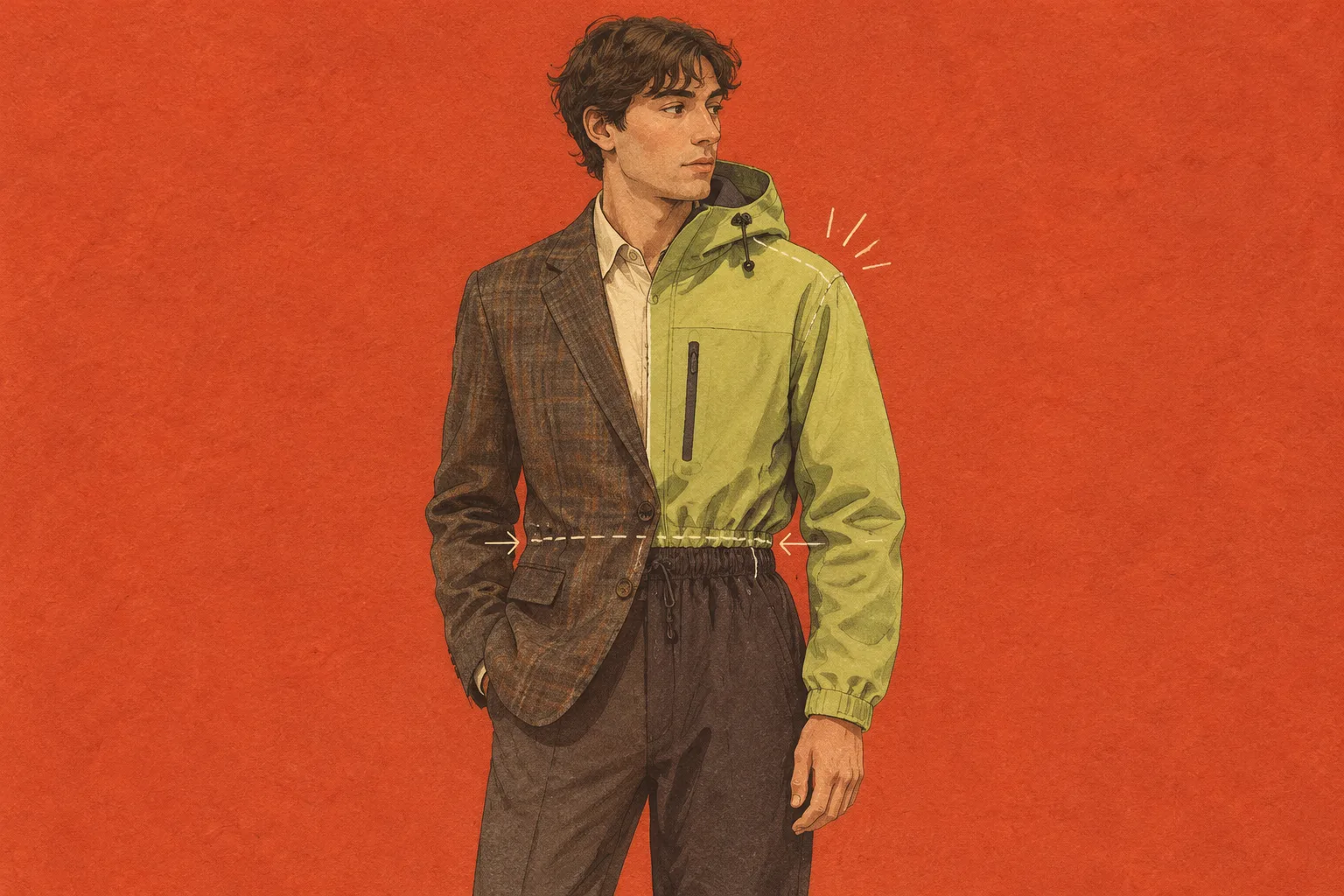
A gray flannel trouser with a drawstring waist. A blazer cut from the same technical shell fabric as a rain jacket. A pair of derbies stitched onto a sneaker sole. These are the objects of a decade-long negotiation, and the negotiation has a name now: sport-and-tailoring. The phrase gets used loosely, usually to describe anything expensive that looks comfortable, but it refers to something narrower and more interesting. It names the attempt to take the two great systems of Western menswear, the structured suit and the performance garment, and make them occupy the same body at the same time.
The results have been uneven. That is the honest part. A lot of what gets sold under this banner is tailoring with a sporty detail bolted on, a suit jacket with a zip pocket where a welt pocket should be, or a tracksuit in a suiting colorway. The mix only works when both sides give something up. The tailoring has to surrender some of its stiffness, and the sportswear has to surrender some of its slouch. The seam where they meet is visible, and pretending otherwise is where most of these clothes fail.
The suit was never as rigid as the story says
There is a piece of received wisdom about tailoring that says it was always formal, always stiff, always built on horsehair canvas and shoulder pads and the stern geometry of the boardroom. The history is messier. The blazer began as a rowing club jacket, a navy wool coat that oarsmen wore on deck. The polo shirt came off a tennis court. The trench coat was a military garment before it was a civilian one. Knitted ties, soft tweed, the whole apparatus of country tailoring, all of it was already a loosening of the dress code.
So the sport-and-tailoring mix is not a new idea. It is a return to a habit that tailoring had before the twentieth century hardened it into a uniform. The difference is the materials. A hundred years ago, the sporty half of the equation was wool in a heavier weave. Now it is nylon, elastane, bonded seams, and fabric that sheds water and stretches in four directions. That changes what the seam between the two worlds can hold.
A soft shoulder is the hardest thing to make
The single clearest test of whether a jacket belongs to this category is the shoulder. A traditional suit jacket has structure in the shoulder: canvas, sometimes padding, a roped sleevehead that stands up and gives the wearer a kind of architectural silhouette. It looks commanding and it feels like a cage after a few hours. A sport coat's shoulder is built to move, so it is soft, unpadded, and the sleevehead is set in flat.
Getting a soft shoulder to hang cleanly is genuinely difficult. The structure is what hides a bad pattern. Remove it and every flaw in the cut shows. This is why the cheapest jackets in the sport-and-tailoring space look so bad: the maker removed the padding to hit the price but did not fix the pattern underneath, so the jacket collapses at the shoulder and bunches at the armhole. A good soft-shouldered jacket costs more to develop than a structured one, even though it uses less material.
There is a second consequence that rarely gets mentioned. A soft shoulder changes how a person stands. The wearer stops bracing. Anyone who has spent a day in a padded suit knows the small relief of taking the jacket off, and a soft jacket gives a fraction of that relief without the removal.
Performance fabric in a tailored cut is a different animal
The other direction of the mix is harder to get right than the soft-shoulder problem, and it gets less attention. This is the tailored garment made from a technical fabric: a blazer in a four-way stretch shell, a trouser in a nylon blend that moves and dries and does not wrinkle. The promise is obvious. The execution frequently fails because performance fabric behaves nothing like wool.
Wool drapes. It has weight and memory, and a tailor can press a seam into it so the seam stays. A synthetic shell is lighter, springier, and it resists the press. Cut it into a suit shape and it tends to fight the pattern: the lapel rolls awkwardly, the chest does not lie flat, the hem of the jacket has a slight wave. The first generation of these pieces, mostly from the last ten years, showed exactly this. They looked like uniforms from a science fiction film about middle management.
The pieces that work tend to borrow from sportswear construction rather than force a tailored construction onto sporty cloth. Bonded seams instead of pressed ones. A raglan sleeve instead of a set-in sleeve, which sidesteps the armhole problem entirely. A cut that is closer to a coach's jacket than to a suit jacket. The garment stops pretending to be tailored and becomes something the body can actually move in, with a collar and a placket that read as formal from across a room.
The trouser is where the two systems actually agree
If there is one place where sport and tailoring genuinely merge without either side losing, it is the trouser. A wool flannel dress trouser and a technical hiking trouser have more in common than either would admit. Both are cut to follow the leg. Both need a crease or a seam line to look intentional. Both live or die on the rise and the break at the shoe.
The most convincing object in this whole category is a plain, flat-front trouser in a stretch wool blend, with a clean waistband, no cargo pockets, and a hem that ends just above the shoe. It reads as tailoring in a meeting and behaves like a track pant on a train platform. The drawstring waist version, the one with the elastic hidden inside the waistband, is the more interesting experiment because it admits what the wearer actually wants. The trick is that the drawstring has to be invisible from the outside. The moment the elastic shows, the trouser stops being tailoring and becomes athleisure with pretensions.
Shoes keep the two worlds from collapsing into each other
The footwear in this mix is where taste gets tested most publicly. A leather derby on a chunky rubber sole is now a common object, and it works for a specific reason: the leather upper keeps the formal signal, and the sole absorbs the punishment of a city pavement. The sole is doing real work. A person walking two miles a day between meetings and a station does not want a leather sole that wears through in a season.
What does not work is the shoe that splits the difference too evenly. A dress shoe upper on a running shoe midsole looks like a mistake because the proportions are wrong: the upper is too narrow and hard-edged for the soft, thick platform underneath. The successful versions tend to keep the sole relatively low and the upper relatively generous, so the eye reads one object rather than two glued together.
The color palette is doing more of the work than the cut
Ask why a particular sport-and-tailoring outfit looks right and the answer is often not the garment at all. It is the color. The pieces that succeed almost always stay inside a narrow range: charcoal, navy, olive, stone, black, and the occasional rust or faded blue. That range is not arbitrary. It is the palette that both tailoring and outdoor gear independently arrived at, which is why a technical jacket in olive sits comfortably next to a wool trouser in charcoal.
Introduce a bright performance color, the kind that belongs on a running vest, and the whole thing falls apart. The eye reads the bright piece as sportswear and the rest as costume. The mix depends on a shared vocabulary of muted tones, and the moment one garment speaks a different language, the outfit stops being a mix and becomes a collision.
What the wearer gives up, and what they get
The honest cost of this category is that nothing in it is the best version of what it imitates. A soft-shouldered jacket will never have the commanding line of a bespoke suit. A performance blazer will never be as weatherproof as a proper shell. The wearer trades peak performance in either direction for range, and range is the whole point.
What the wearer gets is a wardrobe that survives a day with multiple contexts in it. A morning on a bicycle, a midday meeting, an evening that turns cold and wet. Traditional tailoring forces a change of clothes between those contexts. Pure sportswear forces a loss of authority in the middle one. The mix, done well, carries a person through all three without a costume change, and that is a real thing to want from clothing.
The seam is the tell
Look closely at any garment that claims to sit in this category and find the place where the two systems meet. On a jacket, it is often the armhole, or the way the lining is attached, or the pocket construction. On a trouser, it is the waistband and the hem. The quality of the whole piece usually shows at that seam, because that is where the maker had to make a decision about which system wins.
The pieces worth owning are the ones where the seam is deliberate. A bonded pocket on a wool jacket, done cleanly, tells the wearer that the maker thought about the join rather than hiding it. A drawstring waist finished with the same attention as a tailored waistband says the same thing. The mix is not a compromise when it is made this way. It is a third thing, with its own rules, and the seam is where those rules get written.