
The Tennis Skirt, Reconsidered for Real Life
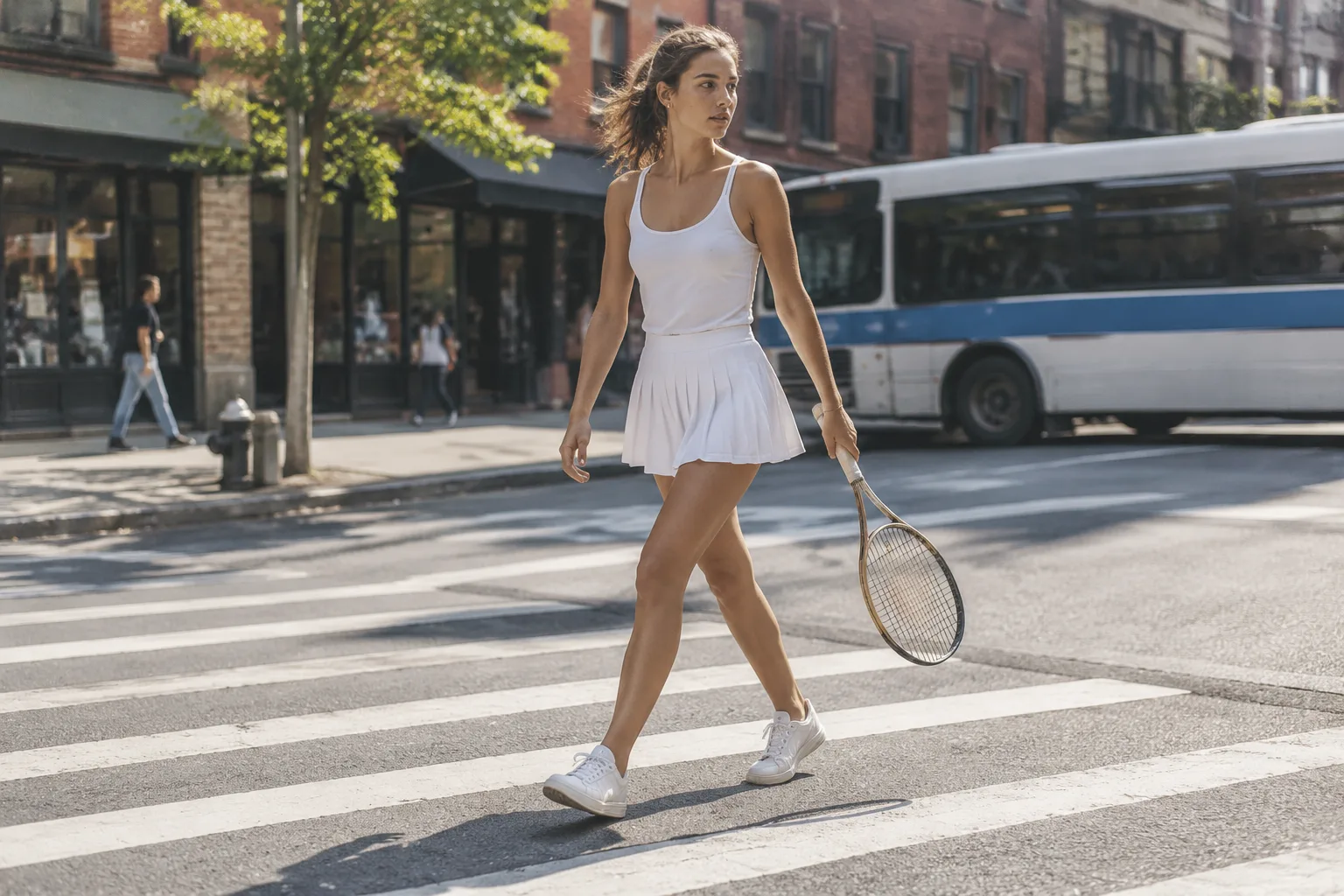
The tennis skirt has escaped. For decades it lived inside a narrow jurisdiction: four feet of baseline-to-service-line at a country club in July, worn by people who actually owned a racquet and knew how to keep score. Then, somewhere in the early 2020s, it crossed the fence and showed up at brunch, at the grocery store, on the subway, at a college lecture. The pleats went everywhere. And the strange part is that most of these skirts are not being worn for tennis at all. They are being worn for the walk from the car to a coffee shop, which is a very different physical enterprise.
That migration is worth taking seriously, because a garment built for one job is now being asked to do another. The tennis skirt was engineered for a specific set of movements: lunging forward, stopping hard on the balls of the feet, reaching across the body, sweating through a hundred and twenty minutes in direct sun. It was not engineered for sitting on a train bench for forty minutes, or crouching to pick up a dropped set of keys, or being worn without the tight shorts that always came underneath. The reconsideration, then, is not about whether the skirt is attractive. It clearly is. The question is whether it works away from the court, and for whom, and under what conditions.
What the Original Design Was Actually Solving For
A competitive tennis skirt is a piece of athletic equipment, and its features map onto real problems. The pleats or the A-line flare exist so the legs can split wide without the fabric tearing or binding. The inner shorts, usually tight and made of a stretch blend, do two jobs: they stop the thighs from chafing during repeated sprints, and they keep the skirt from flying up when the body rotates. The waistband is typically wide and flat, sitting against the lower abdomen rather than digging in, because a player spends the whole match twisting from the core.
Length is the other variable. Most court skirts stop somewhere between mid-thigh and just above the knee. That range is a compromise between coverage and mobility: long enough to stay decent during a lunge, short enough that the fabric does not catch on the back of the leg during a sprint. The fabric itself is usually a lightweight polyester or a poly-spandex blend, chosen for moisture wicking and quick drying, with enough structure to hold a pleat through a wash cycle.
None of that is decorative. Every element answers a physical demand. The trouble starts when the demand changes and the garment does not.
The Inner Shorts Are Doing More Work Than the Skirt
Here is the piece of the tennis skirt that gets discussed least and matters most: the built-in shorts. On the court, they are the functional core. Off the court, they are the reason the skirt is wearable at all, because a loose pleated skirt with nothing underneath is a wardrobe accident waiting to happen on a windy platform or a stairwell. The shorts are the safety mechanism.
But the shorts are also where the off-court version most often fails. Athletic inner shorts are cut close and short, usually with a three-to-five-inch inseam, and they are designed to sit flush against the skin during vigorous movement. That same flush fit becomes a problem during a long, low-activity day. The elastic can press, the seam can rub, and the fabric that wicked sweat beautifully on court now traps warmth on a heated bus. A person who buys the skirt for the silhouette and wears it for six hours of errands is asking the shorts to do a job they were never built for.
Some brands have noticed. There is now a whole category of tennis skirts with longer, softer inner shorts, or with a brief instead of a bike short, or with no inner layer at all and a separate underlayer sold alongside. Those variations exist precisely because the original design assumed a tennis match and the market no longer does.
Why the Silhouette Reads as Casual Rather Than Athletic
The reason the skirt slid so easily into everyday dressing is that its shape is forgiving in a way most athletic wear is not. Running shorts and leggings broadcast effort. They are tight, they are technical, and they signal that the wearer is either about to exercise or has just finished. The pleated tennis skirt reads as soft and slightly retro. It has volume, it moves, and it flatters a wide range of bodies because the flare skims the hip and thigh rather than gripping them.
That forgiving shape is the whole appeal. A person who would never wear a tight running short in public will happily wear a tennis skirt to lunch, because the skirt hides the parts that athletic wear exposes and the shorts underneath handle the practicalities. The garment offers the comfort of sportswear with the social permission of a skirt. That combination is rare, and it explains the migration better than any trend report could.
The Wind Problem Nobody Warns About
Anyone who has worn a pleated skirt in a city knows the specific anxiety of a gust on an open corner. The tennis skirt is light, and pleats catch air. On court this is fine, because the inner shorts are tight and the environment is controlled. On a street, at the top of an escalator, on a bridge, the skirt becomes a small sail. The shorts save the situation, but the wearer spends the day managing the hem with one hand, which is a low-grade tax on any outfit.
The fix is unglamorous: weight. A slightly heavier fabric, or a skirt with a wider waistband and more structured pleats, hangs better and lifts less. The trade-off is that heavier fabric is warmer, which matters in summer. There is no perfect answer here, only a series of compromises that the wearer has to make consciously. The skirt that behaves beautifully on a still, mild day can be a nuisance on a windy one, and pretending otherwise does the garment no favors.
Sizing and the Length Question
Tennis skirts are short. That is part of the design, and it is also the first thing a new wearer notices. On a tall frame, a skirt that hits mid-thigh on a smaller person can sit noticeably higher. On a longer torso, the waistband may land at an awkward point on the ribcage rather than the natural waist. These are not flaws in the garment so much as mismatches between a garment cut for a narrow athletic population and a much broader one now wearing it.
The practical response is to try before committing, and to pay attention to where the waistband actually sits rather than where the size chart says it should. A skirt that rides up when walking will ride up all day. A skirt with an adjustable or elasticated back panel forgives more than a fixed waist. And a slightly longer version, in the sixteen-to-eighteen-inch range rather than the fourteen-inch tournament cut, tends to work better for standing, sitting, and commuting than the shortest option on the rack.
The Case for Wearing It Deliberately
The tennis skirt is not a universal garment, and treating it as one is where the disappointment comes from. It works beautifully in specific conditions: warm weather, moderate activity, a setting where a short pleated skirt is socially normal, and a wearer who is comfortable managing the hem and the shorts. It works less well in cold weather, on long seated commutes, or in any situation that demands the wearer forget what they are wearing.
The honest recommendation is to treat it as a summer piece with a clear job. Pair it with a simple top and flat shoes and it reads as intentional. Layer a light jacket over it and it holds up into early evening. Wear it with the inner shorts it came with, and know that those shorts are the reason the whole thing functions. The skirt is not a magic garment that solves dressing; it is a well-designed piece of athletic wear that happens to have a flattering shape, and it rewards being worn with that in mind.
What the Skirt Costs in Maintenance
Pleats are the quiet expense. A pleated skirt that is washed and dried carelessly loses its crisp edges within a season, and once a pleat softens it does not come back without an iron and some patience. Athletic fabrics also hold odor in a way that cotton does not, especially the polyester blends used for moisture wicking, and a skirt worn for a full day of errands accumulates more than one worn for a single match and washed immediately.
The care routine is simple but not optional: cold wash, hang to dry, and a light press along the pleat lines every few wears. A skirt treated that way will hold its shape for years. One tossed into a hot dryer will go limp by August. That is a real cost, and it is the kind of thing a buyer should know before the first wash rather than after.
The Version That Belongs in a Real Wardrobe
The tennis skirt earns its place in a real wardrobe when it is chosen for the life it will actually live. That means a fabric with a little weight so the pleats hold and the hem stays down, an inner short that is comfortable for hours rather than minutes, a length that suits the wearer's frame and the places they go, and a waistband that sits where the body bends rather than where it pinches. Those four decisions matter more than the brand on the tag.
A skirt bought with those questions answered becomes the piece reached for on a warm Saturday, the one that goes from a market to a late lunch without a change, the one that gets complimented and then quietly does its job. A skirt bought on silhouette alone becomes the one that stays in the drawer after the first windy afternoon. The difference is not taste. It is whether the buyer understood what the garment was built to do, and whether the day ahead of it matches.