

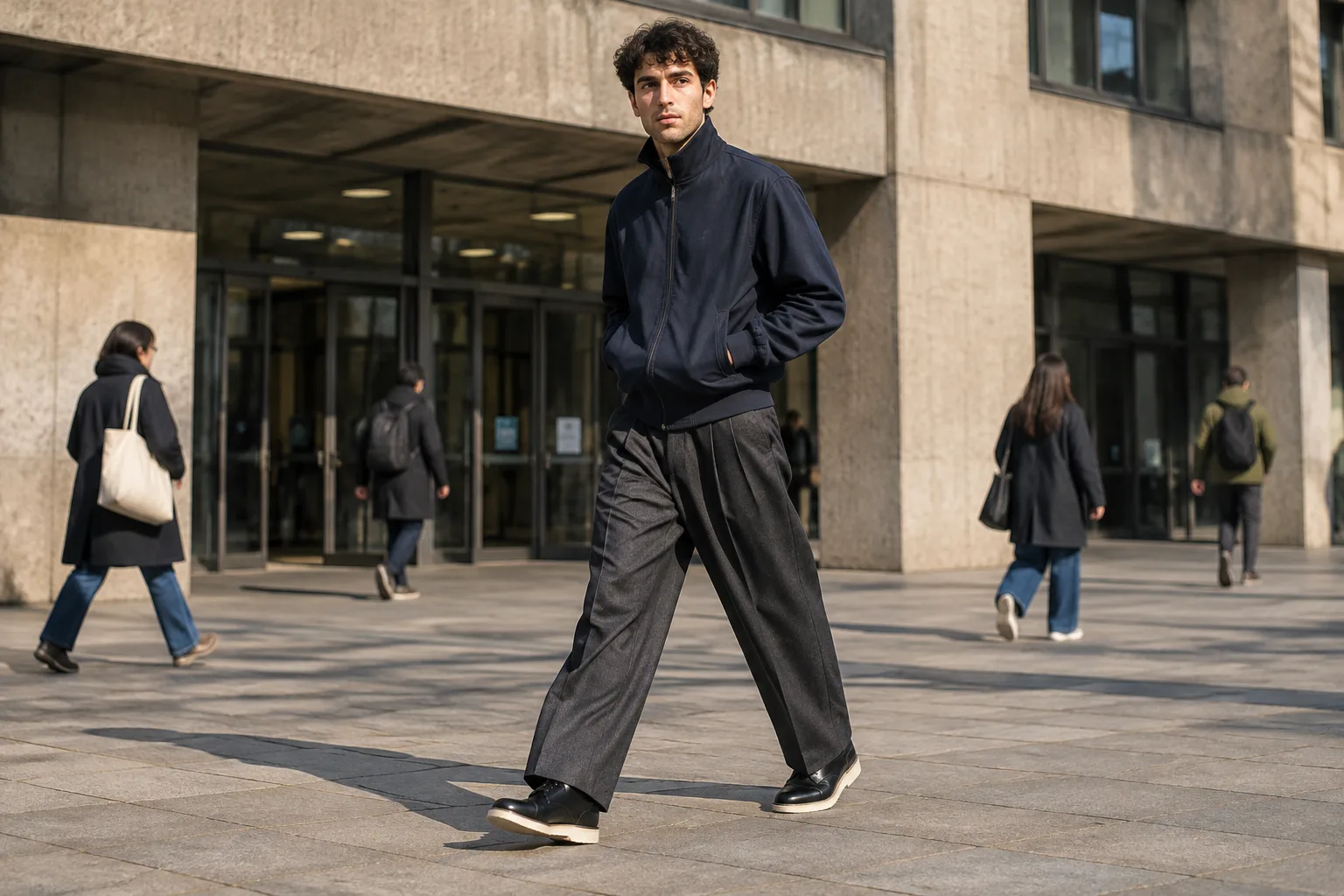
Track Jacket, Tailored Trousers: An Unlikely Pairing Done Right
A navy track jacket, the kind with a zip that ends an inch below the collarbone and a collar that stands up on its own, has spent the last several years migrating away from the gym. It turns up now under wool overcoats, next to pleated trousers, on men and women who have not jogged a step since secondary school. The pairing that once looked like a mistake, athletic top against tailored bottom, has become one of the more reliable outfits in circulation. The question worth asking is why it works, and where the combination stops working.
The pairing makes sense for a reason that is almost structural. A track jacket is soft, cropped at the hip, and cut with a raglan sleeve that leaves the shoulder line relaxed. Tailored trousers are the opposite: a hard waistband, a crease down the front, a fabric with enough body to hold a shape. Put them together and each one corrects the other's excess. The jacket keeps the trousers from reading as office wear. The trousers keep the jacket from reading as a warm-up.
That correction happens in a narrow band. Move the jacket too far toward performance (mesh panels, reflective piping, a chest logo the size of a hand) and the outfit collapses into a costume. Move the trousers too far toward formality (a knife-sharp crease, a high shine, a cuff that sits exactly on the shoe) and the jacket looks like something thrown on by accident. The successful versions live in the middle, and the middle is wider than it first appears.
The track jacket has been formalizing for decades
This is not a new idea so much as a slow drift. The track jacket began as functional kit, then became a leisure item, then a hip-hop staple, then a designer canvas. By the time luxury houses started cutting them in wool and silk, the garment had already accumulated enough cultural weight to sit next to almost anything. The tailored trouser took the same journey in reverse, loosening from a suit component into a standalone piece. Two garments that had drifted toward each other for thirty years finally met.
The collision shows up in ordinary places. A man on a morning train, jacket zipped to the sternum, trousers in a soft grey wool, sneakers clean but not new. A woman leaving a gallery opening, striped track top in cream, black trousers with a single pleat, a small shoulder bag. None of these people look like they are wearing a costume. They look like they made a decision and then stopped thinking about it, which is the highest compliment an outfit can receive.
Fabric weight decides whether the combination reads as deliberate
The single most common failure is a jacket that is too thin. A lightweight polyester track top, the sort sold for actual running, has no presence next to a wool trouser. It flutters where the trouser holds, and the eye reads the mismatch as error. The jacket needs some body: a brushed cotton, a heavy jersey, a wool blend, a nylon with a dry hand and a little stiffness. If the jacket can hold its own collar without help, it can hold its own against a crease.
Trouser fabric matters just as much, in the opposite direction. A very stiff, very formal cloth (a worsted wool with a hard finish, a flannel pressed into a blade) fights the casual top. The best partners are softer: a wool with some give, a cotton twill, a linen blend in summer, a corduroy in cold months. The trouser should look like it belongs to a person who owns more than one pair and does not iron them into submission.
There is a useful test. Pinch the trouser fabric between thumb and forefinger. If it feels like it would crease permanently, it is probably too formal. If it drapes and recovers, it will sit comfortably under a track jacket. The same test applies to the jacket: squeeze the sleeve. A little resistance is good. A sleeve that collapses into nothing will look cheap next to a structured trouser, no matter what it cost.
Proportion lives at the waistband
Most track jackets end at the hip bone or just below. Most tailored trousers sit at the natural waist or slightly under it. The overlap is small, and that small overlap is where the outfit either works or fails. A jacket that stops well above the waistband leaves a strip of shirt showing and creates a visible horizontal line across the middle of the body. A jacket that extends too far past the hip makes the legs look short and the torso look long.
The cleanest version has the jacket hem landing within an inch or two of the waistband, so the two pieces meet rather than gap or overlap heavily. Where a shirt shows, it should be a shirt chosen on purpose: a plain white tee, a fine-gauge knit, a button-down with the collar open. A graphic tee under a track jacket over tailored trousers is a different outfit with a different risk profile, and it usually reads younger and louder.
Rise matters on the trouser side too. A low-rise trouser under a cropped track jacket exposes the shirt and creates a stack of horizontal lines at the midsection. A mid or high rise, worn with the jacket open, lengthens the leg and gives the outfit a cleaner vertical read. This is not a rule about body type. It is a rule about where the eye travels.
The shoe is the tiebreaker
Footwear decides which way the outfit leans. A clean leather sneaker in white or black keeps the whole thing casual and lets the trouser do the formal work. A derby or a loafer pushes the outfit toward smart and demands a sharper jacket to match. A chunky running shoe drags the look back toward the gym and usually undoes the trouser entirely. The safe zone is a low-profile sneaker, a suede loafer, or a simple leather shoe with a thin sole.
What tends to fail is the halfway shoe: a sneaker with too much technical detailing, a boot with too much hardware, a shoe that is trying to be two things. The outfit already carries one contradiction, between athletic and tailored. A second contradiction at the foot makes the whole thing read as unresolved rather than intentional.
Color is where most attempts go wrong
The instinct is to match: navy jacket, navy trouser, or black on black. This can work, but it flattens the outfit into a uniform and removes the tension that makes the pairing interesting. The stronger move is a controlled contrast. A navy jacket over grey trousers. A cream jacket over black. An olive jacket over tan. The jacket and trouser should be clearly different in tone, but close enough in weight that neither looks like it wandered in from another wardrobe.
Stripes complicate this. A track jacket with a stripe down the sleeve or across the chest introduces a strong graphic element. When the trouser is plain, the stripe gives the outfit a focal point and a bit of speed. When the trouser is patterned (a check, a subtle plaid), the stripe competes and the eye has nowhere to rest. One graphic element per outfit is a durable rule, and it applies here more than almost anywhere.
The look has a ceiling, and it is lower than it seems
There is a version of this outfit that belongs in a magazine editorial and a version that belongs on a Tuesday. The editorial version uses a jacket with an exaggerated collar, a trouser with a dramatic break, and a shoe that costs more than the rest of the wardrobe combined. It photographs beautifully and is difficult to wear to a dentist appointment. The Tuesday version is quieter: a plain jacket, a soft trouser, a clean shoe, and a willingness to look slightly underdressed in a room full of suits.
The Tuesday version is the one worth owning. It survives weather, errands, and the occasional dinner. It does not require a particular body or a particular budget. It requires only that the jacket and the trouser agree on how seriously to take themselves, and that the person wearing them has stopped checking the mirror.
A note on the collar and the zip
Small hardware decisions carry more weight than they should. A metal zip reads sharper and more formal than a plastic one. A collar that stands up on its own frames the face and adds a bit of structure that pairs well with a trouser. A collar that flops flat looks casual and can make the outfit read sloppier than it is. The zip position matters too: fully zipped is severe, half zipped is relaxed, open is a third piece doing the work of a layer.
These are not rules so much as dials. Turning the collar up and the zip down moves the outfit toward the casual end without changing a single garment. Turning the collar down and the zip up moves it toward the formal end. The same jacket and trouser can produce three different outfits depending on two small gestures, which is more range than most pairings offer.
Where the pairing stops working
The combination fails when one half is trying too hard. A track jacket with a large chest logo and a trouser with a hard crease is two people at the same party who have nothing to say to each other. A jacket in a shiny technical fabric next to a soft wool trouser reads as an accident of laundry rather than a decision. A trouser that is too tight, or a jacket that is too boxy, throws off the proportion at the waist and the outfit never recovers.
It also fails in very formal settings. A wedding, a funeral, a courtroom: the track jacket has no business there, and forcing it produces a look that reads as a statement rather than an outfit. The pairing works because it sits between casual and formal. Push it to either extreme and the tension that made it interesting disappears, leaving only the mismatch.
The people who wear it best treat the track jacket as a jacket and the trouser as a trouser. They do not apologize for either. They zip up, walk out, and let the two pieces argue quietly on their behalf. That is the whole trick, and it is available to anyone willing to try it once in front of a mirror before committing to the street.