
What a Good Pair Really Costs: A Sane Guide to Sneaker Spending
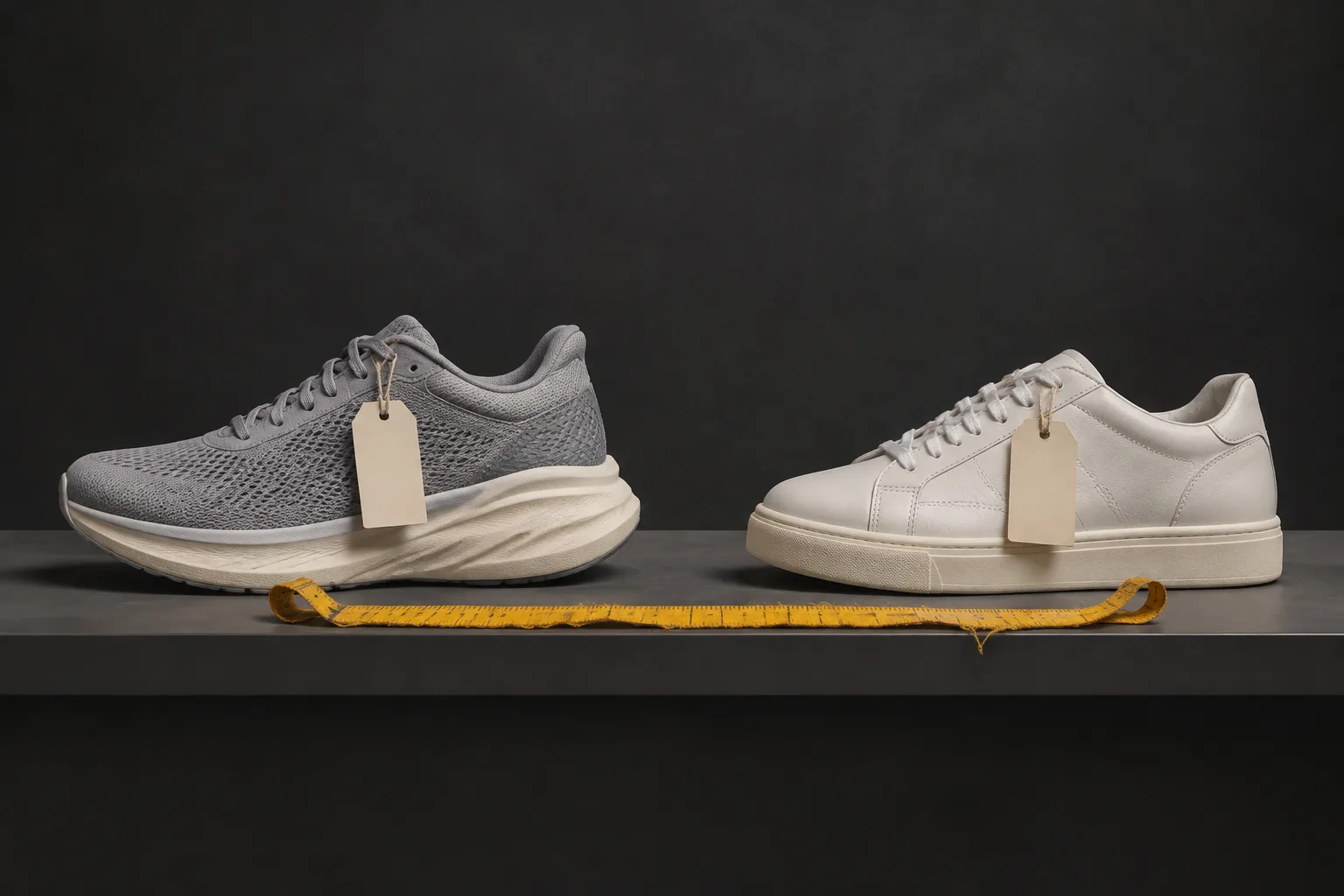
A $160 pair of running shoes and a $160 pair of fashion sneakers occupy the same shelf, the same checkout page, and the same psychological category for most shoppers. They are almost entirely unrelated objects. One has a foam midsole engineered to survive roughly 300 to 500 miles of pavement; the other has a leather upper stitched for a photograph. The price tag tells a person nothing about which is which. That confusion is the whole problem, and it is why sneaker spending has become one of the least examined line items in the average wardrobe.
The sneaker market rewards that confusion handsomely. A shoe is now a $50 object, a $150 object, and a $600 object, often with the same silhouette and the same three stripes or swoosh. The differences live in materials, construction, factory floor time, and the enormous markup of scarcity. Understanding where the money actually goes makes the decision simpler and, for most people, cheaper.
What the foam and the stitching actually cost
Start with the sole. A performance running shoe spends its budget on foam chemistry and outsole rubber, and that budget is real. Compression-molded EVA, supercritical foams, carbon plates: these are genuine engineering costs. A lifestyle sneaker spends almost nothing there. Its sole is often a flat slab of standard EVA or vulcanized rubber, and that is fine because nobody is running in it. A wearer paying $180 for a retro basketball shoe is not buying foam. That person is buying a shape, a colorway, and a story about a year in basketball history.
The upper follows the same split. Performance knit costs more to engineer and less to assemble. Full-grain leather costs more to buy and requires a factory that knows how to cut and stitch it without waste. Cheap synthetic leather costs almost nothing and cracks at the flex point within a season. The price difference between a $90 pair and a $170 pair of the same style is frequently, though not always, the difference between the synthetic and the real thing, or between a glued sole and one that is stitched as well as cemented.
Brand markup and scarcity premium sit on top of all of it. A collab drop can triple the retail price of an identical shoe with a different color panel and a name attached. None of that money reaches the foam. The buyer is paying for the feeling of owning something limited, which is a legitimate thing to want and a terrible thing to call construction quality.
The two budgets inside one price tag
There are two separate budgets in play, and a sane spending plan keeps them apart. The first is the durability budget, which pays for materials that survive weather, walking, and the occasional sprint for a train. The second is the look budget, which pays for silhouette, color, and cultural signal. A $140 pair can be excellent at one and weak at the other. A $70 pair can be honest at both if the wearer knows what to inspect.
Most overspending happens when a person pays look-budget prices while believing the durability budget is included. A fashion sneaker at $220 does not come with a sole that lasts any longer than a $60 one. The upper may be softer, the leather may be nicer, and the shoe may photograph better, but the wear pattern at the heel and the toe box will arrive on the same schedule. The premium bought appearance, and appearance wears out at the same rate regardless of price.
The reverse mistake is just as common. A person buys a hardcore running shoe at full price for daily walking, then complains that it feels unstable and looks strange with trousers. That shoe was engineered for a forward gait at speed on asphalt. It is superbly built for the wrong job. The money was spent correctly and the shoe was chosen incorrectly.
Where a $100 pair stops and a $200 pair begins
In the current market, a $100 to $130 pair of sneakers is the honest middle. At that price, a buyer can reasonably expect a decent midsole, a leather or high-quality synthetic upper that will not peel within a year, and a construction that survives a normal city life of walking and commuting. Below $70, the compromises become visible: thinner soles, uppers that crease and crack, and glue that gives up at the toe. Above $200, the money is increasingly going into design, story, and scarcity rather than into anything the foot will notice.
That range is not a law. Sales and outlet channels routinely put $180 shoes at $95, and a patient buyer can live in that window permanently. The point is that the floor and ceiling are real. A pair at $45 is cheap in every sense, and a pair at $350 is a piece of culture with a sole attached. Neither is a scam. Both are bad defaults for someone who simply wants a good shoe.
The four signals worth checking in the hand
Construction quality is inspectable, and the inspection takes about ninety seconds. First, the sole. Bend the shoe at the ball of the foot, where the toes flex. It should bend there and resist bending in the middle of the arch. A shoe that folds in half like a paperback has no shank and no support, and it will collapse under a long walk. Second, the stitching. Run a thumb along the seams at the heel and the eyestay. Loose threads, uneven spacing, and glue visible at the seam edges all predict an early failure.
Third, the insole. Pull it out. A removable insole over a stitched or lasted footbed signals a shoe built with some care; a thin foam pad glued flat to a cardboard board signals a shoe built to a price. Fourth, the upper material at the flex point. Pinch the leather or synthetic where the toe creases. Real leather wrinkles like skin. Cheap synthetic creases in sharp, permanent lines that eventually crack. That single test separates a $90 shoe from a $170 shoe more reliably than the logo does.
Why the rotation argument is real and overused
The standard advice is to rotate between pairs so each shoe rests and dries between wears, extending the life of both. The advice is sound. Moisture from feet degrades foam and lining, and a shoe given 24 hours to dry lasts measurably longer than one worn daily. The overuse comes when rotation gets used to justify buying four pairs instead of one good one. Two pairs rotated well will outlast four pairs worn carelessly and cost less. The rotation is a habit, not a shopping strategy.
The practical version is modest: one pair for daily wear, one pair for actual sport or bad weather, and a dressier pair if the wardrobe demands it. That is three shoes covering nearly every situation a normal life produces. Anything beyond that is collection, which is a fine hobby and a different budget entirely.
The resale market and the sunk cost of hype
Resale changes the math for a narrow slice of buyers. Limited releases hold value, sometimes appreciate, and a person who enjoys the chase can treat a pair as a semi-liquid asset. That is a collector's game with real risks: values swing, sizes matter, and a worn shoe loses most of its premium immediately. For everyone else, resale is a trap. Paying $400 for a shoe that retailed at $180 buys nothing the foot can feel, and the moment it creases at the toe the premium evaporates.
There is also a quiet cost to buying for the drop. Hype-driven purchases tend to be worn less, because the shoe is too precious for rain or too distinctive for Tuesday. A closet full of unworn $300 sneakers is a more expensive habit than a single $130 pair worn 300 days a year. Cost per wear is the only number that matters, and it rewards boring decisions.
What the money buys at each tier, plainly
At $50 to $70: a functional shoe with visible compromises, best for a specific job like yard work or a gym bag backup. At $80 to $130: the sweet spot, where materials, construction, and price are roughly aligned and a careful buyer can find a pair that lasts two to three years of daily wear. At $140 to $200: better leather, better design, and a small durability gain, worth it for people who care about how the shoe ages. Above $200: design, story, and scarcity, with durability flat or even worse because the shoe is built to look right rather than to endure.
The tier that most people should live in is the second one, and the tier they should visit only deliberately is the fourth. The gap between a $130 shoe and a $300 shoe is not a gap in how long the shoe lasts. It is a gap in what the shoe says, and saying things is expensive.
The pair that lasts is the pair that fits the walking
None of this matters if the shoe does not fit the actual day. A person who walks two miles through a city on concrete needs cushioning and a stable heel; a person who drives to an office and sits needs almost nothing but a clean silhouette. Buying for the life actually lived, rather than the life imagined at the checkout page, is the single biggest saving available. The $130 pair chosen for the real commute will outperform the $250 pair chosen for a fantasy of gallery openings and European travel.
The last check happens at the door. A good pair earns its price by the third month, when the creases have settled into the shape of a specific foot and the sole has worn evenly rather than at one corner. A bad pair announces itself earlier, with a seam that opens or a heel that collapses inward. The money was never the point. The point is a shoe that disappears into the day, and that shoe costs somewhere between a hundred and a hundred and fifty dollars, chosen with ninety seconds of honest inspection and worn until the tread goes smooth.