

What Quality Activewear Really Costs: A Sensible Guide
Fourteen dollars is the price of a decent tube of seam sealant, the kind that keeps a seam from fraying after forty washes. It is also, roughly, the gap between two tiers of running shorts on a rack that otherwise look identical. The sealant is invisible. The gap is invisible. Both decide whether a piece of activewear survives a year of real use, and neither shows up in the photograph that made someone tap "add to cart."
Activewear is one of the few categories where the price tag and the construction tell almost unrelated stories. A $28 pair of leggings and a $128 pair can be photographed to look the same. The differences live in the fabric weight, the stitch density, the elastic recovery, the flatlock seams, and the gusset, and most of those words never appear on a hangtag. What follows is an attempt to price out what a person is actually paying for when the number climbs.
The fabric is the first real cost line
Cheap activewear is usually built on a single-knit polyester that has been brushed to feel soft. It is soft. It is also thin in a way that reveals itself under a squat, and it pills at the inner thigh within a couple of months. The yarn is often a low-denier filament, which means the fabric has little body and no recovery memory.
Better fabric costs more because it blends. A nylon-elastane mix with a higher elastane percentage (18 to 25 percent is common in serious compression wear) holds its shape through a wash cycle and pulls back when stretched. The weight matters too: a 240 to 280 gram-per-square-meter knit drapes and covers differently than a 150 gram one. That weight is a direct cost. More yarn per yard, more money per yard.
The fabric a person can feel in ten seconds is the hand. The fabric that matters over a year is the recovery, and recovery is expensive. There is a reason the cheapest leggings go limp at the knee after a season.
Stitching, seams, and the flatlock tax
A basic overlock stitch is fast and cheap. It produces a raised seam that rubs under a sports bra strap or along the inner arm during a long run. The alternative is a flatlock seam, which joins two panels and lies flat against the skin. Flatlock machines are slower, the operators need more training, and the seam takes more time per garment. That time is the cost.
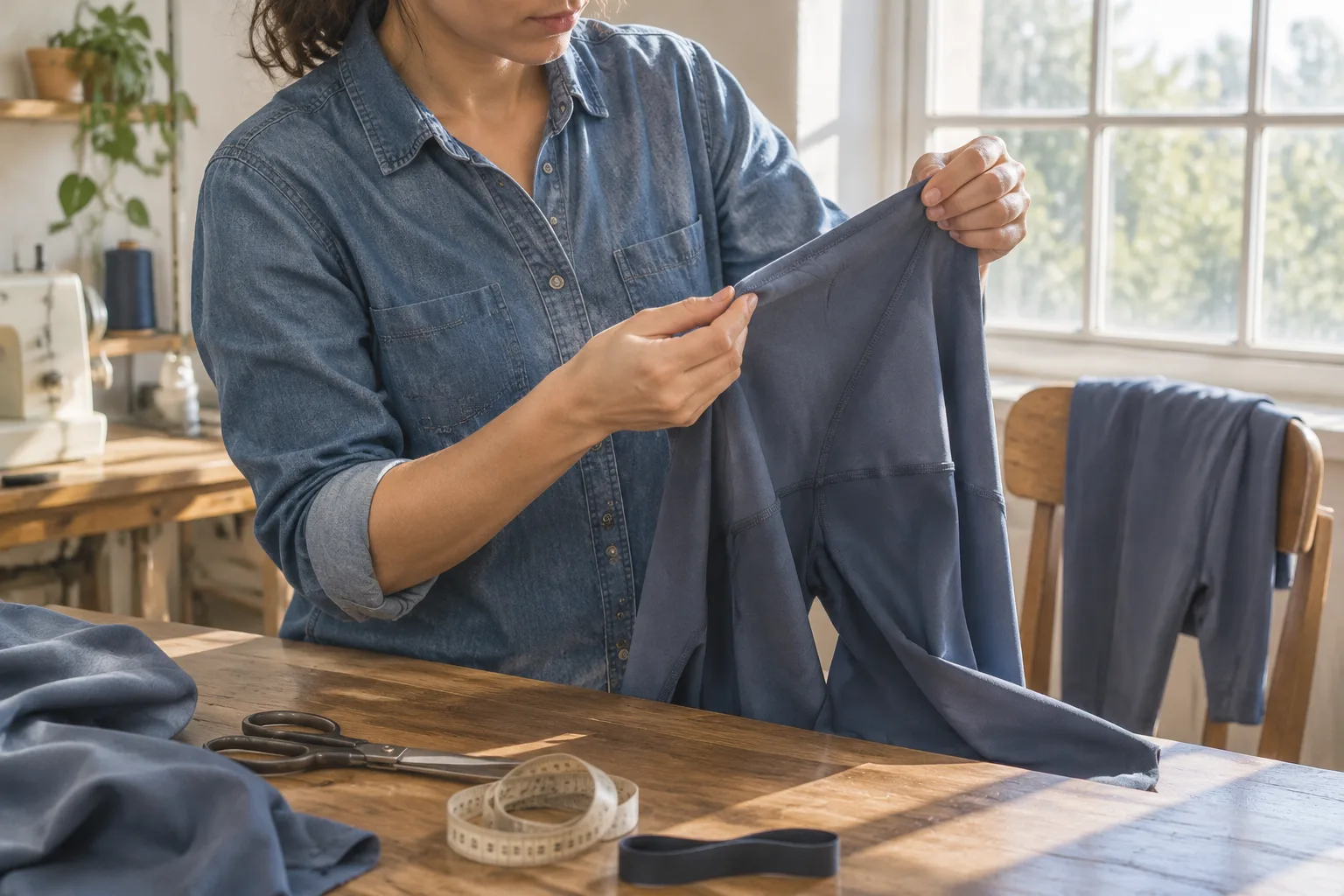
Look at the crotch of a pair of leggings. A cheap pair has a single seam running front to back. A well-made pair has a gusset, a diamond or triangle of fabric inserted to reduce stress on that seam and to remove the seam from the most sensitive contact point. A gusset costs a few cents in material and several seconds in labor. It is one of the clearest tells of whether a brand thought about the body wearing the thing.
Then there is seam sealing and bar tacks. Reinforced stress points at the pocket corners, the strap anchors, the waistband join. These are small operations that add up across a production run. A brand that skips them saves pennies per unit and hands the wearer a repair bill in month eight.
What a waistband reveals about a brand's priorities
The waistband is where cheap activewear most reliably fails. A thin elastic encased in a fabric tube rolls, digs, and loses tension. A wide, bonded waistband with an inner silicone grip strip stays put through a deadlift and a downward dog. Bonding requires heat and pressure equipment and a controlled process; it is not a sewing operation a small cut-and-sew shop can improvise.
A drawcord is another small signal. A flat, woven drawcord with metal or molded tips costs more than a round cord with heat-shrunk ends. The round cord slips through its channel and bunches; the flat one stays where it is tied. These are the kinds of details a person notices only after the third wash, which is exactly why they are easy to cut.
The hidden line item: fit testing on real bodies
Fit is the most expensive thing a brand can get right, and the least visible on a spec sheet. A garment that works on a size 4 fit model and nowhere else is cheap to develop. A garment that has been tested across a genuine size range, on bodies that move differently, costs a brand in fit sessions, pattern revisions, and sample rounds. Each revision is a new set of samples, and samples are not free.
This is where the price gap between a $40 legging and a $110 legging often lives. The expensive one has been through more pattern iterations. The rise is higher in the back. The knee is articulated. The calf is tapered. None of that is glamorous, and none of it photographs, but it is the difference between a garment that disappears on the body and one that demands attention all day.
Where the money does not go
A high price does not guarantee any of the above. Plenty of expensive activewear is expensive because of marketing, a celebrity collaboration, or a store on a prime corner. The construction can be ordinary. A person paying $140 for leggings with a single-seam crotch and a rolling waistband has bought a logo, and the logo will not hold a seam.
Equally, a mid-priced brand can be genuinely well built. There are $60 leggings with flatlock seams, a gusset, and a bonded waistband, sold without a flagship store. The price is not a reliable proxy for the construction. The construction is.
The cost per wear math that actually holds up
A $30 pair of leggings worn twice a week for four months before the seam splits works out to roughly a dollar a wear, and then it is landfill. A $110 pair worn twice a week for two years works out to about fifty cents a wear, and it is still in the drawer. The cheaper garment is more expensive per use, and it also fails at the worst possible time, usually mid-commute or mid-class.
This math only works if the expensive pair is actually built for the wear. A $110 garment with a poor fit gets worn less and the cost per wear climbs. Price buys the potential for durability; fit and fabric decide whether the potential is realized.
A short buying checklist for the fitting room
Turn the garment inside out. The seam structure is right there. Flatlock seams look like interlocking zigzags lying flat; overlock seams look like a raised braid. Check the crotch for a gusset. Stretch the waistband and let go; a good one snaps back and a bad one hangs. Stretch the knee area and watch for the fabric going translucent.
Rub the fabric between thumb and forefinger. A dense, slightly grippy hand suggests a heavier knit with recovery. A slick, thin hand suggests a garment that will pill. Read the fiber content: a high elastane percentage and a nylon or a polyamide base is a better bet than a pure polyester. None of this requires expertise. It requires two minutes and a willingness to look slightly odd in the aisle.
The repair question nobody asks at checkout
The true cost of activewear includes what happens when it breaks. A brand with a repair program, or one that sells replacement parts and offers re-seaming, changes the math. A brand that treats a split seam as a reason to buy new does not. A person can call this the difference between a product and a subscription, and it is worth asking before the card comes out.
The $14 tube of seam sealant is the tell. A garment worth repairing is a garment worth buying. A garment that goes in the bin the moment a seam gives is a rental, paid in full, with no return.