

Wide-Leg Jeans and Sneakers: Getting the Proportion Right
The photograph that circulates every few seasons, the one pulled from a 1994 street-style archive and reposted with the caption "this is the whole formula," shows a woman in a cropped gray sweatshirt, wide jeans that break hard over a pair of chunky white trainers, and nothing else worth mentioning. The jeans are enormous through the leg. The shoes are enormous, period. And somehow the whole thing reads as effortless rather than clownish. That photograph gets passed around because the proportions look accidental, and they are not.
Wide-leg jeans with sneakers is the most democratic silhouette in contemporary dressing and also the easiest one to get wrong. The failure mode is specific: a person buys the jeans, pairs them with whatever sneakers are by the door, and ends up looking shorter and wider than they are, with the hem pooling in a way that reads as sloppy rather than intentional. The fix lives almost entirely in two measurements that nobody talks about at the register: the shoe's volume and the hem's break.
Why the width of the shoe matters more than the width of the jean
A wide leg tapers visually toward the floor. The eye follows the fabric down and expects it to resolve into something. If that something is a slim canvas sneaker with a low profile, the leg looks like it is swallowing a stick, and the whole outfit gains a top-heavy wobble. The jeans appear wider than they are because the anchor beneath them is too small.
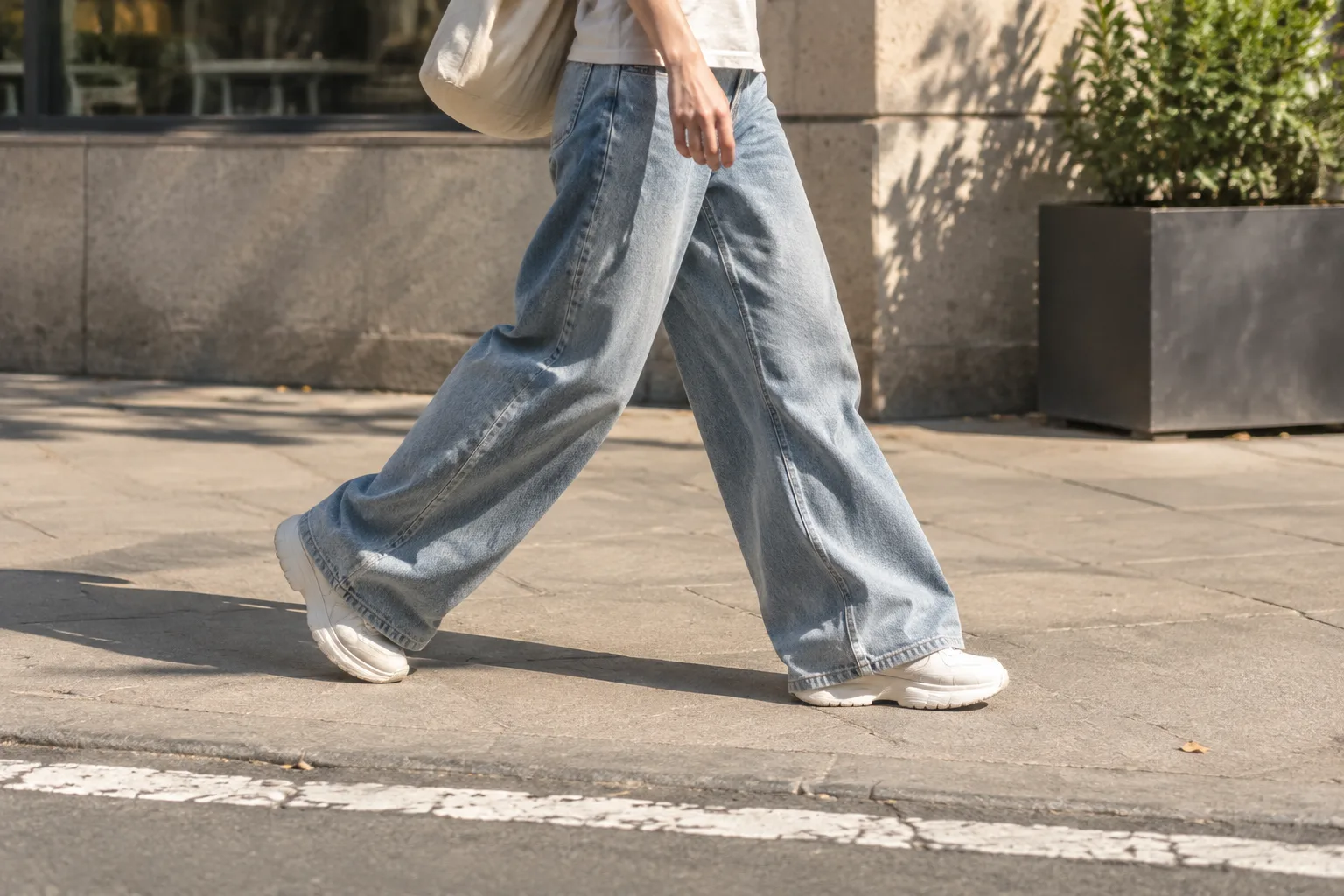
Pair the same jeans with a shoe that has real mass, a thick midsole, a rounded toe box, a substantial upper, and the line resolves. The denim stops looking like a tent and starts looking like a column. This is the single most useful adjustment available, and it costs nothing if the shoes are already owned.
The rule of thumb that holds up across body types: the wider the leg opening, the more visual weight the shoe needs. A jean with a 22-inch leg opening wants a shoe with a chunky sole and a broad toe. A moderate wide leg, closer to 18 or 19 inches, can carry a retro runner or a low-profile leather sneaker without collapsing. A true barrel or balloon leg, the kind that curves out and back in, needs the heaviest shoe in the closet.
The hem break decides whether the look reads deliberate
Break is the old tailoring term for how the trouser hem meets the shoe, and it does more work here than any other variable. A full break means the hem folds once over the top of the shoe. A half break sits just at the shoe's collar with a slight bend. No break means the hem hovers above the shoe entirely.
With wide jeans and sneakers, the half break is the reliable target. The hem should touch the top of the shoe and fold maybe half an inch, no more. That single fold signals intention. It says the jeans were chosen with the shoes in mind, which is the entire game.
Full breaks get risky. A wide leg that pools deeply over a sneaker reads as borrowed from an older brother, and it drags the whole silhouette down. No break can work, but only with a cropped or ankle-length jean and a shoe that deserves the spotlight, and it is a harder look to carry than the internet suggests.
Where the hem should actually land, in inches
Practical measurement: with the sneakers on, the back of the jean hem should sit roughly a quarter inch to half an inch off the ground, and the front should rest on the shoe's instep. If the hem touches the floor at the back, the jeans are too long for that shoe. If a visible gap of an inch or more shows between hem and shoe all the way around, they are too short, unless the crop is the point.
This is why buying wide jeans without the intended shoes nearby is a gamble. A pair hemmed for a chunky trainer will look cropped and odd with a flat canvas sneaker. The same pair, hemmed for a flat, will puddle around a chunky sole. Denim is forgiving, but it is not that forgiving.
The high-top exception and how to wear it
High-top sneakers complicate the equation because the shoe rises above the ankle and the jean has to negotiate it. The instinct is to tuck the jean behind the tongue, which is a look, and a specific one. The cleaner move with a wide leg is to let the hem fall over the top of the high-top entirely, so only the toe and a sliver of the collar show. It keeps the leg line long and lets the shoe's bulk do its job without chopping the ankle.
If the jean is cropped and the high-top is meant to be seen, the proportion flips: the exposed ankle and the shoe's height become the focal point, and the wide leg needs to be shorter and cleaner to keep up. Both versions work. Mixing them, a long wide leg with a fully exposed high-top collar, produces the stacked look that flatters almost nobody.
What the top half has to do with it
Proportion is a whole-body negotiation, and the top half sets the terms. A wide jean with a chunky sneaker already adds visual weight below the waist. If the top is also oversized and long, the body disappears into a rectangle. If the top is fitted or cropped, the waist reappears and the leg reads as long.
The most reliable pairing is a top that ends at or just above the jean's waistband. A boxy tee tucked in, a cropped knit, a fitted tank. The point is to establish where the waist is so the wide leg has something to fall from. A long untucked shirt over wide jeans and chunky sneakers is a choice that works on very tall people and very few others.
Outerwear shifts the balance again. A short jacket, a bomber, a cropped trench, keeps the leg long. A long coat over the whole thing can work beautifully, but only if the coat is long enough to read as a deliberate layer rather than a medium-length interruption at the widest part of the hip.
Color and the disappearing ankle
There is a quiet trick in matching the sneaker to the denim, or coming close. A mid-blue jean over a navy canvas sneaker extends the leg line because the eye does not stop at the ankle. A white sneaker under a light wash does the same. High contrast, a black jean over a bright white chunky sneaker, draws a hard line at the ankle and shortens the leg. That can be a great look, but it is a decision, not a default.
Skin tone showing between hem and shoe is its own variable. A sliver of ankle breaks the line and reads casual. No ankle at all, hem resting right on the shoe, reads more polished. Neither is better; they signal different things. What matters is that the choice is made on purpose, because a haphazard half-inch of ankle is what makes an outfit look unresolved.
The tailor is the cheapest upgrade in the outfit
Most wide jeans are sold in one inseam and expected to fit everyone, which means most people are wearing a hem that was chosen for someone else. A tailor can reset the break for a specific pair of sneakers for the price of a sandwich, and it changes the outfit more than any purchase. The instruction to give: bring the shoes, wear them in, and ask for a half break with the back hem a half inch off the floor.
That single alteration, done once per shoe pairing, is the difference between wide jeans that look bought and wide jeans that look worn. The photograph from 1994 was not magic. Someone stood in a fitting room with the trainers on and got the hem right.