
Windbreaker After Dark: Taking a Shell Into the Night
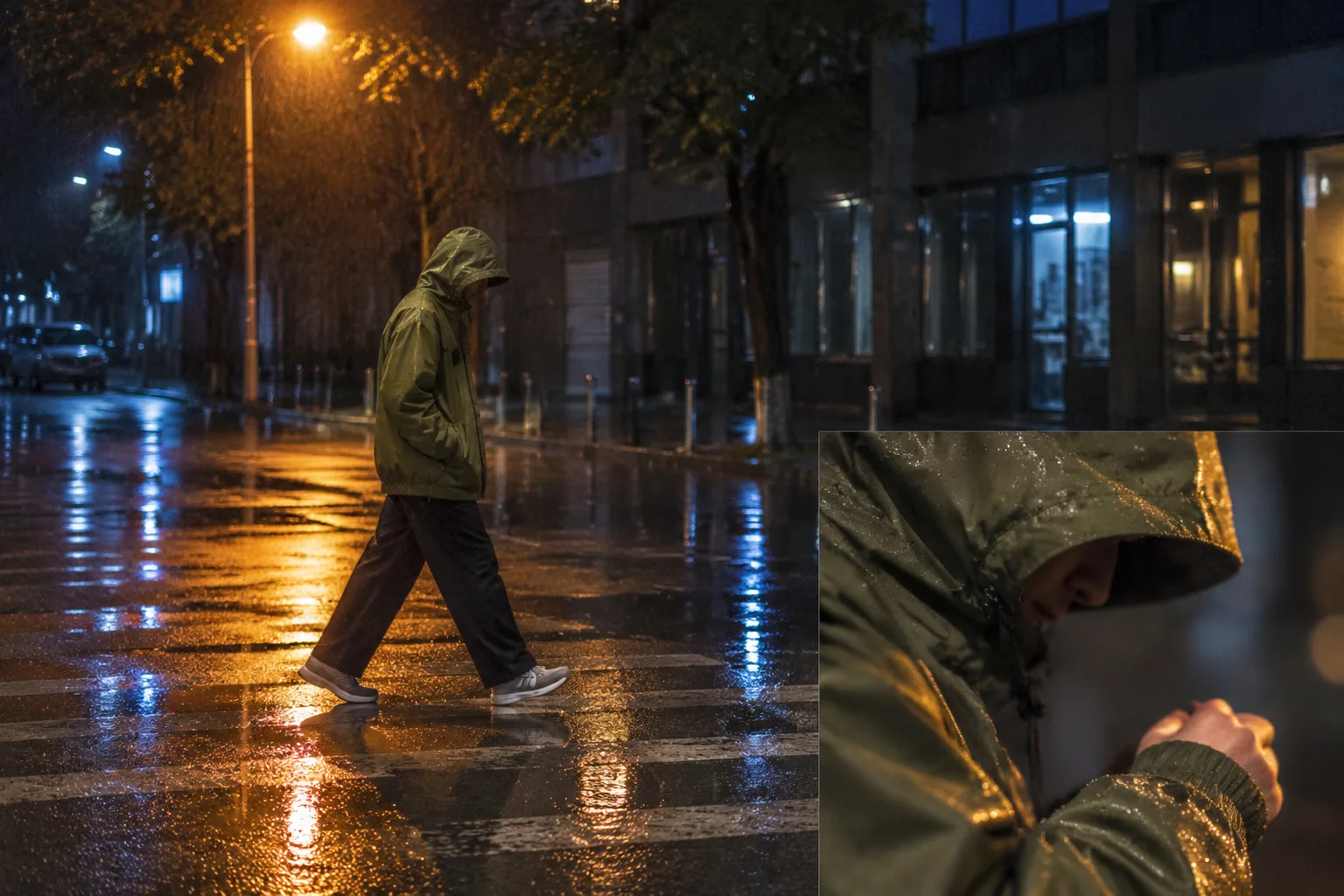
At 11 p.m. on a wet November street, a hooded shell is doing the one job that a rain jacket never gets credit for: holding a small climate around the body while the city goes dark and cold. The fabric is thin, the seams taped, the hood cinched to a face. The wearer is not commuting. Not jogging. Just moving through the night, and the jacket has to answer for it.
Windbreaker after dark is a different proposition from windbreaker in daylight. The jacket that looked smart at noon under a gray sky becomes a piece of equipment once the sun drops and the streetlights come on. Different questions apply. Where does the light catch it. How loud is it when the arms swing. What happens at the cuffs and hem when the body has to stand still for ten minutes. A shell is a shell, but the night asks more of it.
The Shell That Refuses to Be Seen
Most windbreakers sold for evening wear are, almost by design, invisible. Black nylon. Slate gray ripstop. A dark olive that reads as charcoal under sodium lamps. This is the default palette because it is safe, and it is safe because dark fabric hides dirt, hides wrinkles, hides the fact that the jacket is doing structural work on an outfit.
The cost of that safety is real. A person crossing a wet street in a black shell at night is a silhouette, and silhouettes are what drivers miss. The jacket does not need to glow. It needs one small piece of visual information that separates the body from the background: a reflective pull at the back of the hood, a lighter zipper tape, a cuff tab in a color that catches headlights. A single detail of that kind changes the whole contract between the jacket and the dark.
There is a category of shell built explicitly for this, and it tends to look a little odd in daylight. High-visibility panels. Reflective piping. A color somewhere between safety orange and school-bus yellow. In a shop window at noon these jackets read as gear, not clothing. At 11 p.m. on a bike lane, they read as the only sensible choice anyone made all day.
Weight, Warmth, and the Lie of the "Light Layer"
A windbreaker does not keep a body warm. It keeps the wind off a body that is already warm, or it traps a thin layer of heat from a body that is generating some. The distinction matters at night because the ambient temperature falls faster than the activity level does. A shell that was perfect for a brisk walk at 6 p.m. becomes a liability at 10, when the walk slows and the air cools and the fabric has no insulation to offer.
The honest answer is layering, and the honest layering answer is that the windbreaker is the outermost of three pieces, not the only piece. A base layer in merino or a synthetic knit. A midlayer in fleece or a thin down vest. The shell over the top. The shell's job is to keep the wind from stripping the heat the other two layers are holding. Take the shell off and the outfit still works. Take the midlayer off and the shell is a plastic bag with sleeves.
What the night changes is the tolerance for bulk. A puffy midlayer under a shell makes the wearer look inflated, and at night the silhouette is all anyone sees. A thin fleece or a knit sweater under the shell keeps the line clean and still provides a real margin of warmth. The shell should be sized to accommodate that midlayer without pulling at the shoulders, which means buying one size up from the fit that looks best over a t-shirt alone. This is the single most common sizing error in windbreaker purchases, and it only becomes obvious after dark, when the temperature drops and the midlayer comes out.
The Sound of Nylon at Midnight
Nylon is loud. Ripstop nylon is louder. A windbreaker worn on a quiet residential street at midnight announces every arm swing and every shift of weight with a dry, papery rustle that carries farther than the wearer expects. In a city that is never truly quiet, this disappears into the ambient noise. In a suburb, on a sleeping block, it is the loudest thing on the street.
This is a small thing that becomes a large thing depending on the night. A person walking home through a neighborhood at 1 a.m. does not want to sound like a bag of chips. Softer shells exist: brushed polyester, bonded softshell, fabrics with a matte hand that move quietly. They trade a little weather resistance for a lot of social comfort. For urban nights, that trade is usually worth making.
The sound also signals something about the fabric's stiffness, and stiffness is a fit problem. A crinkly shell stands away from the body at the hem and the cuffs, which lets cold air in at exactly the points where the jacket needs to seal. A softer shell drapes and closes. The quiet jacket is often also the warmer one, which is a coincidence worth noticing.
Hoods, Collars, and the Geometry of a Cold Neck
The neck is where a night shell earns or loses its keep. A stand collar that comes up to the chin and stays there blocks the wind that otherwise finds the gap between jacket and scarf. A hood that packs into the collar is useful in theory and useless in practice if it bulges against the back of the neck when down. The best evening shells have a hood that either sits flat when stowed or stays up without a fight.
Cinching matters more than people expect. A hood with a single drawcord at the back adjusts the fit around the crown but leaves the sides loose, so the hood flaps in a crosswind and the wearer ends up holding it with one hand. Two-point adjustment, one at the back and one at each side, keeps the hood seated on the head and the face clear. Small hardware, large difference.
At night, the hood also does something the daylight version does not: it frames the face against the dark. A deep hood with a stiff brim throws the eyes into shadow and makes the wearer harder to read at a distance, which is either menacing or anonymous depending on the street. In a well-lit doorway it reads as privacy. On an empty sidewalk it reads as a person who does not want to be approached. The jacket is doing social work whether the wearer intended it or not.
Pockets That Work in the Dark
Finding a zipper pull at night without looking is a small skill that a good shell rewards. Hand pockets set at an angle, with a pull tab large enough to catch a thumb, let the wearer stow keys or a phone without breaking stride or fishing around. Chest pockets are less useful after dark because the hand has to come up and across the body, which is awkward in gloves and worse in the cold.
What matters more than pocket count is pocket placement relative to a bag strap or a bike frame. A hip pocket under a messenger strap is a pocket that never gets used. A chest pocket that sits under a backpack sternum strap is the same. The evening shell should be tried on with whatever bag or harness the wearer actually carries, because the night is when the wearer notices which pockets are reachable and which are decoration.
Reflective Trim and the Case Against Full High-Vis
Full high-visibility clothing has a place, and that place is a construction site or a highway shoulder. On a city street at night, a jacket covered in reflective panels and fluorescent yellow reads as a uniform, and uniforms attract a kind of attention that most evening wearers do not want. The better approach is restraint: a reflective logo at the back hem, a strip along the back of each sleeve, a zipper pull that catches light. Enough to be seen by a driver. Not enough to look like a crossing guard.
This is a matter of proportion. A single reflective element on a dark shell is more visible than it has any right to be, because the eye is drawn to contrast and the dark fabric provides all the contrast the reflection needs. Three reflective elements on the same jacket start to compete with each other and the effect flattens. One is a signal. Five is a costume.
The Jacket as a Decision Made at the Door
Every evening shell gets chosen at a threshold, with one hand on the door and the other holding keys, and the choice is almost always made on the basis of weight and bulk rather than weather. The jacket that gets worn is the one that can be carried over an arm if the night turns warm, stuffed into a bag if the plan changes, and put back on without fuss when the temperature drops at the end of the evening. Versatility wins over specialization at the door.
This is why the best night windbreakers tend to be unremarkable in the hand: light, thin, packable, with a stuff sack or a pocket that swallows the whole garment. The jacket that folds into its own chest pocket and comes out the size of a grapefruit is the jacket that goes everywhere, and the jacket that goes everywhere is the one that gets used. A heavier shell stays on the hook because it is a commitment, and commitments get renegotiated at 9 p.m. when the plan changes.
What the Streetlights Reveal About Fabric
Sodium vapor and LED streetlights do different things to fabric. Sodium light, the old orange kind, flattens color and turns black nylon into a warm brown-black that looks almost soft. LED light, the new white kind, is harsher and reveals every sheen and every wrinkle. A shell that looks matte and expensive under sodium can look cheap and shiny under LED, and since most cities are converting to LED, the matte shell is the safer investment.
The texture question matters more at night than in daylight because the light is directional and the shadows are long. A fabric with a visible weave or a peached finish catches the light in a way that reads as cloth. A smooth, glossy nylon catches the light in a way that reads as plastic. The difference is subtle in a shop and obvious on a wet sidewalk at 11 p.m., when the jacket is the only thing between the wearer and the dark.
The Case for One Good Shell and No Others
A person who walks at night needs exactly one windbreaker, provided it is the right one. The right one is light enough to carry, dark enough to disappear, soft enough to be quiet, fitted enough to seal at the cuffs and hem, and detailed with one reflective element that catches a headlight without announcing itself. It has a hood that stays up, a collar that reaches the chin, and pockets that can be found in the dark. It is sized to take a thin midlayer underneath.
Everything else is a second jacket bought to solve a problem the first jacket created, and the second jacket will be worse, because it will have been chosen in a hurry against a specific complaint rather than against the whole night. The night is a system: cold, wind, wet, dark, quiet, public. A shell either answers the whole system or it answers part of it and leaves the wearer to improvise the rest. One good shell, chosen at noon and tested at midnight, is the version of this that works.
The test is simple and can be run on any street. Put the shell on at 10 p.m. Walk four blocks into the wind. Stand still for two minutes and see where the cold arrives first. Reach for a pocket without looking. Look down at the sleeve in the light of a passing car and see whether the fabric reads as cloth or as a bag. The jacket that passes all five is the jacket that gets worn until it falls apart, and the night stops being something the outfit has to survive.